Blog
Design Systems for a Multi-Agent World: Branding Beyond the Human Eye
Your Brand Now Has an Audience That Isn't Human
Your brand now lives in places no human ever sees it: API responses, algorithmic feeds, the training data behind machine learning models, the decision logic of AI agents acting on a customer's behalf. Most brand teams haven't accounted for any of this yet.
For decades, a well-crafted style guide was enough. Visual identity guidelines, tone documentation, and a list of approved adjectives: these worked because a human was always the final translator between brand intent and customer experience. Agents skip that translation. They read data structures, not PDFs.
This changes what consistency means. Design systems for a multi-agent world require brands to encode their values in formats machines can execute reliably, not just formats humans can admire.
Take a simple example. An AI agent representing your brand needs to respond to a customer inquiry. It needs your tone, but not as a paragraph of prose. It needs that tone as structured data: your voice, your boundaries, your personality traits, and how each should guide a decision in a given context. When the agent chooses between formal and conversational language, between urgency and reassurance, that choice should still sound like you, without a human checking every output.
Encoding Brand Values as Machine-Readable Guidelines
This is where Machine-Readable Brand Guidelines come in. Unlike documents written for people, machine-readable guidelines encode brand values in formats AI systems can parse and apply. That might mean defining your voice in semantic markup or building decision trees that tell an agent which brand attribute wins when two are in tension.
The Technical Layer: Schema, llms.txt, and What "AI Branding" Actually Means
The technical layer matters here. Schema Markup and llms.txt are becoming standard ways to make brand information discoverable to language models. Properly structured data doesn't just help search engines find you. It helps an LLM understand not only what you say but how you say it. A model trained on well-marked-up brand content absorbs your voice as instruction, not just as text.
That's the practical answer to a question a lot of marketers are now asking: what is AI branding? It isn't AI generating your brand identity for you. It's your existing brand architecture becoming something a machine can reason with, capable of applying your values to situations no one wrote a guideline for.
From SEO to SEvO
This is also behind the shift some in the industry are calling SEO to SEvO, or Search Everywhere Optimization. Search engine optimization made your content findable by algorithms. SEvO makes your brand interpretable by them, so that when an AI assistant answers a question about your category, it represents you accurately instead of relying on a stale training snapshot or a competitor's better-structured data.
Where to Start
Here's where to start. Audit what's already machine-readable in your brand system. Logo files, color palettes, typography specs are already structured data in some form. Your voice and values probably aren't.
Next, document brand decisions as logic, not description. "We use conversational language" isn't usable by a machine. "Contractions are acceptable, jargon is minimized, technical terms are explained before they're used" is. Build a hierarchy for when brand values conflict: does authenticity win over consistency, or the other way around? Does clarity outrank cleverness in your voice? These used to be philosophical questions for a brand workshop. Now they're operational settings.
Building Agentic Design Systems That Carry Judgment, Not Just Components
Consider structured data standards for your brand personality specifically: semantic markup that describes tone across emotional contexts, or a JSON schema that encodes voice in a format AI systems can parse reliably. Your Agentic Design Systems should spell out how autonomous agents represent your brand across channels, down to the component level.
Extending Human-Centered Design, Not Replacing It
None of this replaces human-centered design. It extends it further than most brand teams have had to go. Most teams already know how humans experience their brand. Few have worked out how an autonomous system understands it when no one's watching.
Getting there takes cooperation between teams that rarely sit in the same meeting. Brand needs to work with engineering. Content needs to understand data structures. Marketing needs to think in terms a machine can execute, not just terms a customer can feel.
Skip this work, and agents trained on your content but not on your actual values will start making decisions in your name anyway. That's brand erosion, not brand extension. It happens quietly, one automated interaction at a time.
Most organizations haven't built this infrastructure yet, which means there's still room to do it deliberately instead of reactively. The brands that translate their values into machine-readable formats now, before it's operationally required, are the ones whose voice will still sound like theirs when a machine is the one speaking it.
AI Slop Fatigue: Why Audiences Are Craving Imperfect, Human Content Again
You've probably noticed it. A social media post that reads like it was generated by someone who learnt English from a corporate training manual. A blog article so perfectly polished it feels sterile. Marketing copy so optimized for algorithms that no actual person would ever speak that way. These aren't accidents. They are symptoms of a larger shift in how content gets made and how audiences are reacting to it.
The internet is drowning in content that feels like content. Generated, templated, optimized, and stripped of anything resembling genuine human judgment. And people are exhausted.
What's happening isn't really new. Audiences have always preferred authenticity. But something has changed. The sheer volume of algorithmically-optimized, AI-assisted material has reached a tipping point. We've hit content fatigue, and it's pushing creators and brands in an unexpected direction: backward, toward something messier, more personal, and decidedly less perfect.
The Machinery Behind the Problem
To understand why this matters, we need to acknowledge what is AI slop and why audiences are rejecting it. AI slop isn't necessarily content created entirely by artificial intelligence. It's content that feels like it was. It's the writing that follows every best practice, hits every keyword, addresses every objection, and somehow says nothing at all. It's the video that's been edited to death. It's the social post that's been A/B tested into blandness.
The machinery that creates this stuff is legitimate. Businesses have real incentives to optimize. Algorithms reward certain patterns. Tools make it easier to generate at scale. But the cumulative effect has been a homogenization of online communication that's become genuinely difficult to parse.
Read three marketing emails today. They probably all opened with "Hello [Name]," included a benefit-driven subheading, and ended with a clear call-to-action. The structure works. But when everyone follows the same playbook, the playbook stops working. Attention becomes the scarcest resource, and perfect execution on a template no one remembers isn't worth much.
A Visible Shift
The rise of imperfect, human-first content isn't a trend anymore—it's become a countertrend with real momentum. Look at what's gaining traction online. Unfiltered creator content. Typos left in intentionally. Behind-the-scenes footage that's been shot on a phone. Founders writing rambling LinkedIn posts at midnight. Podcasters who don't edit out their tangents.
This isn't nostalgia. It's recognition. When people encounter something that feels real, it stands out precisely because so much else doesn't. A brand that publishes a slightly rough blog post with genuine voice beats a competitor's perfectly formatted article every time. An email from a CEO that sounds like an actual human writing at 11 PM outperforms the sanitized executive communication.
The pattern is becoming clear: audiences would rather hear from you than hear from your content strategy consultant.
Why Perfection Became the Problem
Authenticity over polish in content marketing isn't actually a new idea. But the pressure toward polish has been relentless. Every platform incentivizes it. Every tool makes it easier. Every benchmark comparison shows you where your production values fall short. Gradually, the standard shifted. Raw became amateurish. Rough became unprofessional. Human became risky.
Except it's not risky anymore. It's the opposite. The risk now is looking like everyone else. The risk is sounding like a machine. The risk is caring more about perfect execution than meaningful connection.
This realization is changing how thoughtful creators approach their work. They're not abandoning quality. They're redefining what quality means. A well-written email that sounds like a real person is higher quality than a perfectly formatted one that sounds like nobody. A podcast episode that meanders through genuine curiosity beats one engineered for maximum retention. A LinkedIn post with a real question in it—one the author actually doesn't know the answer to—performs better than a rhetorical one designed to prime engagement.
The Practical Implications
Why brands are embracing raw, unedited content matters because it changes how organizations should think about creation. If audiences value authenticity, then the best strategy isn't to hire more editors. It's to trust your people more.
Some of the most effective brands right now are publishing content that would have been considered too rough five years ago. Copy with contractions and casual language. Videos that aren't color-graded to perfection. Emails that feel conversational rather than corporate. Not because they've lowered their standards, but because they've changed what they're optimizing for.
This doesn't mean throwing quality out the window. It means recognizing that perfection and connection aren't the same thing. A typo that humanizes your brand is worth more than flawless copy that feels like it came from a template. A rough draft that captures genuine thinking beats a polished piece that obscures it.
Content fatigue and the Road Forward
The fatigue is real. People have developed an almost instinctive resistance to optimized communication. They can smell when something's been engineered. They recognize the patterns. And they're tired of it. So tired that LinkedIn recently added a button that lets users flag any post as "seems like AI slop."
The opportunity, then, isn't in being more optimized. It's in being less so. It's in trusting that a genuine voice, even an imperfect one, will resonate more than another perfectly executed piece of content marketing.
This doesn't require abandoning strategy. It requires shifting what you're strategizing toward. Instead of optimizing for algorithms, optimize for the people you're actually trying to reach. Let your thinking be visible. Show your work. Publish before you're certain everything is perfect. Ask real questions. Admit what you don't know.
The brands and creators who figure this out first will have an advantage that no amount of optimization can match: they'll sound like themselves. And right now, that's the rarest thing on the internet.
Ghostwriting in the Age of AI Detection: Can Executive Voice Still Feel Real?
Your CEO sends back a thought leadership article marked up in red. "This doesn't sound like me," the comment reads. Not the argument. Not the logic. Just the voice.
This happens more often than anyone admits. Executives hire ghostwriters to amplify their ideas, and somewhere between the first draft and publication, something gets lost. The piece reads polished but hollow, strategic on paper but missing the person behind it. Now, with AI detection tools becoming more common, there's a new layer of pressure. The writing has to sound human, sound like the executive, and actually say something worth reading, all at once.
The tension is real. Ghostwriting has long been the quiet engine behind executive thought leadership. A skilled writer takes a leader's ideas, experience, and perspective and turns them into something readable. That work is valuable and entirely legitimate. But the growth of AI-generated content has made readers and platforms far more alert to authenticity. People are asking harder questions about what was actually thought through versus what was simply generated.
Fewer polished sentences or a casual phrase thrown in won't fix that. What's needed is a real rethink of how ghostwriting works when executive voice versus AI-generated tone has become something readers actively notice and judge.
The real question isn't whether AI was involved
The real issue was never whether a machine touched the draft. The real issue is whether the person publishing it actually believes what it says.
When ghostwritten content feels inauthentic, it usually comes down to one of two things. Either the writer never understood the executive's actual thinking well enough to represent it, or the executive never developed a real point of view in the first place. A strong ghostwriter doesn't invent ideas. They clarify and sharpen ones that already exist. They listen more than they write, and they ask the questions that help a leader put words to what they genuinely think about their industry, their customers, and the problems keeping them up at night.
This is where AI detection tools and content authenticity start to collide with something bigger than writing style. It becomes a reputation problem. A thought leadership piece flagged as possibly AI-written doesn't just lose credibility with readers. It quietly chips away at the executive's standing in their own industry. There's a real irony here: using AI to sound more human often ends up making leaders sound less like themselves.
Why the process matters more than the polish
The executives whose ghostwritten content actually lands aren't the ones with the most talented writers. They're the ones who did the harder work before any writing began. They spent time developing their point of view. They wrestled with the implications of their own ideas. They changed their minds when the evidence pushed them to. They show up with conviction, not just a title.
That work happens in conversation, long before a draft exists. Good ghostwriting for thought leadership isn't transcription. It's a thinking partnership built on real questions: What do you actually believe about this? Where did that belief come from? What would change your mind? What are your customers getting wrong that nobody's telling them?
Those conversations surface something different than a generic first draft ever could. Specific stories. Genuine tension between competing ideas. The texture of real thinking, not just smooth, forgettable prose.
What executives are really protecting
The growing focus on personal branding in the AI era has forced a harder question onto every executive's desk: what are you actually known for? Not what you'd like to be known for, but what you've earned through years of demonstrated judgment and insight. A ghostwritten article only serves that reputation if it reflects a real conviction, and if it lines up with what the executive has said before and what they're actually doing day to day.
When there's a gap between a leader's public voice and their real decision-making, people notice, often before they can explain why. And once that gap is visible, it gets exploited fast.
None of this means every ghostwritten piece needs to sound casual or unpolished. Some of the strongest thought leadership is carefully structured and deliberately composed. But there's a real difference between polish and artifice. Polish reflects discipline. Artifice reflects distance from the actual thinking.
The safeguard nobody wants to slow down for
The best protection against inauthentic content isn't avoiding ghostwriting altogether. It's building in genuine human editing in AI-assisted writing, not as a final proofreading pass, but as part of the process from the start. The executive should be reading drafts early, pushing back on phrasing that doesn't sound like them, asking for more specificity where something feels vague, and being willing to cut whole sections that don't ring true.
That friction is a good thing. It's the pull between a writer's instinct for elegance and a leader's insistence on precision. It's the tension between what sounds impressive and what's actually accurate. That friction is what produces content readers can trust.
The stakes are higher now because the comparison point has changed. When readers come across content that feels generated, even if a human technically wrote every word, they measure it against a baseline of authenticity they're increasingly trained to spot. They're asking a simple question underneath it all: did this person actually think this, or was it assembled from familiar patterns?
That question matters. Not because AI involvement is inherently dishonest, but because putting your name on something carries an implicit claim. It says you believe it, you've thought it through, and you're prepared to defend it in a room full of people who disagree.
That's what makes ghostwriting legitimate. Not the secrecy around who typed the words, but the fact that someone's reputation is genuinely on the line. And that's exactly why it matters so much that the voice on the page actually belongs to the person publishing it.
The executives who come out of this transition with their credibility intact will be the ones willing to do the harder work early. They'll spend real time clarifying their thinking. They'll stay closely involved in editing and revision instead of outsourcing it entirely. They'll understand that authenticity was never a writing style. It's a commitment to standing behind what carries your name.
Ghostwriting in the age of AI detection doesn't mean walking away from the practice. It means taking it more seriously than before, treating your voice as something worth protecting, and treating the people who help you find it as thinking partners, not content machines.
Readers can already tell the difference. That's not changing anytime soon.
Corporate Visual Identity vs. Brand Identity: What's the Difference (And Why It Matters)
Every brand meeting eventually arrives at the same moment: someone unveils a new logo, and the room lights up. It looks sharp, modern, exactly what a growing company should look like. A software company's product manager, Amara, watched this exact scene play out with her team. Weeks later, customers were still asking what the company actually did. The logo had done its job perfectly. The brand behind it hadn't been built at all.
This gap shows up in companies far more often than most people expect. Visual identity and brand identity get treated as the same thing, when they solve two completely different problems.
Corporate Visual Identity: The Language of Recognition
Corporate visual identity is everything people see: your logo, color palette, typography, and the design system tying it all together across your website, packaging, and marketing. It gives your company a recognizable face.
Brand Identity: The Foundation Beneath the Design
Brand identity sits underneath the visuals. It's your purpose and personality, along with the promise customers can count on. It answers a harder question than "what do we look like": why does this company exist, and what does it stand for? That answer shapes your mission statement, your tone in customer emails, even how a support call gets handled.
Visual identity is how a brand looks. Brand identity is how it feels, and what it actually stands for underneath the design.
Corporate Visual Identity vs. Brand Identity: Where the Real Distinction Lies
Visual identity lives inside brand identity, not alongside it. A company can have a beautiful logo with nothing meaningful behind it. A strong brand identity, though, always needs some visual expression to carry it.
Think of a company with polished branding and a customer service team that feels distant and impersonal. The visuals promise warmth, while the experience delivers the opposite. That mismatch is exactly where customer trust starts to slip.
The reverse happens too. A company solving real problems for the right customers can still look unprofessional if its visual identity is inconsistent or dated, regardless of how good the underlying business actually is.
The brands that succeed treat both as one system. Color choices reflect personality, typography feels authentic to what the company values, and imagery tells a story about who the company is rather than just what it sells.
The Business Cost of Getting This Wrong
A mismatch between visuals and values rarely announces itself with a single dramatic failure. It shows up slowly, in ways that are easy to miss and expensive to ignore.
Trust is usually the first casualty. Customers pick up on inconsistency even when they can't name it, and once a brand's promise stops matching its reality, skepticism moves in quietly and stays. Internal consistency follows close behind, since teams without a clear, shared sense of identity end up interpreting the brand in their own way, and different departments start describing the same company in noticeably different terms. Positioning suffers last but hits hardest, because a business with neither a clear identity nor the visual language to express it eventually blends into the market instead of standing apart from it.
Building Identity in the Right Order
Brand identity needs to come first. Purpose and personality should be clear before any visual work begins, because design that isn't grounded in something real ends up decorative rather than meaningful. Visual identity should express that foundation, not substitute for it.
Once that order is right, everything downstream tends to fall into place. The website, the product experience, and every customer interaction start reinforcing the same underlying story.
That alignment is what actually earns customer loyalty. People don't just notice a brand that gets this right; they come to trust it and choose it deliberately, again and again.
Content Calendar Strategy: What Separates Top Brands From Everyone Else
You know the feeling. It's Wednesday afternoon, your team's scrambling to figure out what to post tomorrow, and someone's asking whether last month's campaign themes are still relevant. Meanwhile, your competitor just launched something that feels impossibly coordinated—content that flows naturally across channels, timing that feels almost prescient, messaging that builds on itself week after week.
That's not luck. It's strategy.
The difference between brands that feel scattered and those that feel intentional comes down to one thing: how they plan. Not just what they post, but how they think about the entire calendar before a single piece of content goes live.
Most teams operate on a month-to-month calendar. They look at the weeks ahead, identify some key dates, and build around those moments. It feels productive in the moment. Until mid-month when priorities shift, a campaign underperforms, or the market moves faster than anyone expected. Then the whole calendar feels rigid, outdated, and increasingly irrelevant.
Top brands operate differently. They think in quarters.
A content calendar strategy built on quarterly planning creates space for both structure and flexibility. Three months is long enough to identify patterns, build narrative momentum, and coordinate across teams. It's short enough to pivot when data tells you something isn't working. Monthly planning often locks you into decisions made before you had critical information. Quarterly planning lets you stay responsive.
The mechanics matter, too. Why top brands plan quarterly, not monthly isn't just about timeframe—it's about shifting how you think about content entirely. When you're planning ninety days at once, you're forced to see your content ecosystem. You notice gaps. You spot where messaging gets repetitive. You catch opportunities to build on successful themes instead of starting over every thirty days.
This approach also changes how you prioritize. In a month-based system, everything feels urgent. In a quarterly framework, you distinguish between what matters now and what matters eventually. That distinction is powerful. It's where real strategy lives.
Data should guide this process, but most teams collect data without actually using it. Data-driven content calendars aren't sophisticated spreadsheets filled with metrics. They're frameworks where your previous performance directly shapes what comes next. What types of posts generate engagement? When do your audiences actually show up? Which topics create momentum that carries forward?
These answers change everything about how you plan. If you learn that educational content outperforms promotional content by a significant margin, that insight should reshape your calendar. If you notice engagement spikes on Tuesday mornings, that's how you schedule your most important posts.
The challenge is that gathering and interpreting data takes time. Many teams give up before they get there. That's where a different kind of tool becomes essential. AI-assisted content planning removes the manual work that makes data-driven planning feel impossible. Instead of spending hours analyzing past performance, you're working with software that identifies patterns you'd miss, suggests optimal timing, and helps you coordinate across channels in ways that previously required a much larger team.
This isn't about automating the creative work. It's about automating the analysis. The actual thinking—understanding why something works and how to apply that insight—remains entirely human. But when the machine handles the pattern recognition, your team suddenly has bandwidth for strategy.
Implementation is where most efforts derail. Teams get excited about a new approach, build an impressive calendar, and then realize that scheduling across multiple platforms, managing approvals, keeping team members aligned, and actually executing becomes overwhelming. The calendar becomes a document people reference occasionally instead of a system they trust.
The teams that make this work have learned to be ruthless about simplicity. They pick tools that integrate with their existing workflows instead of creating new processes. They over-communicate about what's happening and why. They build buffers into their schedule for the inevitable curveballs. Most importantly, they treat the calendar as a living document, not a fixed plan.
Which brings us to where most teams stumble. Common content calendar mistakes usually fall into a few categories. First is planning without input from the people who willl execute the work. A calendar built in isolation by leadership rarely survives contact with reality. Second is failing to account for the actual time required to produce quality content. Ambitious calendars fall apart because they're simply not feasible. Third is treating the calendar as set in stone. Real strategy means being willing to abandon what isn't working, even if you planned it weeks ago.
The fourth mistake is probably the most costly: creating calendars that look impressive in meetings but don't reflect how your audience actually wants to engage. You can have perfect timing and flawless messaging, but if the content doesn't match what your audience cares about, none of it matters.
The best calendars start with a deep understanding of who you're trying to reach and what they actually need from you. That might mean less frequent posting. It might mean longer, more thoughtful pieces instead of constant updates. It might mean being willing to skip a planned post because something more relevant just happened.
Top brands understand that a calendar is a tool for thinking clearly, not a cage that limits thinking. It's a structure that enables strategy instead of replacing it.
When you plan with a quarterly content calendar strategy, when you let data inform your decisions, when you use technology to handle the complexity—that's when content starts to feel less like a constant scramble and more like something you actually control.
The brands that feel most intentional aren't necessarily producing more content. They're producing content that fits together. They've thought about how one piece builds on another, how themes develop over time, and how channels work in concert instead of isolation.
That's what separates them from everyone else.
Stop Keeping Secrets: How Internal Expertise Becomes Your Best Business Development Tool
Priya sat in her office, staring at the Q3 pipeline report. Her firm had just landed a major client—one that could have come through a referral months earlier. As she scrolled through her contact list, she realized something troubling: her team's best insights, their most innovative solutions, their competitive advantages—they were all locked away in client work, team meetings, and internal documents. Nobody outside the organization knew what they were truly capable of.
This is a problem many professional services firms face. You've built remarkable expertise, solved complex problems, and developed proprietary thinking. Yet that knowledge stays internal, invisible to the market. Meanwhile, your competitors are broadcasting their insights, positioning themselves as authorities, and attracting inbound opportunities without ever picking up the phone.
The disconnect between what you know and what the market knows about you is costing you business development opportunities.
The Hidden Asset You're Not Leveraging
Your team possesses knowledge that prospects desperately need. That methodology your team developed? It solves problems your prospects are currently struggling with. Those lessons learned from failed projects? They are gold for potential clients trying to avoid similar mistakes. Your perspective on industry shifts? It's exactly what decision-makers are searching for.
Yet most firms treat this expertise like a closely guarded secret.
Thought leadership marketing isn't about self-promotion. It's about translating your internal knowledge into valuable content that attracts and educates your ideal clients. When you share the thinking behind your work—not the work itself—you accomplish something powerful: you demonstrate capability while building trust with people who haven't yet hired you.
Building Authority Through Content Strategy for Professional Services
Creating a meaningful content strategy for professional services starts with an honest inventory. What does your team know that your market needs to understand? What questions do prospects ask repeatedly? Where do you see them making costly mistakes?
The best content comes from real experience. Capture the thinking from your recent client projects—the challenges you faced, the approaches you tested, the insights you discovered. Translate that into frameworks, case studies, or thought pieces that help prospects navigate similar situations.
This approach serves dual purposes. First, it establishes an expert positioning strategy by showing how your team thinks, not just what you've built. Second, it creates a natural filtering system. Prospects who engage with your content self-identify as people facing the problems you solve.
Building Credibility Through Content Creates Momentum
When your expertise lives only in client work, only people who hire you learn what you are capable of. Building credibility through content expands that circle exponentially. Each article, framework, or insight you publish works for you continuously, reaching prospects you'll never meet directly.
This creates what might feel like magic: organic lead generation without aggressive outbound effort. Prospects arrive already educated about your perspective, already aware of your thinking, already partially sold on your approach. They've self-qualified by choosing to engage with your content.
The best part? This approach works particularly well in B2B environments where decision-making cycles are long, and trust matters enormously. Your content becomes part of their research process, influencing their thinking before they ever reach out.
From Internal Knowledge to Market Advantage
Here's what changes when you stop keeping secrets:
Your team members become visible authorities in your field. Prospects see them as experts before ever meeting them. Your firm becomes known for a particular perspective, not just services. You attract clients who specifically value your approach. Your business development process shifts from hunting to magnetic attraction.
The barrier between what you know internally and what the market perceives about you doesn't have to be thick. It just requires intentional translation, turning your proprietary thinking into valuable, shareable insights.
Your best competitive advantage isn't a secret. It's the thinking that created your results. When you share that thinking generously, you become the obvious choice for prospects facing the problems you've solved.
Start by identifying one piece of internal expertise your team could share. Then ask: How would this perspective help someone considering similar challenges? The answer is your next piece of content.
Human + AI is the New Job Title: The rise of the AI-augmented professional across roles
Sarah sits at her desk in Toronto, staring at her inbox. Two years ago, she would've spent hours manually sorting through customer feedback, categorising complaints, and flagging priority issues. Today, she reviews summaries an AI system has prepared, but she's the one deciding which insights matter most. She's not being replaced by automation. She's becoming something new: an AI-augmented professional.
This isn't a future scenario. This is happening now, across industries and continents. The job market is transforming. The question isn't whether AI will change work, it's how professionals will evolve alongside it.
The Shift Nobody Saw Coming (But Should Have)
For decades, the narrative around automation was binary: machines replace humans, or they don't. That framing missed something crucial: humans and machines are better together than apart.
AI workflow automation has revealed this truth across every sector. Radiologists now use AI to flag potential issues in medical scans, freeing them to focus on complex diagnoses. Accountants leverage automated systems to handle routine reconciliations, spending their time on strategic financial planning. Content creators use writing tools to handle initial drafts, then invest their creative energy in storytelling and brand voice.
These professionals aren't doing less work. They're doing different work—work that requires human judgment, emotional intelligence, and strategic thinking.
What Makes This Different
The future of work isn't about replacing job titles. It's about expanding them. A marketing manager becomes a marketing manager who orchestrates both human creativity and algorithmic insights. A customer service representative becomes a representative who handles complex emotional situations while AI handles routine inquiries.
This shift demands something new from both employers and professionals: a willingness to view skills differently. Skills-based hiring frameworks are emerging precisely because traditional job descriptions no longer capture what people actually do. Companies aren't looking for people who can do one thing perfectly. They're looking for people who can collaborate effectively with AI, adapt when tools change, and understand when to trust automation versus human instinct.
The Skills That Matter Now
What separates the professionals thriving in this environment from those struggling?
Judgment over information. AI can surface insights. Humans decide what those insights mean for strategy, culture, and relationships.
Complementary thinking. The best AI-augmented professionals aren't trying to compete with machines. They are thinking about what machines do poorly (nuance, context, ethical reasoning) and leaning into those strengths.
Continuous learning. When tools change every few months, your willingness to experiment beats your current expertise. Curiosity becomes a core professional skill.
Cross-functional fluency. Human AI collaboration happens across teams now. A product manager needs to understand how data scientists think. A designer needs to grasp what AI can and can't accomplish. The silos are disappearing.
The Opportunity in Front of You
Organizations that recognize this shift early gain an enormous advantage. Teams that treat human AI collaboration as a design principle and not an afterthought attract better talent and ship better work.
For professionals, the invitation is clear: This isn't a threat to manage. It's a skill expansion to embrace. The people writing the future of their industries aren't the ones panicking about AI. They're the ones figuring out what they do that AI can't, and doing more of that.
Your job title might stay the same. Your actual work—what you spend your time on, what you're valued for, how you contribute—will evolve. That evolution is where the real opportunity lives.
5 AI Tools I Actually Tested (And What the Internet Thinks About Them)
I have a confession to make. I spend an embarrassing amount of time testing AI tools. Not just reading about them, but actually using them, watching them fail, occasionally watching them do something that makes me put my coffee down and stare at the screen. It's become a bit of an obsession. And lately, five tools in particular have been living rent-free in my head.
Let me take you through them honestly — the good, the bad, and the not so ugly.
Manus or The One That Actually Does the Work
Manus (manus.im) is what I'd call the overachiever of the group. Unlike most AI tools that sit comfortably in the "chat and advise" lane, Manus actually executes. It browses the web, runs code, builds files, and hands you back completed work. Tell it to research a topic and come back in an hour — it'll have something waiting for you.
I've always believed the real test of any tool is whether it can work without you hovering over it. For deep research tasks and async analysis, Manus passes that test more often than not. Its Wide Research and Slides features alone make it worth exploring for knowledge-heavy work.
But here's where the story gets complicated. Manus runs on a credit system, and a single deep research task can quietly burn through 1,000+ credits. Worse, reliability wobbles badly when it hits paywalls or CAPTCHAs — sometimes it just loops in quiet desperation. The Reddit crowd is split right down the middle: "Most useful AI product I've tested" on one side, and "Spent $20 to watch it refresh a page for an hour" on the other. Both reviews are probably true, depending on the day.
Cto.new which makes me want to believe “Free Shouldn't Mean Compromised”
Then there's Cto.new which is doing something that feels almost suspicious: it's completely free. Unlimited access to GPT-5 Codex, Claude Sonnet 4.5, and Gemini Pro. No API keys, no credit card lurking in the background.
For developers, the GitHub integration alone is worth the price of entry (which, again, is zero). Assign an issue, come back to a pull request. The multi-agent setup handles both task planning and code review in a single flow, which is the kind of thing that previously required stitching together multiple paid tools.
Of course, "fair usage" limits do exist, and the browser-first UI isn't exactly mobile-friendly. And I'd be lying if I said I wasn't at least a little curious about the long-term sustainability of a fully free model. But the developer community seems unbothered. The dominant Reddit sentiment? "Use cto.new for background agents, keep Cursor for local work — saves hundreds a month." That's a pretty compelling argument.
chroniclehq.com or Decks That Don't Need a Design Degree
Chronicle (chroniclehq.com) caught my attention because it approaches presentations differently. Most AI slide tools give you bullet points dressed up in a template. Chronicle gives you structure. You know, the hook, problem, solution, proof. It thinks in narrative arcs before it thinks in slides.
The output quality reflects that. I've seen users report that their decks come out 85–90% client-ready, which is a genuine leap over competitors like Gamma. The Peek and Deep Hover features are genuinely clever for live presenting. It’s the kind of detail that suggests someone actually thought about the experience of standing in front of an audience.
That said, if you're a designer who likes to control every pixel (padding, spacing, the precise weight of a border) Chronicle will frustrate you. The canvas doesn't do granular tweaking. And the monthly token system, where unused tokens simply expire, is a model I've never loved. The Reddit verdict: "Way better at one-shotting a deck than Gamma," with a footnote that templates can feel a bit rigid for strict corporate brand standards. Fair.
Moda.app or in other words, Design That Understands Design
Moda (moda.app) is addressing a problem that has quietly irritated designers since AI image tools became mainstream: the outputs are flat. You get a pretty picture you can't actually edit. Moda gives you a real layered canvas instead.
What makes it interesting is that it was trained on actual graphic design principles — layout, hierarchy, spacing.Not just aesthetics. You can use it for slides, social posts, PDFs, and UI mockups. In theory, it replaces three or four other tools.
The credit system with no rollover is a recurring complaint, and as a younger product, feature gaps show up (limited animations, no API access yet). The community's main gripe is also revealing: the AI is better at layout than at understanding the actual content you give it. That's an honest limitation worth knowing before you commit. Still, for designers tired of re-editing flat images elsewhere, this feels like a step in the right direction.
Inconify AI: Icons in Seconds, But at What Cost?
IconifyAI is the most specific tool on this list, and it delivers exactly what it promises: 1024×1024 high-definition app icons in seconds, across eleven-plus styles from clay to photorealistic to metallic. Commercial rights included, no attribution required, and credits starting at around $0.08 per icon.
The catch? No free trial. You pay before you know whether it works for you. The output is PNG only. No SVG, no pre-packaged iOS or Android size packs. And quality is inconsistent enough that some users report unclean lines and generic results after spending $17 or more.
The community is mixed. Fans say it kills the freelancer bill for a quick icon. Critics say tools like Recraft or Iconikai give better value. It occupies a narrow but real use case. If that use case is yours, it's probably worth a small test purchase.
So What's the Pattern?
Looking across all five, I notice something. The tools that generate the most genuine excitement — Manus, cto.new, Chronicle — are the ones trying to remove a step from a workflow entirely, not just assist with it. The ones with the most mixed reviews like IconifyAI, and to some extent Moda are working in spaces where expectations are already well-established and quality bars are high.
AI tools aren't magic. But the right one, used for the right task, genuinely changes what's possible in a day's work. My hands are itching to test what each of these looks like six months from now.
Funny how a set of tools can open up that many possibilities.
LinkedIn Video Marketing: What Winning Brands Do Differently
For brand managers and B2B marketers who want to stop blending in.
Why LinkedIn Video Has Changed the Game
Something has shifted on your LinkedIn feed. The posts stopping your scroll aren't text updates anymore. They are videos. And the brands dominating your attention aren't there by accident — they've figured out how the platform actually works in 2026.
Video on LinkedIn isn't just another content format. It's the format the algorithm has learned to reward. Understanding why, and what to do about it, changes everything about how your brand shows up
Native Video vs External Links — Why One Gets 3x the Reach
Upload a video directly to LinkedIn and something different happens inside the platform. Native uploads stay within LinkedIn's ecosystem. The algorithm treats them differently, prioritising them in feeds, recommendations, and visibility over any external link you share.
The same video uploaded natively versus shared as a YouTube link can see up to three times the impressions. That gap has nothing to do with production quality or message. It's architectural. LinkedIn wants people scrolling its own content, not clicking away.
The takeaway: Always upload natively. Stop sharing YouTube links as your primary video post.
How the LinkedIn Algorithm Actually Rewards Video
The algorithm doesn't just prefer video — it measures how people respond to it. Comments, shares, watch time, and how long someone stays on your video all signal value. But only if people actually watch.
This is why posting native video is just the starting point. Brands that win go further. They design every video to earn that engagement, second by second.
Silent Viewing — The Strategy Most Brands Still Miss
Most LinkedIn videos are watched without sound. People scroll in offices, on commutes, in meetings. They are not hunting for audio.
Yet most brands still create videos that depend entirely on what is being said.
The smartest brands on LinkedIn design their videos for silence first. This means:
Subtitles on every video - not as an afterthought but as the primary visual layer
Text overlays that tell the story before anyone unmutes
A visual hook in the opening second — something moves, something changes, something appears that earns attention without sound
By the time a viewer unmutes, they are already invested. That captured viewer becomes an engaged viewer. The algorithm notices the difference immediately.
Video Length — What Actually Gets Watched vs Skipped
The old advice was simple: shorter is better. Thirty seconds. Forty-five seconds. That advice is outdated and incomplete.
What matters is not length. It's momentum.
A three-minute video that is paced well — where every moment builds on the last — will outperform a forty-five-second video that wastes the opening. The winning structure looks like this:
Second 1 — Visual or verbal hook
Second 5 — Clear point established
Middle — Demonstration or expansion, as long as needed
End — Clean, purposeful landing
Some of these videos run ninety seconds. Some run six minutes. Length serves the story, not the other way around.
The metric that matters most here is completion rate - how far people watch before they stop. If half your audience drops at the one-minute mark, the algorithm notices. If ninety percent watches to the end, it notices that too. Design for completion, not compression.
Thought Leadership vs Product Video — What Works for Brands
Brands make a common mistake. They default to product videos because they feel safe and measurable. But on LinkedIn, thought leadership video consistently outperforms promotional content.
Why? Because LinkedIn's audience is there to learn and grow professionally, not to be sold to. The brands seeing the highest engagement are posting videos that:
Tackle a real problem their audience faces daily
Share a genuine point of view — not a safe, polished corporate message
Feature real people, not just brand graphics and voiceovers
Product videos have a place, but they work best as retargeting content, not as your primary organic strategy.
The Specificity Advantage — Who Are You Actually Talking To
The brands dominating LinkedIn video are not making content for "business professionals." They are making videos for operations managers struggling with team coordination. For executives tired of update meetings. For individual contributors trying to move up.
This specificity changes everything - how you frame the problem, how you open the video, what language you use. Specific content feels personally relevant. Broadly applicable content gets scrolled past.
Before you brief your next video, answer this one question: who exactly is this for, and what is the one thing they are dealing with right now?
How to Measure LinkedIn Video Beyond View Count?
Views are vanity. The metrics that actually tell you if your video strategy is working:
Watch time and completion rate — are people finishing your videos?
Engagement rate — comments and shares over impressions
Profile visits after viewing — are videos driving curiosity about your brand?
Follower growth tied to video posts — are the right people finding you?
Inbound messages or leads — the ultimate B2B signal
If your view count is high but comments are low and profile visits are flat, your content is being seen but not landing. Adjust the hook, the specificity, or the format.
What Separates Winning Brands From Everyone Else
It is not budget. It is not production quality. It is not even posting frequency.
It is understanding that every second of a LinkedIn video needs to justify itself. It is designing for how people actually consume content — silently, quickly, on mobile — not how they theoretically should. And it is recognising that the algorithm is not your enemy. It is showing you exactly what works, if you are willing to read the signal.
The brands winning on LinkedIn video understood this shift early. The window to catch up is still open, but it is closing.
What 'Inclusive Brand Design' Actually Means for Businesses
Picture this: Aisha, a project manager in Lagos, opens your website on her mobile phone during her commute. Meanwhile, Marcus in Toronto accesses the same site using screen reader software due to his visual impairment. Simultaneously, Yuki in Tokyo navigates your platform while managing ADHD, needing clear information hierarchy and minimal distractions. Your design choices determine whether all three have a seamless experience or whether two of them struggle unnecessarily.
This scenario illustrates the heart of inclusive brand design. It's not about checking boxes on an accessibility checklist. It's about recognizing that your customers are wonderfully diverse humans with different needs, abilities, and contexts. When you design with genuine inclusion in mind, something remarkable happens: your business becomes more valuable to everyone.
Beyond Compliance: Understanding True Inclusion
Many businesses approach inclusive design as a legal obligation. They implement Accessibility as a Service features, check the requirements off a list, and call it done. But this misses the entire point. Authentic inclusion means weaving accessibility and diverse user experiences into the DNA of your brand from day one, not bolting it on afterward.
Consider how your brand communicates beyond just words. Neuro-Inclusive UX Design matters because roughly one in five people experience neurodivergence, whether that's autism, dyslexia, ADHD, or processing differences. This means designing interfaces that don't overwhelm, that offer multiple ways to navigate, and that respect different cognitive styles. When your design accommodates neurodivergent users, it simultaneously creates clearer, more intuitive experiences for everyone else.
The same principle applies across all your customer touchpoints. Multimodal Interface SEO isn't just a technical consideration; it reflects a fundamental belief that people consume information differently. Some prefer videos, others need text transcripts. Some respond to visual hierarchies, while others rely on clear structural markers. Your brand should speak through multiple channels and formats, creating pathways for every learning style and preference.
Building Experience Equity Into Your Brand
Experience Equity in Branding represents a shift from the old "one-size-fits-most" mentality. It asks: Are we creating equal value and ease of access for everyone interacting with our brand, regardless of their circumstances, abilities, or background?
This extends to how you design customer journeys. If your checkout process works flawlessly for people using desktop browsers but becomes nearly impossible on mobile devices, you're not creating equitable experiences. If your customer service operates only during specific time zones, you're excluding global audiences. If your product requires specific technical knowledge to use effectively, you're building barriers.
Inclusive design thinking reshapes every decision. What color combinations work for people with color blindness? Do your forms provide helpful error messages or cryptic codes? Can users navigate your site with keyboard alone, or only with a mouse? These questions matter because they determine who your brand actually serves.
Ethical AI Design Systems and Responsible Innovation
As artificial intelligence increasingly shapes customer experiences, Ethical AI Design Systems become essential. An AI system trained on biased data will perpetuate those biases at scale. If your recommendation algorithm only shows certain products to certain demographics, you're building discrimination into your operations.
Inclusive brand design means auditing your systems for hidden assumptions. It means recognizing that algorithms are never neutral—they reflect the values and blind spots of their creators. Building ethical AI systems requires intentional diversity in teams, rigorous testing across different user populations, and ongoing monitoring for unintended consequences.
Making Inclusion Your Competitive Advantage
Here's the business reality: inclusive design creates better products. Companies that prioritize accessibility and diverse user needs report higher customer satisfaction, greater market reach, and stronger brand loyalty. When you remove friction from your user experience, when you respect that people are different, you're not just doing the right thing—you're creating better business outcomes.
Start by examining your current brand experience through inclusive eyes. Test with real users who have different abilities. Listen to what people tell you about barriers they encounter. Involve neurodivergent people, people with disabilities, and people from different backgrounds in your design process from the beginning.
Inclusive brand design isn't a destination. It's a commitment to continuous improvement, genuine empathy, and the belief that everyone deserves access to what your business offers.
Ready to assess your brand's inclusivity? Start by auditing one customer journey this week and identifying three friction points that might exclude someone.
Why Founders Who Post on LinkedIn Are Outgrowing Founders Who Don't
There's an old debate about whether a tree falling in a forest makes a sound if nobody's around to hear it. Philosophers have argued about it for centuries. Founders are living a version of it every day.
You can build the best product in the room. You can ship faster, think clearer, and outwork everyone at the table. But if nobody knows you exist, the forest stays very, very quiet.
Priya launched her SaaS startup six months ago with a solid product and genuine conviction. She shipped features, talked to customers, and kept her head down building. Meanwhile, her former colleague Marco, who'd started something similar, spent thirty minutes each week sharing insights about his startup journey on LinkedIn.
Today, Marco's company is growing faster.
Neither has raised institutional capital. Neither has hired a massive sales team. But Marco's inbox fills with inbound partnership requests, customer inquiries, and investor conversations. Priya wonders what she's missing.
The difference isn't luck or timing. It's founder visibility. And it's been compounding quietly this whole time.
The Credibility That Compounds
When founders disappear from professional platforms, they don't just miss opportunities. They leave the door open for someone else to become the trusted voice in their space.
Thought leadership doesn't require a PR budget or a marketing department. It requires consistency and the willingness to say something real in public.
Inbound authority builds differently than outbound hustle. Instead of chasing prospects, you become the person prospects want to find. When you share what you've learned, the wins, the failures, the counterintuitive insights, you're building trust before anyone needs your product. You're essentially pre-selling without a pitch deck.
This is where executive storytelling becomes an unfair advantage. Stories stick because they're human. Data points fade. But the story of how you pivoted your entire go-to-market strategy after a brutal customer conversation? That stays with people. That makes them believe you understand their world, not just your solution.
The Distribution Moat Nobody Talks About
Organic credibility is permission you earn from an audience to influence their thinking. Post consistently about your industry, your learnings, and your perspective, and you're building a distribution moat that competitors simply cannot buy or replicate overnight.
This isn't about vanity metrics. It's about efficiency of a very particular kind. Every post you share is customer research, candidate recruitment, and partnership discovery happening simultaneously, while you sleep, while you're in back-to-back calls, while you're fixing that bug that has no business existing.
Your audience compounds. Each connection becomes a node in a network that amplifies your reach. And unlike paid acquisition, it doesn't stop working the moment you stop spending.
Professional Networking in the Trust Economy
We operate in a trust economy now. Product quality matters. Price matters. But increasingly, who built it matters too.
When someone discovers your company through a thoughtful post you shared three months ago, they approach the sales conversation differently. They've already done mental work. They've already imagined working with you. That's not a cold lead. That's a warm introduction with momentum baked in.
Founders who understand audience compounding recognise that every relationship is an asset with a long shelf life. The engineer you mentor who later becomes a customer. The investor who reads your posts for two years before deciding to back you. The person you helped who quietly recommends you to three others.
The compounding doesn't happen overnight. But when it starts, it's exponential.
What This Actually Looks Like on a Tuesday Morning
You don't need a content calendar managed by an agency. You don't need to become an influencer, a thought leader with a newsletter and a course and a community and a merch line.
You need to share what you're actually learning as you build.
Post about a customer conversation that changed how you think about your market. Write about a mistake that taught you something you wish you'd known earlier. Share a framework you've quietly developed while solving a problem everyone else pretends doesn't exist. Comment thoughtfully on industry conversations where you genuinely have something to add.
Thirty minutes a week. That's what Marco spent.
The founders outgrowing their peers aren't necessarily better at product development or fundraising. Many are simply willing to show up publicly with their thinking, consistently, without waiting until everything is polished and perfect and press-release ready.
The Question Priya Is Now Asking Herself
Priya is starting to understand this. She's begun sharing weekly learnings about her niche. She hasn't quit building. She's just added a 30-minute weekly commitment to articulating her perspective in a place where the right people can find it.
The payoff isn't immediate. But in three months, she'll notice something shift. The conversations will feel different. The people reaching out will be different. The quality of relationships will have quietly changed.
That's what founder visibility actually buys you. Not followers. Not likes. Growth that compounds because you've become someone people want to know, trust, and eventually, work with.
How to Repurpose One Piece of Content Into 10 Without Losing Quality
Imagine you spent three weeks baking the most magnificent cake. Layers, ganache, the works. You served it at a party. Everyone loved it. And then you threw away the recipe.
That's essentially what most content teams do every single week.
One brilliant, well-researched piece of content gets published, gets its moment in the spotlight, and then quietly collects dust while the team scrambles to bake something entirely new. Somewhere in a forgotten folder sits a guide that could have been ten things but was only ever allowed to be one.
Here’s the real issue: it’s not your content’s shelf life. It’s the lack of imagination in how you distribute it.
The Atom Hiding Inside Your Blog Post
Think of your core content as an atom. Perfectly whole. Dense with energy. But not yet split.
Blog atomization is the art of breaking your foundational piece into smaller, purposeful components that each stand independently while still carrying the charge of the original. Your comprehensive guide probably has five major sections. Each of those sections is already a LinkedIn article waiting to happen, an email in someone's inbox, a carousel that stops a thumb mid-scroll.
You're not rewriting. You're reorganising.
An executive on LinkedIn doesn't want your full 2,000-word guide. She wants the one insight about implementation timelines that saves her a meeting. A developer browsing your resource centre wants the technical bit, not the executive summary. Atomization delivers what each audience actually needs, without making them wade through the parts they don't.
From a single well-researched piece, you can extract:
Key takeaways for social media posts and Twitter/X threads
The narrative for a podcast episode or video script
The data for an infographic or LinkedIn carousel
The methodology for a how-to guide or FAQ page
The outcome for a case study or customer transformation story
The philosophy for a thought leadership article
The checklist for a downloadable content upgrade
The conversation for a webinar or live Q&A
The summary for an email newsletter
The updated version for a refreshed evergreen post six months later
Ten formats. One source of truth. Zero creative bankruptcy.
Showing Up Everywhere Without Starting Over
Cross-platform amplification sounds fancy. It isn't. It just means that your message gains momentum when it appears in coordinated ways across multiple channels, rather than shouting into one room and wondering why the whole house didn't hear you.
Multi-format distribution isn't about flooding the internet with copies of yourself. It's about the democratic truth that people consume information differently. Some read. Some watch. Some listen. Some save things to read later and never do, but appreciated the infographic enough to share it.
True transformation is intentional adaptation, not copying your blog post into a new document and changing the font. Your thought leadership piece becomes a how-to guide. Your how-to guide becomes a case study. Different audiences need different doors into the same building.
Your Content Deserves More Than One Moment
The research and expertise embedded in quality content contain far more value than a single publication date can honour.
Repurposing isn't cutting corners. It's the recognition that your best ideas deserve to find their best audiences, however they prefer to consume, wherever they happen to be, whenever they're finally ready to listen.
Your next breakthrough isn't a new idea.
It's seeing what you've already created from ten fresh angles.
Storytelling in Marketing: Why Facts Tell but Stories Sell
Aesop was not a marketer. He had no product to sell, no funnel to optimise, no quarterly targets to hit. And yet, people have been retelling his stories for 2,600 years.
Meanwhile, most marketing campaigns don't survive the next budget review.
The difference isn't budget. It isn't reach. It isn't even the quality of the product. It's that Aesop understood something that modern marketers keep relearning the hard way: humans don't remember what you said. They remember how you made them feel.
And feelings, as it turns out, don't come from spreadsheets.
Your Brain on Stories (It's Not What You Think)
Here's the science bit, and it's worth paying attention to.
When someone presents you with facts, your language processing parts activate. But when they tell a story, multiple neural regions light up—not just language areas, but the sensory cortex, motor cortex, and emotional centers. You don't just understand the story; you experience it. This neurological response is why story-driven campaigns consistently outperform fact-based messaging.
But here's where many marketers stumble. They mistake storytelling for entertainment. Effective brand voice in marketing isn't about crafting dramatic arcs or engineering emotional moments that feel suspiciously like a film trailer for a B2B SaaS product. It's about authenticity. It's about revealing the genuine human challenges your solution addresses, and the real transformation that follows.
Consider authentic marketing through this lens. When you share a customer's actual struggle—not a polished case study, but a real moment of friction—your audience recognizes themselves in that story. They don't see a marketing pitch; they see someone like them finding their way forward. This recognition builds emotional connection far more effectively than any feature list ever could.
The foundation of this approach is customer-centric content. It starts by genuinely understanding your audience's world. What keeps them awake? What small wins matter to them? What constraints do they navigate daily? When your content begins in their reality, everything that follows feels relevant — because it answers their unspoken questions.
The Bit About Decisions Nobody Likes to Admit
Marketing psychology reveals that people make decisions based on emotion first, then justify those decisions with logic.
A prospect might say they chose a solution because of its technical specifications, but deeper down, they chose it because a story made them feel understood and confident about their decision. Your job is to tell stories that speak to both layers—the emotional truth and the practical reality.
Let your story open the door. Let the facts furnish the room.
How Do You Actually Do This?
This is where content strategy becomes essential. Rather than alternating between educational content and promotional content, weave a narrative throughout. Share how a team overcame a challenge. Reveal the before-and-after of a genuine customer transformation. Explain your philosophy through the lens of why it matters to real people, not just why it's technically superior.
The power of narrative marketing lies in this: facts remain abstract until they're anchored in human experience. A statistic about time savings means nothing until you hear from someone who reclaimed ten hours a week and used them to pursue something meaningful. A feature description stays theoretical until you see it solve a problem that frustrated you last Tuesday.
Where to Start
Moving your marketing in this direction requires releasing the belief that objectivity equals persuasiveness. It doesn't. Humans are storytelling creatures. We navigate our world through narrative. When you align your marketing with this fundamental truth, something shifts. Your message stops being something people resist or ignore. It becomes something they actually want to engage with because it speaks their language.
Start here: identify three genuine customer transformations. Not highlight reels—actual before-and-after moments. Then tell those stories like you're talking to a friend who faces the same challenge. Skip the marketing language. Lead with the struggle. Show the turning point. Reveal what changed.
Aesop's fables didn't have a "click here to learn more." They didn't need one.
When the story is right, the next step is obvious. Your audience already knows what to do — you just have to give them a reason to care first.
That's when facts finally have permission to sell.
What is a Design System and Does Your Business Actually Need One?
Picture this: Maya's product team just finished their third redesign of the user dashboard in six months. Across the company, the support team is using an entirely different button style. The marketing website? That uses a completely different colour palette altogether.
This isn't chaos born from incompetence. This is what happens when talented people build independently, without a shared reference point. It costs time, money, and quietly erodes the one thing that's hardest to rebuild: customer trust.
The solution? A design language. Or as the industry likes to call it — a design system.
So, What Are We Actually Talking About
A design system for business isn't a luxury add-on for massive tech companies. It's a living, breathing reference guide that captures how your organization creates digital experiences consistently, intentionally, and without Maya’s team having to reinvent the button for the fourth time.
It includes:
UI components you reuse across products (so no one's rebuilding the wheel at 11 pm)
Design tokens that define colours, spacing, and typography
Brand consistency guidelines that ensure everything feels cohesive and unified
Think of it this way: if your brand were a person, your style guide would be their personality manual. It explains how they speak, dress, make decisions, and show up in the world. Your component library is the wardrobe they reach for every morning. Design guidelines are the values that guide their choices. Put it all together, and you have a brand identity system: the complete, considered picture of who you are.
The Real Business Case
Industry experts indicate that organisations without cohesive design standards face real friction. Teams rebuild solutions instead of reusing them. Designers spend time on decisions that were already made last quarter. Developers implement the same interaction pattern four different ways. And customers? They experience an inconsistency that they can't always name, but absolutely feel.
A proper design system for business solves this by creating a single source of truth. When your brand consistency guidelines are clear, onboarding new designers takes weeks instead of months. When your component library exists, product teams launch faster. When your design tokens are defined, changing a colour across your entire ecosystem takes minutes, not months.
The efficiency gains are measurable. More importantly, the customer experience improves. Consistency breeds familiarity. Familiarity builds trust. And trust, as it turns out, is what makes people come back.
Does Your Business Actually Need One?
Here's the honest answer: it depends on where you are.
If you're a solopreneur building your first product, a formal design system for business might be jumping the gun. You're the designer, marketer, and product person—consistency happens naturally because it's all in your head.
But the moment you add a second designer? A second product? A separate marketing team? You've entered the territory where a design language becomes essential. You're not obsessing over pixels — you're making a smart infrastructure decision.
Scalable design needs foundations. Your brand identity system becomes the infrastructure that lets your organisation grow without becoming fragmented. Design guidelines prevent talented people from working at cross-purposes. Your UI components let teams move faster as you expand.
Starting Without Losing Your Mind
Here's the good news: you don't need to build a perfect, encyclopaedic design system on day one. Nobody does.
Start with what matters most: core UI components, design tokens for colour and typography, and brand guidelines for your most-used patterns.
Document as you build. Create design guidelines that reflect how decisions should be made, not just what the current decisions are. Make your component library accessible to everyone who needs it.
Then iterate. Real design systems evolve because products and teams evolve. What matters is creating a practice of intentionality around your design language.
Your customers will never open your brand identity system. They won't read your component library or admire your design tokens. But they will feel the difference between a product built thoughtfully and one assembled reactively.
A design system for business isn't about perfection—it's about respect. Respect for your customers' time, your team's energy, and your business's potential to scale without the chaos Maya’s team has been dealing with for the past six months.
Your Doctors Have the Answers. Is Anyone Hearing Them?
Marcus came into his appointment armed with three different articles, two Reddit threads, and a lot of anxiety. He had a chronic condition, a stack of conflicting information, and zero idea who to believe. His doctor, instead of brushing past it, sat down and actually explained things. The research behind the recommendation. What it meant for his life specifically. By the time he left, Marcus wasn't just reassured. He was a convert.
That moment? That's physician-led thought leadership. And it doesn't have to stay in the consulting room.
People Trust Doctors. Not Brands.
Patients are online before they are ever in your waiting room. They're searching, scrolling, second-guessing. And in that sea of health content, most of what they find is either too technical, too generic, or quietly trying to sell them something.
What they are actually looking for is a doctor who will talk to them like Marcus's doctor did. Someone who knows the science and the human side of care. When physicians show up in that space, with real insights, in plain language, patients notice. They follow. They share. And when they need care, they already feel like they know someone at your clinic.
What They Want to Hear About
Patients aren't looking for press releases. They're googling real things:
Preventive care: What should I be doing before something goes wrong?
Lifestyle choices: Does this actually work, or is it just a trend?
Treatment innovations: Are there better options I don't know about?
Emerging health risks: Should I be worried about this? And how worried?
A doctor who answers these questions consistently becomes something rare in healthcare: a trusted voice.
The "Let's Get Our Doctors to Post More" Problem
Most clinics have had this conversation. It sounds great in the meeting. Then reality kicks in. Doctors are busy. Writing takes time. The video feels awkward. And without a system behind it, the whole idea quietly dies between one week and the next.
This is exactly what clearowl.ai is built to fix.
Enter Clear Owl: Content That Runs on Doctor Expertise
Clear Owl helps clinics build a steady, sustainable pipeline of physician-led content, without adding to your clinical team's already full plate.
Think:
Expert articles that answer the questions your patients are already searching for
Patient education posts that are short, clear, and genuinely shareable
Video insights that showcase your doctors' knowledge, in a format people actually watch
Health awareness campaigns built around real clinical expertise, not stock photos
Myth vs Fact series because misinformation doesn't take days off
The idea isn't to turn your doctors into influencers. It's to take the knowledge they already have and get it in front of the people who need it.
Educate Consistently. Become Unforgettable.
One great article doesn't build trust. Showing up with useful, honest content week after week does. When patients regularly see your doctors explain things clearly, without jargon and without an agenda, something shifts. The clinic stops being a place they visit when something is wrong. It becomes a resource they actually follow.
That kind of relationship doesn't come from a promotion or a paid ad. It comes from knowledge leadership done right. And it pays off in ways that are very easy to measure: more referrals, better retention, and patients who walk in already informed and already trusting you.
Marcus left that appointment changed. Imagine that conversation scaled to hundreds of people in your community, every single week. That's what ClearOwl makes possible.
Ready to put your doctors' expertise to work?
Visit clearowl.ai to find out how Clear Owl can help your clinic become the most trusted voice in your community.
From Nervous to Nodding: How Informed Patients Change Everything
Why educational transparency is the most underrated tool in your clinic's growth strategy.
Sarah sat in the waiting room running through every worst-case scenario she could think of. She had been referred for a cosmetic procedure she actually wanted, but the closer the appointment got, the louder the questions in her head became. What exactly happens? Will it hurt? What if something goes wrong? She had plenty of fears and not nearly enough facts.
By the time her name was called, the anxiety had done more damage than the procedure ever would.
Sounds familiar? It should. Healthcare anxiety is far more common than clinics realise, and a surprising amount of it has nothing to do with the treatment itself. It comes from not knowing what to expect.
The Real Source of Patient Anxiety
Patients walk into clinics carrying a lot. Whether it is a dental procedure, a cosmetic treatment, a surgery, or a new diagnosis, the fear is rarely about the outcome. It is about the gap between what they know and what is actually going to happen.
That gap is the problem. And it is one most clinics are leaving wide open.
When patients do not understand their treatment, they fill in the blanks themselves. And the blanks are rarely kind. A little clarity goes a long way in stopping that spiral before it starts.
What Happens When You Close the Gap
Research consistently shows that patients who clearly understand their treatment do better across the board. Anxiety going into procedures drops noticeably. Treatment acceptance goes up because patients are making informed decisions rather than fearful ones. Recovery outcomes improve because people actually know what to expect and how to respond. And the number of panicked phone calls to your front desk? That drops too.
When a patient knows exactly what a procedure involves, what sensations are normal, and what recovery looks like day by day, something shifts. The nervous system settles. The questions get smaller. The trust gets bigger.
In 2026, the Best Clinics Are Teaching Before They Treat
Educational transparency is not a new concept, but the clinics that are growing fastest right now have made it a deliberate strategy rather than an afterthought. They are explaining procedures in plain language. They are sharing realistic recovery timelines. They are addressing risks honestly before the patient has to ask.
This kind of upfront education does not just reduce anxiety. It builds the sort of trust that turns one-time patients into long-term ones. People remember the clinic that made them feel informed, not just the one that did a good job.
The challenge, as always, is doing this consistently. One doctor who is great at explaining things does not scale. You need a system.
This Is Where the Clear Owl AI Comes In
clearowl.ai helps clinics deliver structured patient education before consultations even begin. That means patients arrive already understanding the basics, with their fears addressed, and ready to have a productive conversation with their doctor instead of a frightened one.
Through procedure explainers, pre-consultation content, and patient education formats built for how people actually consume information today, Clear Owl turns the information gap into an advantage. Your clinic is not just treating patients, but preparing them.
The result is calmer waiting rooms, shorter consultations, better outcomes, and patients like Sarah who walk out feeling like they were genuinely taken care of from the moment they arrived.
Sarah's story had a good ending. Her provider took the time to walk her through everything, and by procedure day, the anxiety was gone. That kind of experience should not depend on which doctor a patient happens to see. With the right tools, it can simply be the standard.
Want to make informed patients your clinic's biggest competitive advantage?
Visit clearowl.ai to see how Clear Owl AI can help your clinic turn anxiety into confidence, before the appointment even starts.
The Executive's Guide to Thought Leadership: How to Build a Personal Brand That Drives Business
You're sitting in a board meeting when someone mentions a competitor's CEO. Not because of a press release or marketing campaign, but because people are actually reading what she writes. Referencing her insights. Quoting her perspective in conversations about industry trends. And suddenly, the question becomes uncomfortable: Why isn't your voice in those conversations?
This is the gap most executives face. You've built a successful career. Your company is thriving. But your personal visibility—your ability to shape how your industry thinks—remains largely invisible. The irony is that personal branding for executives isn't vanity or self-promotion in the traditional sense. It's a direct extension of your business strategy.
When you develop executive thought leadership, you're not just building a personal brand. You're creating an asset that compounds over time, influencing how clients evaluate your company, how investors view your leadership, and how your industry perceives your organisation's direction.
The stakes are real, but so is the opportunity.
It's Not Another Marketing Campaign. Most executives approach how to build a personal brand with the same mentality they'd apply to a marketing campaign. They think about messaging, positioning, and reach. What they miss is that authentic thought leadership requires something different: genuine perspective backed by consistent action.
Consider what separates someone who actually influences industry conversation from someone who merely appears on LinkedIn. The difference isn't production value or posting frequency. It's that one person has something worth saying, and the other is performing the act of having something to say.
Personal branding for CEOs works only when it stems from real conviction. Your perspective on your industry isn't marketing copy. It's the accumulated wisdom of decisions you've made, challenges you've solved, and failures you've learned from. That's your actual competitive advantage as a thought leader, not the polish of how you present it.
How to Get Thought Leadership Right
Here's what this looks like in practice: A thought leadership strategy begins with identifying the specific intersections where your expertise meets the actual problems your industry is grappling with. Not the problems that sound important in trend reports. The ones you see in boardrooms and client conversations. The ones your team wrestles with daily.
Once you've located that intersection, your role shifts from curating content to creating it. This is where personal brand for business growth separates from personal branding that simply looks polished. You're committing to articulate your unique perspective on problems that matter—and doing so consistently enough that your voice becomes recognizable.
The medium matters less than the commitment. Some executives build personal brand that drives sales through writing. Others through speaking. Some through active participation in industry forums or direct mentorship. The vehicle isn't as important as the consistency and authenticity.
The Essential Ingredient: Discipline
Executive content marketing forces a valuable discipline. When you commit to regularly sharing your perspective, you begin to notice patterns in your thinking. You clarify positions that were once vague. You discover contradictions between what you believe and how you operate. The act of articulating your point of view to an audience transforms it from abstract conviction into actionable philosophy.
This is also where LinkedIn personal branding becomes genuinely useful rather than performative. A well-maintained professional profile serves as the anchor point for everything else. But the real work happens when you use that platform to share substantive thinking—not inspirational quotes or industry news, but your actual take on what those trends mean and how organizations should respond.
The executives who build personal brand online most effectively tend to share a consistent quality: they're not trying to appeal to everyone. They've accepted that strong perspective naturally excludes some people. That's not a weakness. It's what makes your voice distinctive enough to be recognizable in a crowded information landscape.
Consider professional branding tips from this angle. Your personal brand isn't stronger because you've managed to appear credible to the broadest possible audience. It's stronger when you've been specific enough about your perspective that the right people—your ideal clients, your industry peers, potential leaders for your organization—recognize themselves in what you're saying and think, "This person understands my world."
Executive Visibility Compounds
The more consistently you share genuine perspective, the more your industry begins to associate certain ideas or approaches with you. When colleagues face a problem within your area of expertise, your name comes to mind. When journalists need a quote on industry developments, your reputation precedes you. When talented people consider joining your organization, they've already formed an impression of your leadership from observing your public thinking.
Building this visibility requires patience that most executives don't naturally possess. You won't see dramatic results from a single article or one thoughtful post. The value emerges over months and years, as patterns become apparent and your perspective becomes recognizable.
Should You Bring In a Consultant?
B2B thought leadership operates differently than consumer-facing personal branding. Your audience isn't looking for personality. They're looking for someone who thinks clearly about their specific challenges. They want to know that you've wrestled with the same strategic questions they're facing. That you've formed opinions based on actual experience, not abstract theory.
This is why many executives find it valuable to work with a personal branding consultant—not to manufacture a false persona, but to clarify and articulate the perspective they've already developed through their work. The consultant's role becomes helping you identify what you actually think, rather than helping you figure out who you should appear to be.
The question "How to become a thought leader" assumes there's a formula. The truth is more straightforward: you become one by having a perspective worth listening to and making that perspective consistently available. You do the thinking. You take the positions. You explain your reasoning. You demonstrate through your work that your perspective has merit.
A solid leadership content strategy flows naturally from your actual work. You encounter a challenge. You develop an approach. You see results. You articulate what you learned. You let that become part of how people understand your thinking. It's not separate from your job. It's an extension of it.
Who are the Right Thought Leaders?
Here are some tips to get started:
1. Start with a list of broad themes you want the company to project. This may be based on your annual business plan and priorities for the year.
2. Look internally and speak to your leaderS: the executives who may find this effort most challenging are often the ones with the most valuable perspective to share. They're accustomed to speaking internally, to people who already understand their context. Translating that into writing or public speaking for strangers requires a shift. But the effort pays off, both for their organizations and for the industries they influence.
3. Put together a team of content writers who can work 1:1 with your leaders to tease out their perspectives into written words. This may involve briefing calls. Consider rapport-building calls with the leader and writing team before the briefing calls. Put everyone at ease, set a context and get the ball rolling.
4. Be disciplined about setting goals, metrics for success and running the campaign. Leaders get pulled into multiple priorities and firefighting issues. The TL program mustn't be lost amongst these.
5. Share early evidence of success internally. Give kudos to the leaders and teams that supported them.
6. If you don't have a robust team of writers in-house, consider partnering with thought leadership agencies.
Clearly Blue has a deep expertise in thought leadership for technology companies and supports leaders across the world with thought leadership programs. Our senior strategists can work with you to design and execute effective thought leadership programs.
Personal branding for CEOs and founders can become one of your company's strongest assets when it reflects authentic leadership. Build authority online most effectively by kickstarting a well-designed thought leadership program.
Web Design in AI Age: Human Edge
Let's start with a story about Priya, a small business owner in Mumbai, who sits down to redesign her company's website. A decade ago, this would have meant hiring an expensive agency and waiting weeks for mockups. Today, she can just open an Artificial Intelligence (AI) web design tools platform, describe her vision, and watch as layouts are generated in minutes. Impressive, right?
But here's where the story gets interesting. The AI delivers something technically sound—perfectly balanced grids, trending colour palettes, responsive layouts. Yet something always feels off. The site looks like a thousand others. It doesn't tell her story. It doesn't feel like her business.
This is the paradox of designing in an age of AI: technology has democratized creation, but it's also homogenized it.
The human vs AI design conversation often gets framed as a competition. AI versus humans. Winners and losers. But that framing misses something crucial. The real opportunity lies not in choosing between them, but in understanding what each does best.
AI web design tools excel at optimization. They process design principles, accessibility standards, and performance metrics faster than any human could. They eliminate grunt work. They democratize technical knowledge. A solo entrepreneur can now produce work that would have required a team five years ago. That's genuinely transformative.
But optimization isn't creation. Processing patterns isn't understanding purpose.
When you scroll through websites built purely by algorithms, they technically work. They convert, they load fast, they follow web design trends. Yet they often lack something intangible—the spark that makes a visitor pause and actually feel something about the brand. That comes from humans who understand not just design principles, but human psychology, cultural nuance, and the messy, beautiful specificity of what makes one business different from another.
Consider the role of no-code web design platforms. These tools have liberated countless creators from technical gatekeeping. Someone with a brilliant idea but no coding background can now build something real. That democratization is powerful. But the platforms themselves are neutral—they're toolboxes, not vision-makers.
This is where your human edge comes in.
The designers, entrepreneurs, and creators winning right now aren't fighting AI. They're leveraging it strategically while protecting what makes their work irreplaceable: intentionality, cultural awareness, and emotional intelligence.
The most effective approach combines both. Use AI to handle the mechanical parts—generating variations, checking accessibility compliance, optimizing performance. But invest your creative energy where AI can't go: understanding your audience's unspoken needs, making bold strategic choices about what to emphasize, and crafting authentic UX design that reflects your brand's genuine personality rather than algorithmic assumptions.
Authentic UX design isn't about flashiness or following trends blindly. It's about creating experiences that feel honest. A website that knows its purpose. A design that serves the user first and the algorithm second. A digital space that feels like meeting a real person, not encountering a template.
The teams and solopreneurs thriving in this moment are doing something specific: they're using AI web design tools to amplify their thinking, not replace it. They're letting algorithms handle what's repetitive so they can focus on what's strategic. They're understanding their users deeply enough to recognize when an AI suggestion is brilliant—and when it's missing the point entirely.
Your human edge isn't nostalgia for the pre-AI era. It's the ability to make judgment calls that algorithms can't. To understand context. To embrace imperfection when it serves authenticity. To know when to break the rules because the rules don't fit your specific situation.
The websites that will matter most over the coming years won't be the most technically perfect. They'll be the ones that feel intentional. The ones where you can sense a real human making real choices. The ones where technology serves a genuine purpose rather than technology being the point itself.
So use the tools. Absolutely. Let them handle optimization. But protect your creative judgment. That's your real competitive advantage—now more than ever.
AI Made Content Easy, Branding Hard
Jamal sat at his desk, coffee cooling beside him, staring at the blank page on his screen. As the marketing director for a mid-sized tech company, he'd always wrestled with the same challenge: producing enough quality content to stay visible while maintaining the distinctive voice that made his brand recognizable.
Then he discovered AI content generation.
Within weeks, Jamal had produced more blog posts, social updates and email campaigns than he'd managed in the previous six months. His team celebrated the efficiency gain. His boss praised the output volume.
But there was something missing.
When customers started asking why his brand collateral had started sounding “generic” — indistinguishable from dozens of competitors — Jamal realized he'd solved one problem only to create a bigger one.
The Illusion of Solved Problems
AI content branding platforms have made content creation genuinely easier. What once required hours of brainstorming, writing and editing now happens in minutes. The technology is impressive, undeniably practical and genuinely helpful for organizations struggling with volume.
But ease and effectiveness aren't the same thing.
Industry experts indicate that many organizations conflate the ability to produce content with the ability to build brands. These are fundamentally different challenges. One is a production problem. The other is an identity problem.
Where Brand Collateral Built by AI Falls Short
Here's what makes this complicated: AI learns from patterns in existing content. It's exceptionally good at identifying what works statistically across broad audiences. It's remarkably poor at capturing what makes your brand distinctly yours.
Your brand voice isn't just a tone or vocabulary choice. It's the specific way you acknowledge customer frustrations before offering solutions. It's the particular stories you tell about why your product exists. It's the emotional intelligence baked into how you communicate.
When AI generates content, it optimizes for what's average across thousands of examples. Your brand thrives on what's authentically specific about your perspective.
The AI Generated Content Issues Nobody DiscussesAI-Generated
The real AI-generated content issues emerge over time, not immediately. Your content becomes interchangeable. Customers can't distinguish your voice from your competitor's. Your messaging fails to build the emotional connection that drives loyalty.
More subtly, relying entirely on AI removes the thinking process that clarifies your own beliefs about your business. When you write, you discover what you actually think. When you generate, you simply recombine existing thoughts.
Maintaining Your Identity
Maintaining your identity while using AI requires treating AI as a tool within a human-centered process, not a replacement for the thinking behind that process.
This means:
Start with clarity about who you are and what makes your perspective different.
Use AI to accelerate the execution of that vision, not to define the vision itself.
Understand your specific audience deeply — their frustrations, their values and their humor. AI can help distribute personalized messages at scale, but it can't discover what personalization actually means for your customers without human insight.
Edit ruthlessly. When AI generates content, ask: Does this sound like us? Would our ideal customer recognize our voice? Does this communicate our actual beliefs, or just echo what's already out there?
Test consistently with your audience. The content that feels most on-brand to you might miss with customers. Stay curious about which messages resonate and why.
AI–Human Collaboration Done Right
The teams building the strongest brands right now aren't avoiding AI. They're being intentional about it. They use AI for speed while protecting the human thinking that creates distinctiveness.
Jamal eventually found his balance. He used AI to handle routine content tasks and invested the time he saved into crafting the strategic pieces that embodied his brand voice. His output remained strong, but his brand became recognizable again.
Here's the fundamental principle: Will you let AI define your brand, or will you define your brand and let AI serve it?
Answer that, and your path ahead becomes clear.
In the end, your customers are waiting for the authentic voice that's uniquely yours — not another algorithm's best guess.
The Goobe Guide to Branding Chapter 8 - Goan Ravings
Feni finey fo fun, I smell the blood of a Goan woman...
Goa and I go back a long way, ever since I stepped foot on its hallowed beaches on a college trip. I actually think I was a Goan in a previous birth. I don’t know a thing that’s bad about the place..what’s not to like about tropical sunshine, fine feni and chill people? I even love the monsoon in Goa – you can dance in that warm rain!
As I landed in the spanking new Mapo airport in North Goa, I was filled with anticipation. This was an easy breezy two-days-of-work, three-days-of-fun kind of trip. Indipop singer Saket Valdez was in the process of launching his music label in two months. Goobe, as the branding partner, was working with Saket’s digital marketing agency, Rasta, to get his brand positioning right in the marketing collateral. I was to sit with the Rasta and review their proposed marketing roadmap and collateral.
Like I said, easy breezy. After that, I could hear the names in the wind calling my name – Palolem, Baga, Anjuna, even the noisy Calangute!
Be she serene or be she livid, we’ll grind her thoughts for our lovely brand!
It didn’t take much for my mood to alter drastically after an interaction with fellas and fellis from Rasta. These ‘digital marketers’ had totally disregarded the well-thought-out brand manifesto we had crafted for Saket's label ‘Matchbox’ and made beautiful mincemeat of it.
“What’s not to understand?? Don’t you guys get it at all??”, I screamed as we sat across the table in Saket’s dining room. Saket had splurged some of his well-gotten gains as India’s top Indipop (and inevitably, Bollywood playback) singer into his ancestral Goanese villa. The place reeked of lived-in luxury and invited you to relax.

But right now, Saket and the Rasta folks – Mira, Rasta’s head and Rahim, her underling – looked at me in alarm. I suppose I am a sight to behold when I’m mad.
I took a deep breath and tried again. “Guys! Mira, Rahim. We went over this a few weeks ago, right? The brand manifesto is holy. It’s all your holy books rolled into one. You cannot deviate from it when you build out your marketing collateral.”
“But Pity, we have adhered to it!” Mira quickly defended her team’s work. “The colours are as per the brand palette, don’t you see?”
“What is the brand palette? What is it?” I asked. Saket sat with us, his wiry goatee ping-ponging back and forth in alarm.
I picked up my Mac and scrolled down to the palette section. “It’s two shades of grey, black, white and shades of fire – orange, yellow and a couple of colours in that spectrum. Don’t you get it? He’s lighting a match to the music scene in India. Your campaign needs to light up the market. And what are you guys doing?! You’re going Goth on us. What’s with the mournful black-and-white theme for these social media creatives? This is not an ageing European rock band!”
Rahim nodded furiously. “We got that, Ma’am! But our designer felt that sticking to a stark black and white initially may make it all look very cool. We could introduce the shades of fire later.”
“Hang your designer!”, I snarled. “I’m the owner of the brand voice here. No Goth. Am I clear? The brand message is ‘Set the world on fire’. Matchbox is going to push aside the grey copycats who are dominating the music scene and bring in originality. Light. Fire! I want that in my visuals! Whereas, your design team has just focused on the funereal.”
Mira and Rahim looked at each other. Mira reached for her bag and pulled out some glossy pictures.
“What do you think of this set, Pity?”
I looked through this new set. Desi pirates in dreadlocks looking out of a cityscape. Rough-looking men and women in colourful headdresses in front of a grey shipwreck, Saket at the helm with a wicked smile. They were composite images based on our video shoot with Saket and his band for his single ‘Afire’, but the treatment was just right – and on brand!
“Why didn’t you show me this before? See how closely this aligns with the visual guidelines and inspirations we gave you in the brand manifesto? This is genius!” I exclaimed. “I like! Strike that – I love! Now, this is cool.”
Mira and Rahim had wide grins on their faces. “She’s a junior designer, new on the team. I wasn’t sure if her work passed muster. So I started with what the senior team had put together.”
“Mira, darling!”, I drawled. “Please, promote her, will ya? I want to work only with her for this campaign!”
Saket sat back, relieved. His label release was back on track!
****
Translating a brand manifesto into actual campaigns is hard work. It requires discipline and creativity. Discipline to toe the brand line as it were, and creativity to draw inspiration from it and soar high. It gets all the more tricky when two agencies are involved. The originators of the manifesto would have built a narrative that closely matches the founding or managing team’s vision. The language, whether visual or in messaging, must flesh out this narrative more.
When in doubt, go back to the beginning.
See if the collateral being produced gives you the same feeling or mood that you envisioned when building the brand. Trust your instincts…
When it comes to campaign execution, marketing teams get into the nitty-gritty of what collateral they must create to fulfil the campaign’s goals. Depending on the campaign – brand awareness, user acquisition, event, product launch or something else – the channels change, the customer journey changes and the type of collateral changes.
For example, Saket’s Matchbox campaign was designed to build on his already existing personal brand as a top singer. So we drew upon his desi boy image and built upon it. Although he was an industry insider, Matchbox would focus on newer fusion artists and bring in elements of rock as well as classical music into its releases.
The Rasta team had decided to go big in the digital space, building a website, focusing on Instagram and Facebook, for the label launch. They had also lined up a series of interviews with TV and YouTube channels, as well as a release of the single Afire on Matchbox’s new YouTube channel.
The launch party was attended by the who’s who of Bollywood, and some heavyweights from other music streams. The creatives Rasta deployed across the channels supported all the beautifully. Afire got a million hits before launch day.
A branding campaign well done!
When SEO Met AEO and GEO: EO-EO-O!
If Old McDonald had a website, it sure would be in a confused state today. What EO to take care of, and what not, he may scratch his wizened pate and ask!
E-I-E-I-O has given way to S-E-O, A-E-O, and G-E-O. And unlike the cheerful barnyard tune, this alphabet soup requires rather more than a catchy melody to master. Welcome to the brave new world of search optimization, where your content must now charm not just Google's crawlers, but also answer engines, voice assistants, and artificial intelligence systems that are increasingly becoming the first point of contact between your brand and your audience.
The good ol’ ‘Simple EO’ days
Remember when life was simple? You stuffed some keywords into your meta tags, begged a few websites for backlinks, and prayed to the Google gods. Search Engine Optimisation (SEO) was straightforward enough that even your nephew who "knows computers", could have a crack at it.
Traditional SEO focused on one primary goal: getting your website to rank on that coveted first page of Google results. The mechanics were clear: optimize your title tags, sprinkle keywords like fairy dust across your content, ensure your website loaded faster than your morning coffee brews, and build authority through backlinks. All of us “SEO engineers” got rewarded with those precious blue links that users would click to reach your digital doorstep.
Fast forward to early 2026. While SEO hasn't exactly gone the way of the dodo, it's had to make room for some rather demanding housemates.
The era of the zero-click search
Answer Engine Optimisation arrived when search engines got clever enough to answer questions directly. You've seen it in action: ask Google "What's the boiling point of water?" and you get the answer right there at the top. No clicking required. Position Zero, they called it. Featured snippets. Knowledge panels. The works.
AEO is about optimising your content so it becomes the chosen one, the source that search engines pull from to directly answer user queries. Voice assistants like Alexa, Siri, and Google Assistant have supercharged this trend. When someone asks their smart speaker for a recipe, they don't want to browse ten websites. They want an answer, and they want it now.
The implications for website designers are quite direct. Your content must be structured to answer questions directly and concisely. Think FAQ schemas, clear headings that pose questions, and those first forty to sixty words doing the heavy lifting. If your content rambles before getting to the point, the answer engines will simply bounce off and look elsewhere.
And then there was GEO
Just when you thought you had mastered the SEO-AEO two-step, along comes Generative Engine Optimisation to turn the dance floor into something rather more complicated.
GEO is what happens when artificial intelligence doesn't just find your content—it synthesises it into conversational responses. ChatGPT, Claude, Perplexity, Google's AI Overviews et al – these platforms now field questions from millions of users daily. And unlike traditional search, they don't simply link to your website. They read, understand, contextualise, and cite sources within their generated answers.
The change is happening rapidly. AI-referred traffic jumped a staggering 527% in the first half of 2025. Over 89% of B2B buyers now use AI platforms for research. Traditional search volume is predicted to decline by 25% over this year, and by an amazing 50% by 2028. This isn't a gentle evolution; it's a seismic shift in how humans discover information.
Here's what makes GEO particularly fascinating and challenging. These AI systems don't care about your keyword density. They care about whether your content is authoritative, well-structured, and trustworthy enough to cite. They also prefer earned media—third-party mentions, expert citations, and community validation—over carefully crafted marketing copy. In other words, what others say about you now matters more than what you say about yourself.

The new McDonald’s Web Farm: Tackling the 3-headed EO-EO-EO
The holy trinity for web content designers
So how does a poor website designer navigate this three-headed beast? The good news is that these optimisation strategies aren't mutually exclusive. Think of them as concentric circles rather than competing priorities.
Foundation first: Your technical SEO remains the bedrock. Site speed, mobile responsiveness, clean architecture, and proper schema markup help all three engines—search, answer, and generative—crawl and understand your content. If AI systems can't read your JavaScript-heavy pages, you're invisible to them.
Structure for answers: Format your content with clear headings, direct answers in opening paragraphs, and FAQ sections that address genuine user questions. This serves both AEO and GEO while supporting traditional SEO through improved user experience signals.
Build authority broadly: GEO systems heavily favour content that's been cited, mentioned, and validated by authoritative third parties. Your digital PR strategy—getting mentioned in industry publications, earning citations in expert roundups, building presence in community discussions—now directly impacts your AI visibility.
Maintain E-E-A-T: Experience, Expertise, Authoritativeness, and Trustworthiness. This Google framework translates beautifully to generative engines. Content backed by transparent author credentials, reputable citations, and regular updates consistently outperforms shallow material across all three optimisation disciplines.
Keep it fresh: AI engines favour recency. Unlike traditional SEO, where evergreen content could coast on authority for years, generative platforms actively seek updated information. That brilliant guide you wrote in 2022? It’s the right time for a refresh this year.
What’s the new song?
Old McDonald's website might indeed be confused, but it needn't be paralysed. The fundamental principle remains unchanged: create genuinely valuable content that serves real human needs. What's evolved is the sophistication of the systems that evaluate and distribute that content.
The websites that will thrive are those that stop thinking in terms of "optimising for algorithms" and start thinking about "optimising for understanding." Make your content clear enough for AI to parse, authoritative enough for it to trust, and structured enough for it to cite.
SEO+AEO+GEO isn't an either-or proposition. It's more of a yes-and-more approach. The barnyard may have grown more complex, but the song remains fundamentally about making meaningful connections.
E-I-E-I-O? More like S-A-G-E-O. And yes, if the acronym sticks, you know where you heard it first!
Sources
https://www.tryprofound.com/resources/articles/generative-engine-optimization-geo-guide-2025
https://www.athenahq.ai/articles/generative-engine-optimization-tools
https://www.frase.io/blog/what-is-generative-engine-optimization-geo
The Hidden Costs of AI Content: Why 'Free' AI Tools Might Be a Lie
It begins with convenience—an AI tool ready to generate that marketing copy you need for tomorrow's deadline, all at zero cost. So you sign up, impressed by the initial output. Yet within a few weeks, the notification arrives: "You've reached your free limit. Unlock unlimited generations for just $19.99/month."
What happened to free? The answer reveals much about how today's AI content creation costs operate beneath the surface of flashy landing pages and promises of infinite productivity.
When a business offers something for nothing in the digital economy, the product is rarely the tool itself. More often, it's you—your data, your content, your eventual conversion to a paying customer. This reality lurks behind many of today's most popular AI writing and image generation platforms.
The True Economics of "Free" AI Tools
The computational resources required for running sophisticated AI models represent substantial backend expenses. Every time you generate content through these platforms, you're utilizing processing power, accessing proprietary algorithms, and leveraging models trained on billions of parameters. None of this comes cheap to the providers.
Companies offering "free" AI tools typically employ one of several AI pricing models that eventually lead to revenue:
The freemium trap begins with generous limits that gradually tighten. As you integrate the tool into workflows, the constraints become increasingly problematic—exactly when switching costs are highest.
Data harvesting occurs when platforms collect and repurpose your inputs and outputs to refine their models, creating a resource they can monetise through other channels or use to improve paid offerings.
Tiered functionality begins with basic capabilities, reserving the truly valuable features for paying customers, thereby creating an intentional gap between what can be accomplished for free and what's possible with a payment.
Each approach disguises the eventual cost until you've already invested time and effort into the platform.
The Hidden Extraction of Value
Beyond direct monetary costs, "free" AI tools extract value in less obvious ways. Many platforms retain rights to analyse and learn from everything you generate, effectively using your creative work to improve their products for others.
This creates a peculiar dynamic where users unwittingly contribute to AI vendor lock-in by making the tool progressively more capable through their usage. The more you use it, the better it becomes—but that improvement primarily benefits the vendor who can then charge higher premiums for access.
Additionally, these tools often come with unexpected limitations on commercial usage. Content generated through free tiers may come with licensing restrictions or mandatory attribution requirements, creating legal entanglements that only become apparent when you're preparing to publish or distribute what you've created.
The Real Price Tag: Unexpected {AI tool hidden fees}
As dependence on these tools grows, users frequently encounter unanticipated costs:
Quality deterioration often appears over time in free tiers. The best outputs are reserved for paying customers, while free users receive progressively less impressive results, creating pressure to upgrade.
Version obsolescence happens when platforms maintain superior AI models for paid tiers while free users remain stuck with outdated technology that falls further behind with each update.
Storage limitations emerge once you've created substantial content, forcing you to either delete previous work or convert to a paid plan to maintain access to your history.
These AI tool limitations often materialise precisely when abandoning the platform would be most disruptive, exploiting the psychological commitment you've already made to the service.
The True Value Equation
Understanding these dynamics isn't about rejecting AI tools outright, but rather approaching them with clear-eyed awareness of their true costs. The fundamental question isn't whether these tools cost money—they inevitably do—but whether the value they provide justifies whatever forms of payment they ultimately require.
For businesses integrating AI into their workflows, this means carefully assessing not just the upfront AI subscription costs but also the long-term implications of committing to particular platforms. How will costs scale as usage increases? What happens to your data? Who maintains ownership of the generated content?
Toward {AI pricing transparency}
As the market matures, we're beginning to see providers adopting more transparent approaches to pricing and data usage. Some newer platforms explicitly promise not to train on user content, while others offer genuinely free tiers with clear, permanent limitations rather than temporary teasers designed to convert.
The most ethical providers clearly communicate what they're taking in exchange for their services—whether that's money, data, or usage rights. They present comprehensive terms upfront rather than burying critical details in fine print discovered only after investment in the platform.
When evaluating AI tools for your organisation, look beyond the initial offer to understand the complete value exchange. Consider factors beyond immediate cost: data security, content ownership, export capabilities, and integration with existing systems all affect the true price you're paying.
Remember that "free" in technology rarely means without cost—it simply means the cost takes a form other than direct payment. By understanding the hidden costs of AI tools, you can make informed choices about which resources truly deliver value proportionate to their actual price.
The most powerful position is one of informed choice rather than subsequent surprise. Ask the right questions, read the fine print, and select AI partners whose business models align with your needs and values. Your content strategy—and your budget—will thank you.
Clearly Blue 2025 Year in Review: The Year AI Content Grew Up
Looking Back at the Year We Learned to Stop Worrying and Start Building
Remember January? That's when everyone was still arguing about whether AI-generated content would "destroy authenticity" or "revolutionize marketing." Turns out, both camps were asking the wrong question.
What we learned from talking to marketers at technology services providers and platforms, healthcare organizations, wealth managers, insurance companies, and community banks this year is that, it isn't about AI versus humans. It's about what happens when you stop treating them as competitors and start building systems where they actually complement each other.
This is our story, and what we learned from yours.
Why We Chose to Disrupt Ourselves
Let's be honest: we could have stayed comfortable. As a content marketing agency, we had steady client relationships, proven processes, and a talented team of writers. But comfortable isn't the same as sustainable.
We saw it coming in late 2024. Our clients were drowning in the same challenges:
Revenue targets climbing while marketing budgets stayed flat
Compliance requirements that turned every piece of content into a legal review marathon
The demand for personalization at scale that traditional processes simply couldn't meet
Teams stretched so thin that "strategic thinking" became a luxury reserved for quarterly planning sessions
The traditional agency model (trade time for content, charge by the word, deliver in weeks) was breaking down. Not because it was bad, but because the world around it had fundamentally changed.
So, we made a choice that felt risky at the time: we built the Clear Owl to extend, maybe even replace in some segments, the very model that had sustained us. We chose evolution over extinction.
The Landscape We Discovered: More Complex Than We Expected
Here's what surprised us most as we talked to MSME marketers throughout 2025: the biggest barrier to AI adoption wasn't technology. It was trust.
Three distinct camps emerged:
The AI Enthusiasts
These early adopters had already experimented with ChatGPT, Claude, or other general-purpose AI tools. They'd seen the potential but hit a wall. The content felt generic. The voice was inconsistent. They spent more time editing than they would have writing from scratch. One CMO at a regional bank told us: "We tried having AI write our customer newsletters. Our compliance team flagged every single one. It was faster to start over with a human team."
The Cautious Observers
The largest group was watching, waiting, and worrying. They understood AI wasn't going away, but they had real concerns. "How do we maintain our brand voice?" asked a marketing director at a property management firm. "Our clients know us. They'd notice if we suddenly sounded like everyone else." These organizations wanted the efficiency that came with AI but couldn't risk their reputation on content that fell short.
The Skeptics
These teams had decided that human-only content was their competitive advantage. Some had legitimate concerns about compliance and liability. Others had tried AI tools once, gotten disappointing results, and written off the entire category. "We care about quality," one healthcare marketing lead told us, the implication clear: AI couldn't deliver that.
What we learned:
Every camp was right about something, and wrong about what it meant. The enthusiasts were right that AI could accelerate content creation, but wrong to think general-purpose tools could understand the nuances of regulated industries. The observers were right to worry about brand voice, but wrong to assume that hybrid approaches couldn't solve this. The skeptics were right that many AI tools produce generic content, but wrong to conclude that all AI applications would.
The Journey We Watched Unfold: From Fear to Framework
As the year progressed, we noticed something fascinating: the conversation was shifting.
January through March: The Panic Phase
"Will AI replace our marketing team?" The question dominated many a conversation. Organizations either froze in fear or rushed to implement tools without strategy. We watched several companies adopt AI platforms without clear use cases, then abandon them months later when results didn't materialize.
Our role: Talking people down from both extremes. No, AI won't replace your team. No, you don't need to implement it everywhere overnight.
April through June: The Experimentation Phase
The conversation evolved to "How do we use this responsibly?" Companies started small pilots (a blog post series here, social media content there). Success rates varied wildly based on preparation. Those who invested time in training their AI on brand voice and industry knowledge saw results. Those who expected magic prompts to solve everything didn't.
Our role: Helping organizations understand that AI implementation is change management, not just technology adoption. The human element (training, governance, feedback loops) mattered more than the model.
July through September: The Integration Phase
"This could actually work!" became the emerging sentiment. But only when done right. We saw the emergence of the hybrid model: AI handles the first draft, research, and variations. Humans provide strategic direction, emotional intelligence, and final approval. The most successful organizations weren't using AI to replace human judgment. They were using it to amplify human capacity.
One property management company put it perfectly: "Our marketing manager used to spend most of her time writing routine property updates. Now AI handles those, and she focuses on strategy and tenant engagement campaigns. We're producing significantly more content with better results."
Our role: Building the Clear Owl platform specifically for this hybrid model. We realized that generic AI tools would never understand the difference between a compliant financial services email and a risky one. Domain expertise had to be built into the system, not added as an afterthought.
October through December: The Maturity Phase
By year end, the leaders had pulled ahead. They weren't asking "Should we use AI?" anymore. They were asking "How do we measure ROI on AI content?" and "How do we scale this across departments?"
The laggards were still debating. The gap was widening.
Our role: Developing frameworks for measuring what actually matters (not just content volume, but business outcomes). Time saved for strategic work. Costs driven down from sky-high agency rates. The human-in-the loop to ensure quality. And always, a close adherence to brand voice.
What Our Clients Told Us (And What It Means)
Let's talk about what we observed, because anecdotes are powerful and patterns tell the full story.
Across our client conversations in 2025:
The most striking pattern wasn't about output volume. It was about how marketing teams spent their time.
Before the Clear Owl, a typical week for a bank's marketing manager might include spending the majority of their time conjuring up briefs for blog posts, reviewing agency submissions for brand voice adherence, and planning social media calendars in multi-hour meetings, with limited hours left for strategy and planning.
After implementing our hybrid system, that same person spent significantly less time on drafting briefs, dreaming up themes or performing brand voice validations, freeing up substantial hours for strategy, campaign development, and customer insights.
Same person. Same work week. Completely different focus.
This is what we mean when we talk about amplification, not replacement.
We also noticed:
Content velocity increased substantially when organizations moved to our hybrid AI-human model
Marketing team capacity effectively expanded without new hires, as routine content production was automated
Content performance metrics (engagement, conversions, time-on-page) remained stable or improved in many cases.
The actual transformation is in the team morale. When you stop spending hours on routine content and start spending that time on creative strategy, work becomes more fulfilling. Several clients told us their retention improved because their team members felt they were finally doing the work they were hired to do.
The Resistance We Encountered (And What It Taught Us)
Not everyone embraced the shift. And honestly? They taught us as much as our enthusiasts did.
"We're not a content mill"
Several creative teams pushed back hard. They saw AI as a threat to craft, to creativity, to the careful art of storytelling. One creative director told us bluntly: "If you think AI can write like our team, you're delusional."
She was right. AI can't write like her team.
But here's what changed her mind: watching her junior writers spend most of their time on routine blog posts about insurance policy updates instead of developing the brand campaigns they'd been hired to create. When she saw AI handle the routine so her team could focus on the creative, she became one of our strongest advocates.
Lesson learned: Resistance often comes from a legitimate place. Don't dismiss it. Understand what people fear losing, and show them what they could gain.
"Our industry is different"
Healthcare was particularly skeptical. "You don't understand HIPAA," we heard repeatedly. "You don't understand medical accuracy. You don't understand the stakes."
They were absolutely right. We didn't understand it as well as they did.
We integrated industry-specific safeguards, trained the content review team on approved medical communication guidelines, and created review workflows that matched their existing processes.
Lesson learned: Domain expertise can't be an add-on. It has to be fundamental to the system.
"We tried AI and it didn't work"
This one was common. Organizations would show us examples of AI-generated content that was clearly terrible (generic, off-brand, sometimes factually questionable).
When we dug deeper, we found they'd used ChatGPT (or a similar LLM) with minimal prompting, no training, and no review process. One company had literally asked ChatGPT to "Write ten blog posts about property management" and was shocked when the results were unusable.
Lesson learned: Bad results from bad implementation don't mean the technology is bad. It means the approach was wrong.
Where We See This Going: 2026 and Beyond
The conversation is about to shift again. Here's what we're seeing on the horizon:
From "AI vs. Human" to "System Design"
The question won't be whether to use AI anymore. It'll be how to design systems where AI and human expertise flow together seamlessly. Organizations that figure out governance, workflows, and quality control will dominate. Those still debating whether AI is "cheating" will fall behind.
From "Content Creation" to "Content Orchestration"
The bottleneck is shifting. Creating content is becoming easier. Coordinating it across channels, personalizing it for segments, and maintaining consistency at scale...that's the new challenge. We predict the winning marketing teams will be those who master orchestration, not just production.
From "One-Size-Fits-All AI" to "Purpose-Built Systems"
Generic AI tools had their moment. Now the market is demanding specialization. Healthcare organizations need AI that understands HIPAA. Financial services need AI that understands SEC regulations. Property management needs AI that understands fair housing laws.
We built the Clear Owl with this principle from the start. As the market matures, this will become table stakes.
From "Cost Savings" to "Strategic Capacity"
The ROI case is evolving. Yes, AI-powered content systems can save money. But the real value is in what your team can do with their freed-up time. Strategic capacity (the ability to think, plan, and execute at a higher level) is becoming the new competitive advantage.
The organizations that will win in 2026 won't be those who cut costs. They'll be those who redirected saved time toward innovation.
The Uncomfortable Truth We've Learned
Here's what we didn't expect when we started this journey: AI didn't make content marketing easier. It made it different.
The skills that mattered in 2024 (being a fast writer, managing production schedules, coordinating with freelancers) still mattered in 2025, but they're no longer sufficient in 2026.
The skills that will matter increasingly in the new year are:
Prompt engineering and AI training (teaching systems to understand your brand and industry)
Quality control at scale (reviewing and refining AI output efficiently)
Strategic thinking (deciding what to create, not just how to create it)
Change management (bringing teams along on the transformation)
Data analysis (understanding what's working and optimizing the system)
We've had to completely retrain our own team. Some embraced it. Some struggled. A few left for more traditional agencies, and we don't blame them. This shift isn't for everyone.
But for those who lean into it, the opportunities are extraordinary.
What We're Building Next
2025 taught us that the hybrid model works. But it's just the beginning.
In 2026, the Clear Owl is evolving in three directions:
Deeper Industry Intelligence
We're working with compliance experts in financial services, healthcare, and insurance to build industry-specific modules that don't just avoid violations. They actively optimize for regulatory excellence. Your content should be compliant by design, not by review.
Better Human-AI Collaboration
We've built our interface around the actual workflow of marketing teams. Less "Here's AI-generated content, good luck editing it" and more "Here's a collaborative workspace where human expertise and AI capability work together naturally."
Measurable Business Impact
In 2026, we’re moving beyond content and calendar gen to posting and scheduling on the major social platforms. A Content Marketing Dashboard will keep our marketer users appraised about their campaign numbers. The Clear Owl will fly as the complete AI-powered marketing platform for MSMEs.
Our Ask: Join Us in Building What Comes Next
This year taught us one crucial lesson: we don't have all the answers.
The best insights came from honest conversations with clients who pushed back, asked hard questions, and shared what wasn't working. The hybrid model we built emerged from those conversations.
So here's our request as we head into 2026:
Tell us what's not working. We'd rather hear "This feature is frustrating" than watch you struggle silently.
Challenge our assumptions. We built the Clear Owl for specific ICPs in the US and India: tech services, healthcare, and banking/insurance. But maybe we're missing opportunities. Maybe we're overcomplicating things. Tell us.
Share what you're learning. The organizations getting the most value from AI content aren't just using tools. They're developing processes, frameworks, and insights. Share them with us, and we'll share them with the community.
Experiment together. We're launching a customer advisory board in Q1 2026. If you're interested in shaping where the Clear Owl goes next, let us know.
A Personal Note from Our Team
When we decided to disrupt ourselves in 2024, we honestly weren't sure it would work.
Building the Clear Owl meant questioning everything we'd built our agency on. It meant uncomfortable conversations with our team about changing roles. It meant late nights debugging systems that didn't exist six months earlier.
But watching what you've built with the Clear Owl this year...that made it worth it.
Thank You
To everyone who took a chance on the Clear Owl this year...thank you.
To those who gave us honest feedback when something wasn't working...thank you.
To the skeptics who made us think harder and build better...thank you.
And to those still considering whether hybrid AI-human content is right for your organization...we're here when you're ready to talk.
Here's to a 2026 where we spend less time debating AI versus human and more time building systems that let both shine.
See you next year.
The Clearly Blue Team
Ready to explore how hybrid AI-human content could work for your organization? Let's talk.
We've entered a world where machines can write. Now what?
Thoughts on The 80/20 Rule of AI Content: Why Machines Write, But Humans Still Win
Sandya stared at her screen at 11 PM, three blog posts still unwritten and a content calendar mocking her from the corner of her monitor. Her coffee had gone cold hours ago. In desperation, she opened an AI writing tool, typed in a prompt, and watched as paragraphs materialized in seconds. The content was... fine. Grammatically correct. Logically structured. Utterly forgettable.
She thought about the article that had gone viral for her client last month, the one that started with a vulnerable admission about failure, weaving in unexpected research about human psychology, landing on an insight that made readers pause and rethink their approach. That piece took her two days to write. The AI had just produced three posts in two minutes.
Which one mattered more?
This is the paradox every content creator faces today. We've entered a world where machines can write - blogs, articles, newsletters, stories or reports, it seems like LLMs can spin out in seconds what takes humans hours, even days and weeks. Yet, something feels missing in these AI-generated paragraphs. Yes, it’s that spark of originality, the wit that makes you smile, the insight that shifts your perspective. As AI tools populate our feeds with content, the question isn't whether they can replace human writers, but where exactly humans provide the most value.
The 80/20 principle offers us clarity. These are the days when 20% of effort produces 80% impact. But which 20% should remain firmly in human hands?
Engaging and efficiently built?
What a question! The promise of AI in content creation is fundamentally about efficiency. Algorithms excel at pattern recognition, data processing, and mimicking established formats. They can draft basic articles, summarize research, and generate variations at scale.
The numbers tell a compelling story. McKinsey estimates that generative AI could add $2.6 trillion to $4.4 trillion in annual economic value, with around 75% of this value concentrated in customer operations, marketing and sales, software engineering, and R&D. Industry analyses drawing on McKinsey’s work suggest that organizations using AI for marketing content creation can achieve double‑digit productivity gains and notable reductions in content production costs, though specific figures vary by study and use case. Meanwhile, BCG's analysis suggests that AI-powered marketing capabilities could potentially deliver a 3-6x improvement on the net contribution of marketing investments.
This efficiency creates space and much needed breathing room for human creativity. When freed from routine writing tasks, content teams can focus their energy on what machines cannot replicate: originality, emotional resonance, and contextual understanding.
Consider this reality: when deadlines loom and content calendars need filling, AI content efficiency allows teams to maintain consistency without sacrificing quality on their most important pieces. The first draft no longer requires staring at a blank page; instead, it becomes a collaborative starting point.
The human elements that matter the most
While AI handles the efficient 80%, human writers must focus on the vital 20% that creates genuine connection and insight. These elements can include:
Strategic thinking and audience empathy. AI can analyze audience data but cannot truly understand what moves people. Humans grasp nuance, cultural context, and emotional subtlety in ways algorithms cannot. We intuitively know when humor will land or when vulnerability will resonate.
Originality and unexpected connections. AI excels at identifying patterns but struggles with true innovation. The fresh perspective that makes content memorable comes from human experience and creative leaps that algorithms can't duplicate.
Ethical judgment and brand alignment. Values-based decisions require human oversight. Content that aligns perfectly with an organization's ethos while navigating complex social issues demands human sensitivity and judgment.
Storytelling that resonates emotionally. Effective stories require understanding human psychology and emotional journeys. The most compelling narratives come from writers who recognize which details matter and which emotions to evoke.
These capabilities form the irreplaceable core of content creation—the 20% that drives 80% of content impact.
Finding a balance that works
The most effective approach combines AI's efficiency with human creativity. This collaboration typically unfolds in several ways:
AI provides research assistance, gathering information and identifying trends that humans might miss. Writers then interpret this information, finding meaningful patterns and implications.
Algorithms generate first drafts or outlines, giving writers a foundation to refine rather than a blank page. The human touch transforms these drafts from adequate to exceptional.
AI handles personalization at scale, while humans craft the core messaging that will be personalized. This ensures efficiency without sacrificing authenticity.
The key is recognizing where machine capabilities end and human creativity must begin. This boundary shifts as technology evolves, but the principle remains: let machines handle the routine so humans can focus on the remarkable.
Navigating Generative AI content challenges
Despite their capabilities, generative AI tools present significant challenges that require human intervention:
Factual accuracy remains inconsistent
AI can generate plausible-sounding but entirely incorrect information. In other words, the now-infamous "hallucinations." Human verification remains essential, particularly for specialized content.
Ethical considerations abound
From potential bias in training data to questions of originality and attribution, AI-generated content requires careful human oversight to ensure it meets ethical standards.
Voice consistency requires guidance
While AI can mimic styles, maintaining a consistent brand voice across all content still demands human direction and refinement.
Context and cultural sensitivity demand human judgment
AI lacks the cultural awareness to navigate sensitive topics appropriately, creating potential reputation risks without proper oversight.
These challenges highlight why the most effective content strategies position AI as a collaborative tool rather than a replacement for human creativity.
Preserving the human touch in a machine-powered world
As AI capabilities grow, the distinctly human elements of content become more valuable, not less. The most successful organizations recognize which aspects of content creation benefit from automation and which require human insight.
Effective content teams establish clear boundaries: using AI for research, drafting, optimization, and distribution while reserving strategy, creativity, and final approval for human team members. This division preserves both efficiency and quality.
The future belongs to those who master the art of harvesting the best out of human-machine collaborations. By applying the 80/20 rule—automating the routine 80% while investing human creativity in the critical 20%—organizations can create content that is both efficient and exceptional.
It isn't about whether AI will replace human writers. It's about how human writers will evolve alongside AI to create something neither could produce alone.
The Goobe Guide to Branding Chapter 7 - Business-like Bangalore
“Did you hear anything untoward in the galli outside your house last night?”
I’m a big-time whodunit fan. From Agatha Christie to Abir Mukherjee, I’ve read them all, and then some. You could say I’m more of a whydunit fan nowadays. I’m usually able to say whodunit within the first few chapters with most authors. There are very few who actually get me thinking, and Chandna Sethi is one of them.
CSeth (as her fans call her) is famous for novels set in the bylanes of Varanasi – rich romps of Rastafarian sadhus in ochre holding blonde femme fatales hostage and shooting Russian oligarchs on the ghats. I love the colour in her novels and dream of becoming a writer like her when I ‘grow up’ and outgrow Goobe (except, my stories will be set in Bangalore, of course).
So it was no surprise when I literally whooped in joy when the suave Vikram Sethi called, asking for branding help. After all, he may be a new hi-tech wizkid who’s brought home millions of greenbacks to our city, but to my eyes, he’s just CSeth’s elder son. If I got a chance to meet the OG herself, well, nothing like it, I told myself!
****
He sure is a dazzler, the boy, I said to myself as I shook hands with Vikram. While most Americans I know seem to pride themselves on acquiring healthy tans all over, many desis who step onto foreign shores seem to acquire pale, almost vampirish glows. In Vikram’s case, it was possibly because he’d spent far too many hours in front of screens or in boardrooms. The paleness, however, did nothing to diminish his godlike looks. If they were casting for the new Ramayan, he’d make it to the front of the line to audition for Ram.
This divine visage was marred by an almost unholy sneer at the moment.
“So you guys will do some branding for us?” he drawled as he ushered Maya and me onto the plush sofas at one end of his office. “Let me tell you, I’ve built a successful enterprise without spending a dime on marketing to date. Payal knows it very well. You’ll have to convince me why I need to start today.”
Maya and I exchanged glances. We’ve seen many engineering wunderkids-turned-CEOs in Beantown, and they invariably looked down on marketing. But we know the value we bring to the table, so I rolled up my mental sleeves and took a deep breath.
I need not have worried. His newly minted Marketing Head, Payal Singhi, sitting at the other end, frowned. In an exasperated tone, she said, “Vik, we’ve been through this so many times! Marketing is not just about nurturing prospects; it’s also about building a sustainable brand in the marketplace. It will help us with customer success activities, as well as make us an attractive destination for job candidates.”
Vik held his hands up in surrender and laughed. “I hear you loud and clear, Payal! I’m taking this meeting, am I not? Let’s talk, Goobe folks!”
And so we did. I opened with my overview about brands and brand manifestos, and Maya patiently walked him through our archetype deck. As we went through the exercise, I could see that we had him hooked. He understood the value of what we sought to build – he’d be a fool if he did not, and this man was no fool.
Vik asked a lot of incisive questions, and engaged us for almost two and a half hours – well over the hour we’d initially been invited for. Payal initially grew restive as the hour neared, but when she saw that her plan was becoming reality in front of her eyes, she sat back, pleased.
I couldn’t help asking, “Have you really not spent any money on marketing to date at all?”
“Well, no money is an overstatement”, he admitted. “We’ve done our fair share of press releases, brochures and websites and stuff. It’s usually handled by the division heads. I’ve not felt the need to carve out a Marketing function. Our Head of Sales, Sharan, has people to take care of much of this, and now, Payal will spearhead all of it” Vik nodded semi-sheepishly.
I grinned, satisfied. Marketing by any other name smells just as good, in my book! And I’m yet to see a company make it big without some flavour of branding and marketing in place.
“So how long will it take for you guys to build our brand manifesto?” Vik was quick to seize the momentum.
****
The brand book, or brand manifesto as we dub it, is the central document or deliverable from your branding team. It captures the essence of the brand that all people who work with the brand must follow – marketers, designers, salespeople, anyone building content, collateral, creatives or design for the brand
Your brand manifesto is your brand’s marketing Bible. Make sure your branding consultant captures all the nuances required to build your marketing collateral – today and one year down the line. |
A brand manifesto typically consists of:
The vision of the brand – in what way is the brand going to change the world forever?
The brand message – what are the keywords and phrases associated with the brand?
The brand voice – does the brand speak in a friendly, chatty voice or an authoritative, masterful tone, or in a totally different tone altogether?
What are the archetypes the brand is built on?
colour palette, iconography, moods and design elements that make up the brand
…and other such details.
For those who don’t want to engage a branding expert, I recommend some introspection, starting with answers to such questions. Put together your own manifesto based on what I’ve listed above – add, delete and modify as you feel relevant to make your vision a reality. Your manifesto can be a clarion call to your team, your suppliers, partners and ecosystem on how best to represent your brand – the ‘binder’ that brings it all together.
Some branding experts even evoke the moods of cities or people to associate with the brand.
For Vik’s org, for example, an initial moodboard of New Bangalore that Maya sketched really brought together the energy he was looking for.

We used that as a baseline to kickstart an introspection session with his leadership, where we did some ‘whydunit’ – Vik and his team pondered on the reasons why they did what they did. Such exercises, when done together (preferably with everyone in the same room), really help bring everyone on the same page when it comes to the brand message – in fact, I recommend every org do this once every couple of years.
We also did some competitive branding research and built a manifesto that screamed vibrant “Viking” – his enterprise.
And…I got to meet CSeth at the brand kickoff meeting – she’s his head of Content Strategy after all! I must say, it was a terrific half hour discussing what the late-night noises in my galli could portend!
Pro tip
Share your brand manifesto with a friendly designer and ask them to generate a social media post based on what the brand manifesto says. It’s a good way to test if your brand manifesto translates well. |
When Digital Systems Lock Out Customers
Time for Tear-free, Thoughtful Solutions that Actually Help
I live on the outskirts of Bangalore near a large industrial area, and bank at a semi-rural branch nearby.
A recent visit to clear up some credit card issues was eye-opening for different reasons. The lady sitting on the chair next to me was weeping audibly as she traced something on a sheet of paper. Upon enquiring, I was told that she was due for a “re-KYC”- the annoying periodic requirement to renew our ‘Know your customer’ details with the authorities.
The lady in question, being illiterate, had made her literate sister sign her name the last time she ‘KYC’ed and was now stymied - with said sister being out of town, she had no means to renew her KYC but to learn to sign. Ergo, the staff member helping her took out a printout of the old signature and asked her to practice away. “ತಿದ್ದಿ!”(trace it!), he entreated her in Kannada, with a couple of others crowding around, encouraging her.
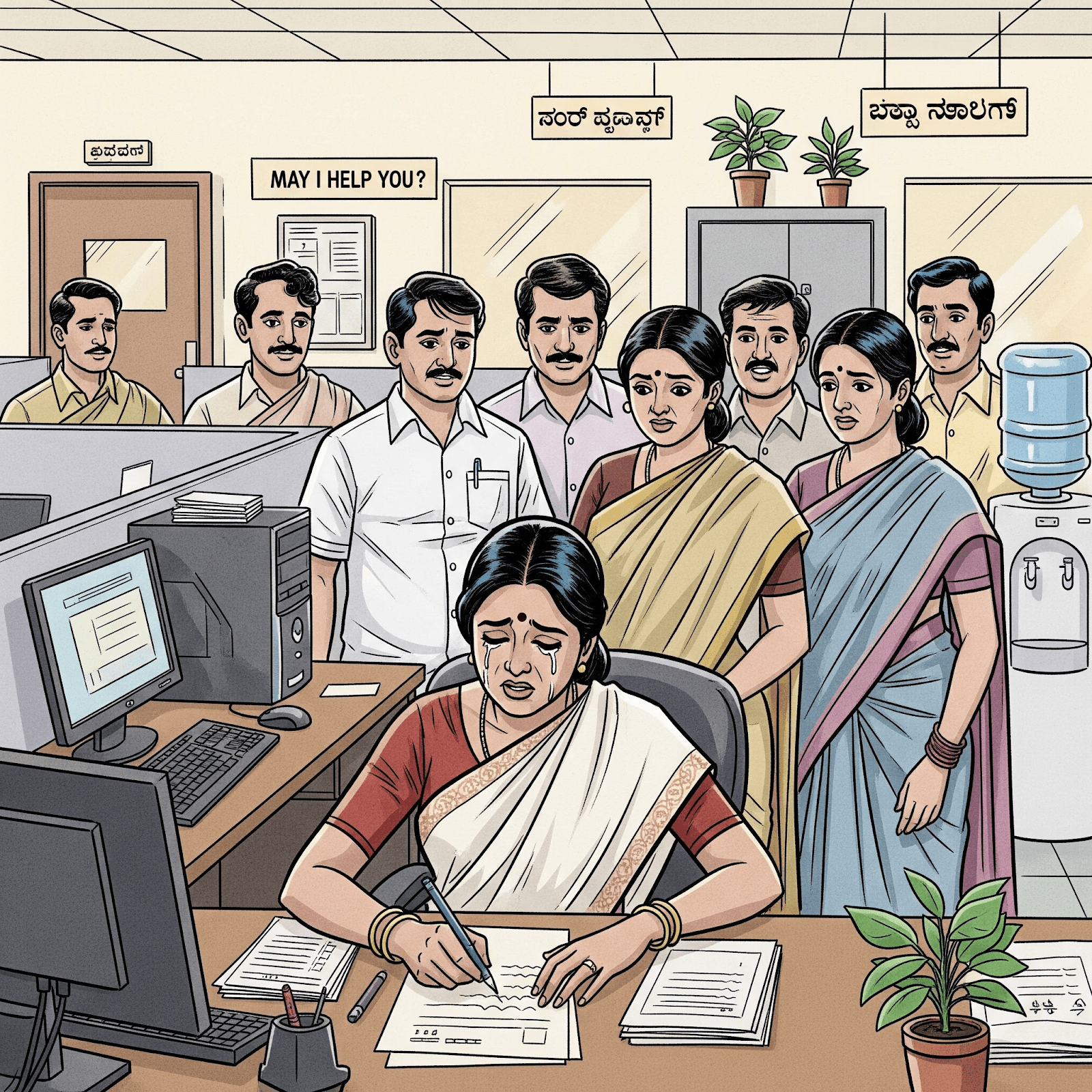
Complying with opaque requirements to draw her salary
So, the scene I entered into, had the poor lady sobbing and trying to manipulate unused wrist muscles into writing so that she could access her salary.
Very helpfully, (I thought!) I asked the staff to just hold her hand and help her with the signature - it may speed up the process perhaps? They hurriedly told me that CCTV cameras were observing everything they did, and helping her sign would be illegal.
Such scenes are probably playing out across the country as millions of people struggle to work with digital systems and opaque processes that are not designed for their particular needs and constraints. The digital divide is very real for them - smartphones and a raft of digital infrastructure may abound, but the thoughtfulness required to actually make them work, and impact the user on the other side, is missing.
For the banks, these are costly design failures. These users at the bottom of the pyramid are not yet too vocal about their unhappiness with systems that just don’t work. But we’ve seen the tide swellingーfor example, social media is flooded with videos, many of them in banks, of customers unhappy with staff transferred in from remote locations who cannot speak the local language. That issue can be a huge barrier for customers unused to speaking in a different language to access their own funds.
These are problems which beg for thoughtful digital solutions. Else, banks will suffer reputational damage, regulatory friction, or worse.
Imagine if the sobbing lady didn’t have to sign that paper, but could use biometrics and facial recognition. These can serve to verify a person’s identity, which is what signatures are used for in the first place. One may argue that signatures also act as a person’s approval or agreement to a process or course of action. We could take care of this by recording a simple video on the spot - we already do this for digital signatures. Even literate folks may benefit, such as senior citizens who may have tremors in their hand, people with disabilities, those who are injured, or children.
Here’s more: post-authentication, what if banks had voice-first kiosks that ask questions and request document uploads so that onerous compliance formalities such as KYC can be done with helpful chatbots? With AI in the mix, it’s feasible to provide such services in the user’s language or dialect. We can do away with many forms and documents for many bank processes if we design and build such systems. These chatbots can perhaps help the bank staff also get acquainted with the basics of local language interactions.
Banks and financial institutions can earn ultimate brand loyalty by handing out smartphones to feature phone customers, moving them firmly into the modern world. The smartphone could be loaded with voice-enabled applications that help users take care of their banking needs. A simple training video (available in the user’s language) can help them at onboarding.
Imagine if the bank had handed the unhappy lady a smartphone as a Re-KYC reward and walked her through authenticating herself and verifying her credentials with a simple app - she would have been so happy she would have probably walked back in with a few friends to get them accounts in the branch!
Areas for improvement. Missed opportunities. Room for change.
The Goobe Guide to Branding Chapter 6 - Rising From the Ashes in Coimbatore
Serendipity:
Did I ever tell you that I’m a budding writer? ‘A blooming writer’, some of my frenemies may say snarkily, and not in the good sense of ‘blooming’.
Whatever the case may be, my writer's antennae are always on. I look for topics, stories and characters wherever I go. And my antennae went into a full tizzy when I stepped into the world of machines and machine people in Coimbatore.
You may think us branding people live in some rarified haven, blowing smoke into the A/C ducts as we ponder on archetypes and whatnot. The blowing smoke may be true in some cases (mea culpa!) but much of the time, we’re actually down in the trenches, living with our customers in their habitat, observing, distilling, seeking. We’re ‘flies on the wall’, Lilian says, ‘observing the brand personifications going about their business’. She even has a name for this ‘fly on the wall’ - she says he’s an Amazonian housefly called Dario!
Well, middle-aged hot flashes apart, I think you get my drift. While we like to think of ourselves as roll-up-your-sleeves kind of people, I got a whole new sense of being down in the trenches at Jaya Kamath’s manufacturing plant in Coimbatore. The assembly floor was an uneven patch of green epoxy pockmarked with exposed cement. The workers on the floor literally wore grey, as they went about their (noisy) business, moving ‘parts’ from machine to machine. They were literally taking chunks of steel, and pulverising them into usable components for automobiles, screw threads and all.
It was an alien world for me. I’d only seen factory floors in movies and TV shows, and had somehow assumed that today, in the 21st century, things would be far more…cleaner? Swankier? Quieter? But the factory shop floor, despite new-fangled automatons doing parts of the workflow, is still a noisy, almost rowdy place - people literally have to shout to make themselves heard over the din.
Jaya Kamath wanted this place branded.
I held my breath for a few seconds as I let the atmosphere wash over me. Grey uniforms, blue and white machines, epoxy green floors. Steel and metal automation. People working in shifts with red ear plugs on to protect their cochlea. Excel printouts pinned on the wall, glinting in plastic protectors with greasy fingerprints on them. Yellow hardhats. Safety and hazmat posters in large Tamil and English lettering on the walls. Yes, the moodboard created itself.
The archetype was clear too – an everyman with a dash of hero? Jaya certainly had a dash of superhero herself. A Indian Army veteran who lost her legs in a helicopter crash, Jaya had literally risen from the ashes of what could have been a life in the periphery to take over her dad’s manufacturing unit and had taken it to new heights. She was exporting now, to places like Western Europe and the Middle East. She was feted by her industry associations and featured on magazine covers. But inside, she remained the cool, level-headed girl in two plaits I knew from school.
“Well, what do you think?”, Jaya asked, as she perched in her wheelchair beside me. “Do we have an outfit that can be branded?”
“Is that even something to ask, Jay?”, I rolled my eyes at her. “Let’s go to your office and get started.”
“I have sketched some ideas for the logo I want to run by you, for starters”, Jaya sounded kicked as we made our way out of the organised chaos.
Hm, a budding illustrator on top of everything!, I mused as I followed her. Jaya was talented.
****
Most clients associate a branding exercise with logos. Deservedly so – as a symbol of who you are and what you stand for, a logo is that one mark that you carry with you in your lifetime with the brand, and perhaps even beyond. My advice? Think simple. I’ve endured hours of brainstorming and hand wringing with clients who want a logo to be ‘pregnant’ with meaning and tell their entire life story. I’ve had to give many of them a figurative kick in the pants to help them understand that it need not be so. Logos can evolve over time, and have variants that state a hundred different things, but start with the premise of why. As Simon Sinek famously observes, if you can identify the ‘why’ of your business, you’re halfway to building your logo. Start with phrases or words that answer the ‘why’.
In 1971, Phil Knight started Blue Ribbon Sports to make running shoes. BRS imported shoes from Japan for seven years and then decided to make their own. Knight approached graphic designer Carolyn Davidson and asked her to design a logo that denoted ‘movement’. She charged him a princely $35 (her rate was $2/hour) for the ‘swoosh’ she put together – one among a half dozen designs she proposed. He didn’t love it at first, apparently, but it certainly seems to have grown on him as Nike reached the pinnacle of the sporting goods industry riding the ‘just do it’ swoosh.

So, here’s my second piece of advice. Be like Phil. Instead of going after your designer for six or twelve more designs for your first logo (and I promise you, the 18th one will be a shambles), go with the easiest on the eye among the first few. Iterate and build it over the years, as you find your product’s market fit and anticipate market trends. Your ‘why’ will evolve and morph, and so can your logo.
Go with simple and functional for your first logo - something distinctive but simple. The ‘why’ of your brand will evolve and morph as time passes, and so can your logo.
Try out logo makers, AI tools and the like if they make sense and if it helps you put together your story for your logo. But I’ve always found it easier to work with a designer who understands your brand and branding framework, to collaborate with to build something impactful and enduring.
Machine logos abound, but it’s easier to work with a designer who understands your brand and branding framework.
Blogging Beyond the Classroom: My Experience as an Intern at Clearly Blue Digital
The feeling of taking learning beyond textbooks is one that every student craves—especially as they step into early adulthood. Each curious mind is plagued with questions: Will what I’m learning actually matter in the real world? Will the hours I spend buried in case studies and spreadsheets somehow tie into my job in the future?
That's the beauty in seeing classroom concepts take shape in real-life projects. Like watching Philip Kotler’s marketing principles spring to life in a branding workshop with a client, or making sense of hundreds of data rows using a pivot table. That’s the kind of validation that fuels a student’s drive to keep learning.
Like many students seeking that crucial bridge between classroom and career, I was fortunate to experience this firsthand during the summer of 2025, when I spent five transformative weeks as a marketing intern at Clearly Blue Digital. During that time, I had the chance to contribute to projects spanning AI in event technology, edtech platforms, and even polymer manufacturing. Each task brought its own challenges and learning curves—and I loved every bit of it.
Still a B.Com student, with far more curiosity than credentials, I’m deeply grateful to the Clearly Blue team for welcoming me with open arms and treating me like one of their own from day one. They never gave me a chance to feel like I was out of my depth. Instead, they gave me what every young adult quietly hopes for: the affirmation that my perspective and voice matter.
My journey with Clearly Blue began with a project focused on developing a customer’s profile, value proposition, and brand voice. Having only vaguely encountered these concepts in classroom lectures, I was suddenly pulled into a five-hour client meeting right from the start—both thrilling and intimidating.
While many might have questioned whether a student could contribute meaningfully to such large scale endeavours, Mrs. Padmaja Narsipur, Mrs. Linda Jacob and team fully supported me. They not only invited me to sit in on the meeting but also took my insights and observations into account afterward, incorporating them as the project progressed.
I entered this internship expecting to watch from the sidelines. Equipped with a book and a knack for quick note taking, I was ready to observe the professionals at work and make the most of my learning from afar. Given these expectations, I was pleasantly surprised when I found myself contributing to real strategies, weighing in on decisions regarding client direction based on my insights and understanding of industries.
My experience spanned across various areas. I gained experience in analyzing competitors and carrying out social media audits to determine content strategies. I also got the opportunity to dabble in using Canva for simple designs of reports. My analytical skills were strengthened through hands-on experience with new tools, from advanced Excel features to Semrush.
But what I gained went beyond skills that I could have also picked up from an online course. I got to work beside professionals who took up marketing with the objective of delivering high value to customers, backed by expertise in their own industries. This combination allowed them to analytically approach a client's offering and help them not only promote their product, but also achieve the true objective of marketing: actually improving what they deliver to customers.
It was through these interactions that I realized how much it was the textbooks left out.
What they don’t teach you in the textbooks
Storytelling Begins With Strategy: Marketing is about building better offerings for a customer, not just prettier advertisements
Generic Customers Don’t Exist: Knowing exactly who is going to walk through the door means you’re halfway to developing a viable product offering
Play Detective: The marketer’s role is not merely to advertise the product– it’s to help develop the best version of the product itself
Data points aren’t everything: Sometimes a client doesn’t give you much to go by, which is when you roll up your sleeves and dive into the industry to find your competitive advantage
The Importance of Interaction: A large portion of gaining traction with a client is about developing content that a potential customer would want to interact with
But above all else, I learned that tools are just tools. As we navigate this agile and evolving landscape, where artificial intelligence is at the forefront of all innovation, students’ greatest learning can only be that our distinctly human perspective becomes our biggest asset.
Clearly Blue exemplifies this balance perfectly, fostering a culture where human creativity takes center stage. I feel fortunate to have worked alongside such talented individuals who remind me daily that our greatest strength lies in what makes us human.
AI in eLearning: From Buzzword to Daily Work Partner
When was the last time you spent hours on a task that could have been done in minutes?
Artificial Intelligence (AI) has become intricately woven into our daily lives in ways we often don't even notice. It goes far beyond just chatbots and text generation. Think about the playlist that predicts your next favourite song, the map app that recalculates routes in real time, or the social media algorithm that serves up posts that feel like they're speaking directly to you. AI powers these everyday experiences quietly in the background, shaping decisions and habits.
The real debate today isn't "Will AI replace my job?" — it's "What skills do I need to make AI my personal assistant?" Much like earlier technological waves, those who adapt and learn thrive, while those who resist often struggle to keep up. The mantra is to make AI work for you, rather than get written out of the workplace. As many have famously remarked, "You won't get replaced by AI, you will get replaced by someone who knows AI!"
The Pattern We've Seen Before
Reflect on the time when computers first entered offices. Log books vanished and suddenly tools like Tally or MS Excel became indispensable skills. The people who embraced them were able to transition smoothly, while others were left behind. AI is the same story, just a new chapter. Instead of fearing it, the smarter choice is to learn how to work with it.
I've had to reinvent my own workflow more than once. At one point, I remember shifting from creating linear PowerPoint-based modules to building branching scenarios in Articulate Storyline. It wasn't easy, the first few projects felt clumsy. But once I embraced it, I could design far more interactive experiences that learners loved. Later, when analytics dashboards became available in LMSes, I had to relearn how to interpret learner data, moving beyond completion rates to insights like "Where do learners drop off?" or "Which activity sparks the most engagement?"
AI feels like that same turning point. Just like Storyline replaced my static slides, AI is now replacing much of the grunt work of content generation. Instead of spending hours drafting assessment questions, I can ask AI to create 20 options in minutes and then refine them. Instead of staring at a blank page for a course outline, I can use AI to build a first draft and then focus on tailoring it for learners. The tools are different, but the pattern is the same: those who adapt and learn thrive.
Your eLearning Partner That Never Sleeps
When it comes to learning, AI can serve as a personal learning coach that never gets tired. It knows your goals inside out, adapts to your learning speed and offers support whenever you need it.
I've seen this play out in my own work. For instance, when I had to prepare a classroom session on eLearning Fundamentals, I was running short on time. AI helped me brainstorm ideas, build the basic script and even create slide-wise content. It wasn't just AI handing me answers — it felt more like collaborating with a partner. That session turned out to be one of the most interactive I've delivered because I had the time to focus on engaging learners instead of struggling with the deck.
As an instructional designer, I also use AI inside authoring tools like Storyline 360 to generate on-screen text, suggest images and even produce voiceovers. It helps me design branching scenarios, quizzes and projects — and draft eLearning scripts that I later refine for tone and context. What once took hours now gets done in a fraction of the time, leaving me free to focus on design and learner flow.
Why Humans Still Matter More Than Machines
What does all this mean for us humans? We still win at the 'heart and intelligence' stakes. Empathy, creativity and cultural understanding are what make learning truly impactful. AI might recommend a course, but only a human instructor can inspire, motivate and connect with a learner on an emotional level. The best results come when AI handles the heavy lifting and humans provide the emotional and strategic spark that lights many a learner's fire.
So how do we position ourselves to thrive in this human-AI partnership?
Skills for the AI-Enhanced eLearning Era
If you're working in education, training or even as a learner, here are the skills that matter in this AI-enhanced learning landscape:
Prompt Mastery: Knowing how to guide AI tools with the right instructions for high-quality results. Instead of asking "Create a quiz," try "Create a 10-question multiple-choice quiz on project management fundamentals for mid-level managers, with detailed explanations for each answer."
Data Interpretation: Turning analytics into meaningful, actionable improvements. Learn to spot patterns in learner behaviour and translate them into course improvements.
Ethical Literacy: Understanding issues of bias, privacy and accuracy in AI use. Know when to question AI outputs and how to maintain fairness in automated systems.
Creative Experimentation: Using AI as a brainstorming partner to test and refine ideas. Think of AI as your creative sparring partner, not your replacement.
Human-Centred Design: Ensuring learners feel included, motivated and supported, no matter the technology. Remember that behind every data point is a human being with unique needs and circumstances.
Practical Examples of AI in Action
AI is already transforming how stakeholders across the learning ecosystem work:
Course Designers: Auto-generate a first draft of a training module and polish it with human expertise. I often use it to create assessment pools, scripts and project scenarios before refining them—reducing initial content creation time by roughly 70%.
Instructors: Use AI dashboards to track learner progress and send personalised nudges to those who fall behind. I've relied on AI-driven insights to spot dips in learner activity and quickly fix the exact sections where drop-offs happen.
Learners: Access real-time explanations, tips and resources without waiting for a classroom session. AI tutors can provide instant feedback and personalised learning paths.
Organisations: Measure the effectiveness of training instantly, adjusting programs on the go instead of waiting for annual reviews. Real-time analytics enable continuous improvement.
Communications Teams (my use case): Create drip campaigns, polish emails and draft student nudges. This reduced our email drafting time by 60% and made the learning journey significantly smoother.
The Future Is Already Here
AI in eLearning isn't a far-off dream — it's shaping how we learn right now. Just as those who embraced Excel thrived during the computer revolution, those who learn to collaborate with AI will lead in this new era.
For me personally, the biggest shift has been moving from relying only on Google to experimenting with tools like Perplexity and ChatGPT for research, ideation and content creation. My team has also started exploring AI-generated images and video snippets, which help us make courses more engaging without ballooning production time.
So, don't see AI as a replacement. Instead, think of it as a tireless partner — one that's ready to help you design, deliver and elevate learning experiences like never before. The future of education is not human versus machine, but human with machine.
Start small—pick one AI tool this week and experiment with it for 15 minutes daily. Whether it's using ChatGPT to brainstorm course topics, trying AI-generated images for your presentations, or experimenting with automated feedback systems, the key is to begin. The learning curve is gentler than you think, and the productivity gains are immediate.
P.S. Yes, AI helped me shape this blog — not by replacing my ideas, but by helping me express them faster and sharper.
The Goobe Guide to Branding Chapter 5 - Finding my voice in Pune
Lillian:
One Friday morning in November, I found myself making an emergency trip to Pune. One of our long-time clients wanted a ‘consult’ to define his brand voice. Our team of branding experts and designers had been working with him on the brand identity for a new product of his. So, when Maya told me that I should hop across to discuss brand voice, I was flabbergasted. Brand voice after all is very much part of the branding exercise. I just couldn’t figure out why I needed to go in for a meeting focused only on brand voice.
And then I got the lowdown from the team. Chris (as Martin Christopher Ponnusamy likes to call himself) is a serial entrepreneur. He’s made oodles of moolah with his SAAS platform focused on supply chain logistics for pharma companies. His new brainchild was an AI-enabled Electronic Health Record system that would act as a Dr’s assistant. Now Chris's current grouse was that his marketing team was using the brand voice for Medsafe (the pharma platform) and Jarvis (the EHR system).
So, here I was on my lonesome trip to Pune. Maya weaseled out ( hot date apparently ). Pity was on one of her self-discovery trips to Varanasi. Not sure if it’s the pot or god(s) that draw her there! I made sure to catch the early morning flight. They still run those turboprops in the early mornings (I like to call them chicken sheds with wings). While they used to give me the jitters earlier, they now welcome me like old friends.
I reached well in time for a small detour to get my supply of Shrewsbury biscuits and Mawa Cakes from Kayani bakery and then forged ahead to Hinjewadi. I waltzed in expecting to catch my breath before the meeting (Chris is normally late and I was 20 minutes early). But I was ushered into a conference room where Chris was pacing while his team sat in nervous silence. With a bare acknowledgement of the niceties, Chris got down to brass tacks. He strongly believed that Jarvis was on the brink of becoming the next Unicorn. The only thing stopping it, he felt, was that the messaging and even the language used in the platform did not jive with the medical community.
Chris has an incredible energy and passion for sharing his thoughts and ideas, which sometimes leads to a flurry of words. It's like solving a fun puzzle, piecing together his thoughts! When I could get a word in, I reminded him that the brand voice was a manifestation of the brand archetype we had agreed on for Jarvis. A combination of the Caregiver (60%) and Everyman (40%). After taking a look at the customer journey map and a few of the user interfaces developed, I felt we could perhaps tone down the current formal speak and make it more casual.
For example, Jarvis currently reports a treatment plan as below:
The patient has been promptly started on aspirin, nitroglycerin, and clopidogrel, and is scheduled for a coronary angiography to assess coronary artery blockages. We have also initiated IV heparin to prevent further clot formation.
We can slightly tweak this to say:
Hey Dr Taylor,
How’s your day been? I’ve got an update on John Doe’s treatment plan.
We gave John some aspirin, nitroglycerin, and clopidogrel. He's also scheduled for a coronary angiography to check his arteries. We've started him on IV heparin to prevent further clot formation.
Want to know anything else?
Similarly, we could tweak marketing messaging to read as:
Our AI-enabled Doctor's assistant is like your personal healthcare buddy. We've got your back, making sure you are well informed.
****
The brand voice is the manifestation of your brand archetype. As human beings we crave connection. Nothing makes you sit up and listen more than a voice that’s speaking specifically to you. When a mother speaks to her child, it’s very different from when she talks to a salesperson on the phone. In fact, if you know a person well enough you can figure out who they are speaking to by just listening to the tone used.
Your brand should talk to your target audience. If your brand voice resonates with your target audience, then they’ll keep coming for more.
Tone of voice is very important. Your tone and language should be what your audience wants to hear. No point in singing classical carnatic music to an audience that wants to listen to Elton John. |
For example, MailChimp's brand voice is approachable and creative. They provide email marketing solutions, but their messaging is fun and engaging. Their "MailChimp & Co." campaign featured quirky, anthropomorphic characters, making email marketing approachable and memorable.
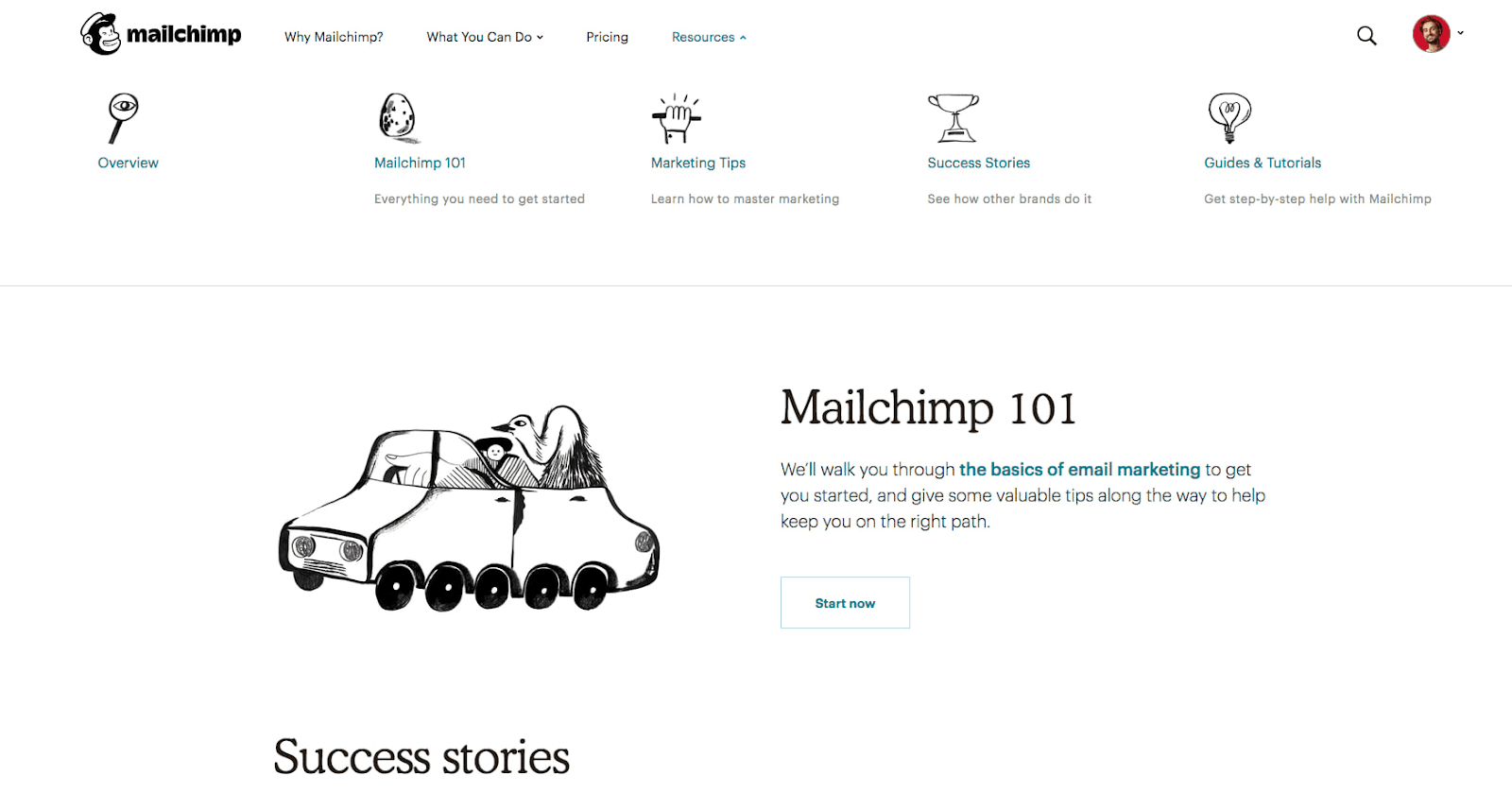
The first step of course is to define your target audience and your brand archetype. This then gives you the broad canvas to explore your brand voice. Make sure they match, else, you’ll end up giving bi-polar vibes. For example, if your archetype is Caregiver, then your brand voice should be warm and empathetic.
Something like:
Life can be tough, but together, we'll navigate these stormy waters. Our promise to you is simple: we care, we listen, and we're here to provide you with the understanding and support you need.
Protip: If you are working with branding experts to figure out your brand, make sure to ask them for key messages and messaging samples so that your voice doesn’t get diluted as you scale your marketing efforts. |
Old-School SEO Meets AI: The New Rules of Keyword Research
We are living in times when Artificial Intelligence(AI) seems to have its fingers in everything—and yes, that includes marketing. Scroll through your feed, join a webinar, or step into any digital marketing huddle, and you will hear the same chant: AI is changing the game.
And while entire marketing teams are busy riding the AI wave, at Clearly Blue, we decided to pause, step back, and examine keyword research more closely. How does AI contribute to SEO keyword research?
Before we dive in, it’s worth remembering that there’s a timeless principle of SEO: Effective and solid keyword research is the backbone of every SEO strategy.
So, let’s rewind for a second—how did we actually do keyword research before the AI frenzy?
It involved a lot of manual and time-consuming work. The process started with brainstorming keywords, followed by using tools like Google Keyword Planner to check search volumes and competition levels, among other steps. Marketers would spend hours sifting through spreadsheets and grouping related terms into clusters to arrive at the best keywords to target. The process was slow and, to boot, prone to errors.
Then along came AI.
With free AI chatbots now accessible, content creators and marketers extensively rely on chatbots like Claude, ChatGPT, Perplexity, and Gemini for keyword research.
The biggest win? Speed.
With these AI chatbots, brainstorming keywords, content ideation and refining keyword strategies become easy—all without any subscription fees. These chatbots can generate lists of keyword suggestions based on input topics or target audiences. For example, when asked to provide keywords for any topic, they can deliver primary keywords, long-tail phrases, and even related questions or search intents. AI chatbots are powered by Large Language Models (LLMs) at their core which are trained on vast amounts of data – so they often think like real users. That means by leveraging their language understanding capabilities, they often mimic the way users search online, helping content creators align with real user behaviour.
But can we throw caution to the wind and blindly trust all keyword suggestions thrown up by the AI chatbot?
We would recommend not.
While AI tools have undoubtedly become a part of every marketer’s toolkit, and they are great for idea generation and keyword suggestions, they don’t provide critical SEO metrics like search volume or competition data like dedicated SEO platforms. Another issue to be wary of is AI hallucination—a phenomenon where AI confidently presents inaccurate or fabricated information. This hallucination seeps into keyword research too. It is not uncommon to find that on verifying keyword suggestions on SEO keyword research tools, many of the keywords have little or no search volume. In some cases, keyword suggestions could be too broad and competitive, making them difficult to rank for. On the flip side, some keyword suggestions might be too specific, flagged by SEO tools as too long or complex for practical use. Adding to this confusion, AI chatbots sometimes mix up headline ideas or content themes and present them as keywords.
So, what’s the way forward?
Think of AI as a brainstorming partner for your SEO keyword research. Consider the keywords suggested by AI tools as starting points. They must be validated, augmented and refined with further research to ensure relevance. Validating a keyword involves checking whether it is worth targeting based on real-world SEO data. This is where traditional SEO keyword research tools like Ahrefs or SEMrush continue to play a vital role.
What does the future hold?
AI chatbots are definitely a boon for those starting out in SEO or working with lean budgets. They speed up keyword ideation, help break through creative blocks, and support SEO-friendly content planning.
Here’s the key: the best outcomes for SEO come from combining AI’s power with human expertise, strategic thinking and creativity. For a well-rounded, effective SEO strategy, it’s essential to pair AI-generated suggestions with data-driven insights from professional keyword research platforms. This combination helps ensure that your keywords are competitive and capable of driving real traffic.
The Goobe Guide To Branding Chapter 4 - Moody Chandigarh
Serendipity:
I’m not a patient person by nature. Back at the office, Maya keeps saying, “Fast cars, fast men, life in the fast lane, she likes ‘em all”. There is some truth to the statement. I detest meetings that go beyond a half hour. I prefer aeroplane trips to noisy, smelly trains that meander all over the countryside – why suffer through a day of that, when you can reach your destination in a couple of hours without disrupting your deo?
So, when Lilian told me of this assignment with Diva Couture at Chandigarh, it didn’t jive with me. “Why me?”, was my whine. Lilly and Maya had been working on this prospect for months. Listening to their telecons, I was convinced the Diva folks were world-class dawdlers.
Diva is a renowned international brand in the realm of bling couture. From East European tennis stars to Vegas drag queens and hot pop stars from the Caribbean, individuals around the world proudly showcase Diva's dazzling creations in their social media and PR shots. Sometimes, as pop queen Brianna just did, Diva bling is all they sport – scandalising our prude Indian sensibilities. It’s a great feeling for the exchequer to rake in Diva dollars I guess, but not so great when the Diva Lakshmi in silver and Swarovski is dangling between a buxom pair of you-know-whats!
My protests notwithstanding, Lilly and Maya pushed me firmly out of the door and told me to go smell the roses in C’town. I read the background notes our mousy market researcher Mia had put together on Karma Kaur, the genius behind Diva on my flight over. A hard-nosed Punjaban who’d risen from the wrong side of the tracks and blazed a career across the world in 15 short years, Karma was fending off ankle biters – young whippersnappers from South East Asia – who were aping her and one-upping her in the bling game. Time for a rebrand?
***
Chandigarh is certainly beautiful. It’s organised, I mused, as a chauffeur in all white whisks me to Karma’s villa in Sector 5. Quite unlike most Indian cities. The car is a silver Merc S-class, no surprises there. What took my breath away (other than the chauffeur’s discreet request not to smoke!) were the all-silver interiors. It was classy, no doubt, but the encrusted jewellery and silver-lined upholstery were a bit much for my taste. It started giving me an insight into the mind of my hostess. The bling begins, I thought, as I fidgeted with my phone, longing for a ciggy.
***
Karma Kaur is a force of nature. Correction, a dramatic force of nature. Her perfume and two minions preceded her as she swept into her (bejewelled, but naturally) living room. Tall and statuesque, with a mane of hennaed hair, clad in a burgundy kaftan, she exuded a regal vibe. This is how one of Ranjit Singh’s ranis must have looked, I thought to myself. She also exuded a typical Punjabi friendliness as she ushered me to her dining room after pleasantries. A huge (and I mean, huge) spread of Punjabi delicacies – think paneer, butter, chicken, onion, tomato in all variants and combinations thereof – sated me. And then we sat down to chat.
Karma and I had a long, long chat about her roots, her aspirations and ambitions. She was restless, yearning to break free from the loud and proud Punjabi bling she had made her name on over the last two decades. She has evolved as a designer and person since – she wants to showcase her deep knowledge of Indian textiles, art and architecture. She has developed a keen interest in the various forms of classical dance and wanted to integrate these new strands in her persona into Bling!
I’ll cut to the chase and share my notes with y’all.
****
Client: Karma Kaur, Diva Creations
Requirement: Personal Branding as Diva launched her new collection Bling! [The company will do the official social media, but she wants to raise her brand quotient and go to Hollywood a la Bhanu Athaiya]
Channels recommended: Instagram, YouTube
****
The first piece of branding advice I gave Karma was to call the collection something other than Bling! Pretty garden variety advice you may say. But when you aspire to please the Pupul Jaykar and Laila Tyabji crowd, ‘bling’ is certainly not the word the mind conjures up to wow them.
We brainstormed names as a way to start the branding exercise. From ‘Indigo’ (too airliney) to ‘Aama’ (yawn!), we went through a bunch of possibilities as the afternoon gave way to the evening. Cocktails and brazil nuts appeared miraculously as we built a rapport and hooted over zany names. I told Karma the name wouldn’t get done so easily and suggested moodboards as a line item we could knock off on this trip. I’d got some suggested options from Mia, but after the surprising turns of this conversation, I just googled up some more for her.
****
What is a moodboard?
A moodboard is a visual palette of moods – colours, colour combinations, fonts and other artefacts – that helps everyone in the team get on the same page about the vibe of a brand. Typically used by interior designers, moodboards are something we’ve found to be hugely useful to ‘set the tone’ for a branding exercise with clients. It often gets co-founders squabbling noisily during branding workshops, but hey, squabbling before branding is set, rather than after, is any day better in my book!
Here are some examples I presented to Karma. She was somewhat familiar with the concept, in contrast to many clients who aren’t. Some view the entire exercise with suspicion – especially those with an engineering or technology bent of mind! But once we show them a sample social post or two, and talk about how colour, font, tone and message pull a brand voice together, they quickly ‘get it’.
As you can see, each board tells a story, and evokes a distinct mood.

Pic: The EM Forster Board, courtesy Google Images
I call this one the ‘E M Forster’ board. It has images of the ‘typical’ – one might even say stereotypical – India.


Pic: The Ashram Board, courtesy Google Images
This one here is an ‘ashram’ board. Very spa-ey and spaced-out, wouldn’t you say?

Pic: The Memsahib moodboard, courtesy Google Images
This is my ‘memsahib’ board. The vision an Octopussy girl may have, perhaps?
I think you get the gist of where I go with moodboard conversations with my clients. Which do you think Karma went with?
If you thought the memsahib one, you were way off! I initially thought so too, but after we brainstormed more, we built a moodboard from some of her latest photoshoots and photos she’d taken on her travels. Here’s what we ended up with:

Pic: Karma Kaur’s moodboard
magenta of a patka, think the bright red of a Punjaban bridal trousseau; as well as the more sober colours of Karma’s new passions in traditional weaves and textiles.
Captures the new collection (and the new Karma) quite well, I thought! The palette, in my opinion, gives the brand a vast scope for building evocative brand collateral.
PS: This new brand was eventually now dubbed Karmic - expressive in more ways than one, I thought!
Remember, the moodboard is exactly that — the mood you want to invoke in your audience. when they see or hear anything related to your brand. Think mood when creating your moodboard!
Neural Networks & Content Marketing: How Deep Learning is Reshaping Brand Storytelling
I read that the time required to produce a live-action film was anywhere between 2-6 weeks. So when “Chai and Secrets”, produced by Paco Torres, shown at the Pune International Film Festival, created in 240 minutes, stitched with a bunch of AI tools, one becomes aware of the narrative shift
Living with, embracing, learning and using AI will disrupt and reveal new avenues. Large Language Models, when in the hands of good actors, create masterpieces of experience. I lean on these to share learning and points of view about AI in storytelling, branding and marketing.
Deep learning models are continuously evolving to transform content generation and marketing, enabling brands to adapt to customer and market changes faster than ever before.
Led by transformer-based models for text generation like GPT (from OpenAI), T5 by Google, Generative Adversarial networks (StyleGAN, CycleGAN) and Diffusion Models (Dall-E) for image generation, coupled with Audio, Music and Video generation (JukeBox, Synthesia) make life for a content creator more exciting.
An interesting campaign that I’ve been following for a few months now is by Air India. Ever since it was taken over by the Tata Group, which has been using AI for their branding, content and marketing campaigns. One look at their YouTube playlist and there’s something for everyone. It appears AI has well and truly embraced AI! My sense, watching its content, tells me that a team of highly creative people have worked with AI to produce prolificly, frequently, and fairly personalized content while maintaining the brand voice of Air India that reflects an emotionally engaging, globally aspirational and premium service. A quick glance at the old v/s new tagline from “Your Palace in the sky” to “Fly the new feeling” says it all.
For a content marketeer, there is a plethora of AI playgrounds that can be tuned with prompt engineering combined with rapid iteration to ease the challenge of creating highly tailored marketing content. Building and managing volumes of tailored variants has become seamless and measurable thanks to hyper-automated workflows in marketing tech stacks running on top of data intelligence platforms.
AI-enabled workflows improve efficiency, improve feedback and continue to keep the human in the loop while producing better results and models with less additional effort.
Let me go deeper into how deep learning is changing brand storytelling:
Personalized content creation
Marketing campaign models are augmented user interaction data (clicks, dwell time, purchase history) to update and improve content preferences and create tailored recommendation while remaining aligned with broader campaign goals.
Generative AI systems trained on brand campaigns produce variations tailored to different customer segments and automation creates thousands of personalized ad variants.
Improved visual storytelling
Text-to-image models like DALL-E and Midjourney enable brands to rapidly generate visuals that match specific brand guidelines and emotional tones.
Computer vision algorithms analyze successful campaigns to identify visual elements that drive engagement, helping brands optimize their imagery.
Voice and tone consistency
Large language models continuously fine-tuned on brand materials learn to mimic specific brand voices, enabling consistent messaging across thousands of content pieces and across multiple campaigns.
Sentiment analysis tools scan all brand communications to ensure emotional consistency and flag potential misalignments.
Real-time adaptation
A/B testing platforms powered by reinforcement learning automatically optimize content based on real-time performance metrics and content lifecycle management for retiring and/or refreshing content that improves AI recommendations
Natural language processing monitors social conversation about campaigns and recommends narrative adjustments based on audience reception.
Emotional intelligence
Facial recognition in digital ads tracks emotional responses to specific storytelling elements, helping brands understand what resonates.
Multimodal AI systems like the ones mentioned in the film creation earlier, analyze text, images, and audio together to measure emotional coherence across brand touchpoints.
Multilingual and multicultural reach
Neural translation models preserve brand voice and cultural nuances when adapting content to new markets.
AI tools scan for cultural sensitivities and recommend adjustments to make stories relevant across different cultural contexts.
Tying it all in with an AI-led content strategy offers clarity on how best to leverage deep learning and neural networks to transform the content creation, delivery and optimization processes. Company strategy can leverage AI across
Planning for content intelligence by using AI to conduct audience analysis, gather competitive insights and trend forecasts
Enhance the creation process using AI with human collaboration for emotion & creativity while easily integrating multimedia
Optimize distribution channels with AI models that predict campaign performance, adapt to specific market segments and enable quick A/B testing
Measure and continuously improve branding strategies with natural language processing to correlate content elements with brand performance and content refreshes.
Investing in an AI led content strategy is a bold move that will change the ways businesses and products evolve. Areas to improve on include –
Biases – most models are trained on a “western” view of the world and are biased with their training data. Case in point being the story of an Indian musician who designed Sur, an AI-powered stem splitter. No existing music production tool had been trained on Indian Classical Music until then.
Guardrails that safeguard interest of the business and its customers. Smart data intelligence platforms allow for deep customization of content generation with guardrails, so results are reviewed before delivery.
Using models that can respond to different languages and cultural data sets. Global open source models are a great place to start, coupled with the Government of India’s AI Kosha data sets can help personalized marketing & content platforms reach wide and deep across the sub-continent and the Global South, democratizing AI for everyone.
These are a few noteworthy ones. LLMs are improving fast. Machines are on track to be a lot smarter, says the godfather of AI, Geoffrey Hinton, than he’d previously thought. “Few-shot” learning models means that it takes very little for LLMs to quickly “learn” a new thing it wasn’t previously trained on. With this premise, content marketing, branding and storytelling are poised to experience a dramatic shift.
I wear an optimist’s hat in saying that disruptions will create new avenues for humans. Learning how to embrace what’s upon us can only allow our brains to uncover new paths and, who knows, give new challenges for neural networks to surpass.
P.S. As an Indian, one will spot several flaws in the movie. They are gone in 60 minutes.
The Goobe Guide to Branding Chapter 3 - Aamras in Amdavad
Pity and the Begum of Begur (as I call her), have passed on a very broad order for me to fulfil. They think the essentials of marketing can be learned. Maybe they were inspired by the movie Ratatouille, yet I don’t think just anyone can market! I had better, since we’ve made it our busy ness to show people how to. The Begum is dear Lilian. With little regard for my trepidation, they put me on a plane to Ahmedabad, or Amdavad as Pity calls it, she isn’t a native though and absolutely shrieks when she sees sweet dal. Those Amdavadis would have a good ‘saaru che’ at her expense. Mary Poppins said that a spoonful of sugar makes the medicine go down, I say pinches of it in daily cooking elevates any dish to a stratospheric gastronomic heaven. I know Lilian will get it! Or ask any Puneri or Amdavadi. It’s the Puneri in me, we own aamras, graciously lent to Amdavadis and beyond, samazhla? Get it??
I was assigned the task of uncovering the brand arche - type of our clients, Moorjani Engineering. Lilian lives and breathes archetypes. She’s a master storyteller and Pity with her magic masala pretty much breezes through this exercise. I, on the other hand, am a jittery mess. My usual self! Our clients were a traditional engineering companywith solid credentials and standing amongst automotive component manufacturers and smart electronics over the past 30 years. I felt somewhat proud that their components sat in some of the best-selling cars in the country and they commanded the smart home market in the NCR region. Hmm, these folks know their bolts, screws and studs! I dug deeper into their company profile. Familiar data around CAGR, Moorjani’s steady penetration into African markets, consolidation in Italy and a commendable 18 % in competitive Germany, as trusted fastener suppliers, made for fascinating reading. I loved the fact that they’d kept pace with the times and had already future-readied themselves as the market veered towards low-cost, lightweight, corrosion-resistant materials and had invested in upgrading their facilities accordingly.
I tried researching Manju Bagga who was to be our point of contact. But other than discovering that she was a graduate of the famous UID and an Amdavadi – her Instagram profile showed her to be a drama enthusiast – I found little else. She had started as a design engineer with the company’s smart electronics division and was now the CTO of their new venture – EV vehicle component manufacturing. She knew dear Pity from their days as IIM chums. Pity as usual had WhatsApp-introduced us and quietly dropped the string on my shaky shoulders. I checked in.
Manju was putting her team together, wanted to build a world-class company and was finding it hard to present the group as an attractive proposition to potential campus hires. She’d shared this with Pity and Lili. So we thought that helping them figure out their archetype would help them create a rock-solid EVP that would attract talent.
We went through a whirlwind of immersive activities – plant visit, EV vehicles 101 sessions, meeting people, watching (colours, shapes etc), listening (to their language and other cues) to round out our discovery phase.
Once that was done, I took them through our deck that detailed all 12 archetypes and what they meant in terms of brand voice, persona, colours and messaging. Since Manju had a 5-member team assembled for this exercise I gave each one of them 15 minutes to assimilate the archetypes and think about how they would relate these to their brand and their audience. They then had to jot down their primary and secondary archetypes of choice and the reason for their choice.
After a gruelling two and a half hours and many arguments (sometimes I feel like a referee in a boxing ring in these meetings, we zeroed down on 70% Creator and 30% Explorer.
Choose a Brand Archetype and personify your brand. It enables you to confer human-like attributes to your brand making it more relatable to your customers.
Brand Archetypes
I wonder if Margaret Mark and Carol S. Pearson envisioned that brand archetypes would become so popular when they wrote the book “The Hero and the Outlaw”. But it’s really not so surprising considering that humans connect best with other humans. So what better way to connect to your audience than personifying your brand with the very characteristics that your target audience is looking for:
Doesn’t IKEA give you the vibe of being your friendly, helpful neighbour? That’s because their brand archetype is that of the Everyman. Not sure what this means? Read on and all will be revealed!
Your brand archetype is a quick and easy way to define the characteristics you want your brand to reflect. This will then act as a mental shortcut for your marketing team to generate consistent, engaging content that is sharply targeted at your audience.
We recommend that you define your archetype as a combination of two archetypes at a 60:40 ratio. Why? Because we humans are more complex than a single archetype. Using two archetypes makes your brand two-dimensional without making it so complicated that your marketing team pulls their hair out trying to figure out how your brand should behave.
Pearson and Mark drew on Swiss psychiatrist Carl Gustav Jung’s work on human psychology and philosophy. Jung proposed the existence of universal, recurring symbols and themes in human experience, which he called “archetypes.” He believed these archetypes were part of the collective unconscious shared by all humans and that they influenced our thoughts, behaviours, and dreams. That’s what we are capitalising on here.
There are 12 of them, so here’s a snapshot of all of them together to get your head around them.
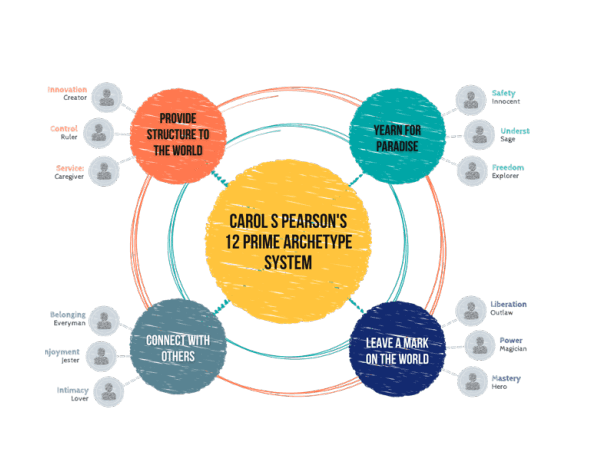
PRO TIP
Find your brand of cocktail and go with it. Make sure your brand archetype speaks to your target audience. It would be great if you could give your brand opinions and an outlook on life.
What do you love and why?
What do you dislike /hate and why?
Where do you bring the most value to your audience
What is the one thing you would change about your industry above all else, and why?
Why is your market a great space to be in?
What positives and negatives do you believe social media has brought about in our society? What is the purpose of your existence
What is important to you for doing business?
What does your audience need to be protected against?
Are you paying a prompt engineering tax?
The hidden costs of modern content creation and how marketing teams are caught between the AI ‘devil’ and the human ‘deep blue sea’
How green was my content!
Confession time! When I started creating marketing content, SEO was a dream in some Silicon Valley techie’s brain. Marketers rode successive waves of website writing, keyword-focused blog writing, sharp social media creation with hashtags and SEO-driven marketing. Now, it’s the turn of prompt engineering.
Transformation is an understatement for what we’re experiencing now. From AI-driven SEO keyword research to AI-assisted content generation, marketing teams are witnessing an AI tsunami in their tasks and tools as the output of LLMs makes its way to websites, social platforms, and marketing materials. Yet, despite these technological leaps, creating quality content has paradoxically become more complex and expensive than ever before.
Marketing teams now find themselves in an uncomfortable position—trapped between the efficiency promised by AI and the reliability delivered by human writers. This predicament isn't merely about choosing between two options; it's about navigating a complex ecosystem of tools, skills, and costs that weren't part of the equation just a few months(!) ago.
The One-Size-Fits-All AI Trap
“ChatGPT or Claude? How about Jasper? Have you checked WriteSonic? DeepSeek does a great job of reasoning while it’s working! Hey, Perplexity reports can perhaps make great blogs!” – water cooler talk in agencies and marketing hangouts, circa 2025.
Small to medium marketing teams nowadays find themselves overwhelmed by generic AI platforms that promise the world but deliver more – complexity, that is. These platforms typically offer a bewildering array of features designed to cater to enterprises with dedicated AI teams—not the modest marketing department trying to produce next week's blog posts.
Consider the typical scenario: A marketing manager logs into their AI platform, and starts surfing the web for the latest and greatest prompt to get quality blogs. She’s spoilt for choice with Large Language Models (LLMs) to talk to, each with a cheery interface that serves up good content for detailed prompts but many a time, degenerates into some hallucination or the other as the chat progresses. The words sound fabulous, the sentences flow, but read the blog once or twice, and she emerges puzzled - Did I read that right? Is that run-on sentence really leading up to something? Is it really making sense? Within a few blogs, she tires of the repetitive phraseology and approaches. Anything more complex needs sophisticated prompts. Should I sign up for a prompt engineering course then?, she scratches her head.
Then, there are the ‘marketing AI’ platforms with interfaces that seem to require a computer science degree to navigate effectively. What should be a simple task—generating a simple marketing blog or listicle, or social media post—becomes a technical ordeal.
The complexity doesn't end with the interface. Marketing teams must also contend with the reality that most AI platforms are designed as general-purpose tools rather than specialised content creation assistants. The brand voice doesn’t match the topic suggestions! We’re an edtech firm - why is it suggesting meditation-related topics?
Features crucial for marketing teams are often buried beneath layers of functionality more relevant to developers or data scientists. Who wants to be confronted with 50 prompt widgets when you have a sharp set of asks for the month?
The Prompt Engineering Tax
Perhaps the most unexpected cost in modern content creation is the learning curve required to use AI effectively. Prompt engineering—the art and science of crafting instructions for AI models—has become a prerequisite skill for content marketers.
This skill doesn't come easily. Marketing teams must invest significant time in crafting, refining, and testing prompts to get usable output from AI systems. What begins as a simple request often evolves into a multi-paragraph instruction set, complete with examples, constraints, and formatting guidelines. This "prompt tax" is rarely accounted for when organisations consider the efficiency gains of AI.
Even more concerning is how this skill requirement has created a new divide between marketing teams. Those with the resources to hire dedicated prompt engineers or train their staff extensively gain a significant advantage, while smaller teams struggle to extract valuable content from the same AI tools they're paying for.
The Verification Burden
Once content is generated, the work has only just begun. Marketers must now verify everything the AI produces—a necessary but time-consuming process.
Failure to verify AI content comes with serious risks: reputation damage from publishing inaccurate information, legal issues from inadvertently plagiarised content, or simply publishing material that doesn't align with the brand's voice or messaging strategy.
The verification process itself has become increasingly complex. Teams must run content through plagiarism detection tools to ensure originality, fact-check statements that may be hallucinated by the AI, and review the tone and style to ensure consistency with brand guidelines. Some organisations have even begun using AI content detectors to identify and potentially revise sections that sound too obviously machine-generated.
Each of these verification steps requires additional time and tools, adding layers of complexity to what should be a straightforward content production process.
Tool Subscription Overload
The modern content marketer's toolkit has expanded exponentially, and with it, the associated costs. Today's marketing teams typically maintain subscriptions to multiple services:
LLM subscriptions provide access to the AI models that generate initial content drafts. These can range from general-purpose platforms to specialised content generation tools, each with its own pricing model and limitations.
Plagiarism detection tools have become essential to ensure content originality, particularly when working with AI-generated material that might inadvertently replicate existing content.
Grammar and style checkers help refine both human and AI-written content, ensuring grammatical correctness and stylistic consistency across all marketing materials.
SEO optimization tools analyse content for search engine visibility, suggesting keywords, headings, and structural changes to improve ranking potential.
Individually, each tool may seem reasonably priced, but collectively, they create a significant recurring expense that often exceeds what was initially budgeted for content creation, not to mention the time needed to train on the tools and integrate them into marketing workflows.
The Human Writer Premium
Despite the rise of AI, human writers remain invaluable for creating truly distinctive content. However, quality human writing has become increasingly expensive, creating a difficult choice for marketing teams: pay premium rates for human-crafted content or accept the limitations and additional workload that comes with AI.
The scaling problem is particularly acute. While AI content can scale almost infinitely at minimal marginal cost, human-written content scales linearly with cost. Doubling your content output means doubling your investment in human writers.
Many organisations have turned to freelance networks as a compromise, but this introduces new challenges around consistency, availability, and management overhead. Finding writers who truly understand a brand's voice, industry, and audience takes time—a resource already stretched thin for most marketing teams.
The Content Creation Dilemma
Today's marketing teams find themselves in a content creation dilemma: caught between imperfect AI solutions that require significant time investment to use effectively and increasingly expensive human writers who provide quality but at a scale that's difficult to sustain.
This predicament isn't simply about choosing between human and machine—it's about finding a sustainable approach that leverages the strengths of both while minimising the hidden costs that have made content creation so challenging in the modern landscape.
As the industry continues to evolve, forward-thinking organisations are searching for solutions that bridge this gap, offering the scalability of AI with the quality and strategic thinking of human expertise. For marketing teams feeling the pressure from both sides, relief may soon come in the form of more specialised tools or platforms designed specifically for their workflow and content needs.
From Classroom to Conference Rooms
My Internship Journey at Clearly Blue Digital
- A Blog by Summer 2025 Marketing Interns
If Internships came with warning labels, mine would have said, “ Caution: May cause rapid growth, intense Canva bonding and mild obsession with pivot tables!”
They say college prepares you for the real world -but my textbooks once did not mention the client calls, pivot tables or the sudden addiction to Google Analytics.
Before I joined Clearly Blue, I imagined marketing was all about interesting slogans and cool colours. I soon discovered it was about the audience personas, SEO rabbit holes, and learning how to make data look exciting in client reports( Spoiler: it's harder than it looks!)
Marketing 101, But Real
Day One was a blur of introductions and smiling faces and my mind buzzing with questions: What if I mess up? What if I asked stupid questions? What if I don't fit in? Clearly Blue threw me right into the action - with a crash course on their services, client expectations and content marketing.
My first task: Sit in a client meeting and take notes. Simple right? Not when half the words tossed around were acronyms I never heard before.I got my first taste of brand workshops and storytelling frameworks where I learnt that ICP doesn't mean a cool tech gadget but Ideal Customer Profile.
By the second week, I was writing client meeting reports using Canva (yes, me!) and gathering buzzwords like value proposition and nurture plans. I progressed from formatting meeting summaries to building social media audits and a master trainer’s playbook.
I also learnt that there is a right way to choose colors based on the brand colours - no, pickling your favourite shade of blue wont work.
The next week, it was all about analysis. Competitor analysis? Market positioning? Social media strategy? , you name it - I was on it. Clearly Blue trusted me to dive deep into competitor analysis and marketing strategies that can be followed. I even learnt to build a social media calendar.
Here it was that I found a newfound appreciation for excel. And my spreadsheets got an upgrade: pivot tables, filters and —-drumroll—dashboards. I built dashboards for email campaign outreach, analyzed lead data and summarized the results using charts and funnels.Honestly,even excel seemed impressed.
I realised that it requires more brainpower than a semester of finals to analyse all the data and come up with long term content strategies.
Wrapping the loose ends without losing my mind!
The big day arrived- doing a presentation to the team. Heart pounding, slides ready. And I clicked, ‘Present’. For the first time, I realised I wasn't an intern fumbling with acronyms anymore but a contributor, a learner and a part of the team.
What I really learned:
Beyond the tasks and tools, this internship taught me how to:
Adapt quickly in a fast-paced environment.
Communicate clearly( when in doubt, overcommunicate)
Take initiative and trust myself - even when I felt clueless
And yes, how to use Excel like a functional adult.
Clearly Blue didn't just offer me an internship. They gave me ownership, guidance and space to grow. I walked in as a student. I left as someone who could confidently contribute to marketing and maybe even explain all the buzzwords to a friend without crying.
Reigning Supreme: The Unstoppable Power of Visuals in Digital Marketing
Let’s be honest: our digital experience is often a perpetual scroll, punctuated by viral moments that instantly hijack our focus. The allure of a dog eating spaghetti often wins out over even crucial emails. We consume more content in a single scroll than we did in a week a few years ago.
In this relentlessly noisy and "scroll-happy" digital landscape, how does your brand cut through the clutter?
The answer is clear: you go visual.
Here’s why visual content isn’t just important—it’s the reigning king of digital marketing.
Humans are walking, talking eyeballs
The human brain processes visuals 60,000 times faster than text—it takes only 13 milliseconds. That’s probably why you still remember that hilarious meme from 2016 but can’t recall what you opened your refrigerator for. Your brain loves visuals. It’s hardwired that way. We remember visuals better, respond to them more quickly, and feel more emotionally connected when we see a face, a colour, or a scene.
It’s why a single image can make you laugh, cringe, or immediately add to the cart. Your audience isn’t tuning you out—they just need something that looks worth noticing.
Make them stop scrolling
Think of social media as an endless buffet of distractions. Getting someone to stop scrolling? That’s digital gold.
Whether it’s a bold graphic, a clean infographic, or a thumb-stopping video, visuals make people pause. And pausing is the first step to engaging.
Text alone? That’s homework. Visuals? That’s an invitation.
Social media loves visuals
Platforms are increasingly prioritising visual content, especially videos. Instagram reels, YouTube Shorts, and TikTok are currently the most binge-worthy marketing tools out there. And they’re not just for Gen Z dance trends anymore—businesses, creators, and even your favourite local coffee shop are leveraging these platforms to tell their stories visually.
Why? Because visual content gets more engagement. Period.
It’s all about the Brand vibe
People don’t just buy products—they buy stories, aesthetics, and vibes. Visual content is your brand’s golden ticket to ‘vibe central’.
Want to come across as minimalist and modern? Stick to clean lines, neutral palettes, and chic design. Want to scream fun, playful, and a little chaotic? Neon colours, bold fonts, and movement are your BFFs.
Through visuals, your brand builds an identity—one that your audience can recognise, relate to, and yes, fall a little bit in love with. A strong visual strategy means people can see your content and instantly think, “Ah, that’s so them.”
Infographics over text-heavy papers
Infographics take all those stats, charts, and facts and turn them into something that doesn’t make people’s eyes glaze over. Even complex topics become digestible when they’re wrapped up in colourful graphics.
If you want to educate and entertain, infographics are the unicorn of visual content.
The share factor
People don’t usually forward long paragraphs to their friends. But a meme? A quote graphic? A short video that made them laugh or cry or nod in agreement? That’s getting sent to the group chat.
Visuals don’t just get more attention, they’re also way more likely to be shared, spreading your brand to new audiences without a single ad rupee.
Willingness to hit record
Video isn’t optional anymore—it’s essential. From 15-second TikToks to product explainer videos, people crave movement and story.
Why? Because video combines all the best things: sound, visuals, emotion, and narrative. It’s immersive. And, with smartphone cameras and editing tools being what they are today, you don’t need a full production crew. All you need is just a clear message and a willingness to hit “record.”
Whether it’s a founder talking to the camera or a timelapse of your product being made, video builds trust fast.
The algorithm picks visuals
Social platforms aren’t subtle, they want you to post videos and images. They reward you for it with better reach, more engagement, and higher visibility.
Want to grow on Instagram? Show up with Reels. Trying to get noticed on LinkedIn? Native videos and clean graphics are your go-to.
Words still matter. Blogs, captions, and storytelling they’re important. But visuals are what open the door. They’re the reason people stop, pay attention, and remember.
So the next time you're creating content, ask yourself:
● Would I stop to look at this?
● Does it tell a story without words?
● Is this on-brand visually?
If the answer is yes, congratulations. You’re not just creating content but also opening doors to engagement and conversions.
Go forth and be seen!
The Goobe Guide to Branding Chapter 2 - Introspecting in Kochi
Lillian:
I regretted it long before landing in Kochi. Pity was ruthless in her aggravation. She hates these forays outside Bangalore and felt that the three of us going to meet a client was a waste of time. Hey, it’s not as if we were on a 16-hour flight to meet the kangaroos. It’s literally just a hop and skip to Kochi. But, no! Our Diva must whine and smoke her way to drive me nuts.
If that was not enough, Maya was on her high horse and was bent on finding fault with everything ever since we landed in Kochi. For God’s sake, I have no clue why the powers-that-be decided to use heavy teak furniture in the Kochi airport. While I was booking a cab to get us to Infopark in Kakkanad, Maya was on her phone (cursing the spotty internet) trying to find out how many trees were butchered to furnish the airport. Talk about priorities!
OK. Let me take a deep breath, calm down and tell you why the three of us are in Kochi on this sweltering hot day. A couple of weeks ago, a friend of a friend of a friend, recommended us to Mr Mathews Tharakan of STARK Technologies. No, Mr Mathews is not a misguided Avengers fan. He says his company is 20+ years old and was named way before Tony Stark was christened by Stan Lee and Larry Lieber. I had to apologetically correct him and let him know that Mr Tony Stark was around in the Marvel universe from the 1960s. But Mr Mathews of course had not encountered Mr Stark and named his company STARK Technologies in ignorant bliss. He did tell me what the acronym stands for but it’s locked in some obscure cupboard in my brain for now. I’ll do the grand reveal as soon as I locate the forgotten cupboard. Well, to cut a long story short, STARK Technologies has been a major IT player with almost 50% of the world’s aviation software being produced by them. Mr Tharakan has now decided to branch out into medical solutions that are enabled by AI and automation. He contacted us to help him build an entirely different brand for this new vertical.
After a couple of disjointed calls where Mr Tharakan and his very subservient team popped in and out of hour-long Zoom calls, I decided that we needed to pin them down for a day-long workshop to make sense of what was required. I persuaded Pity (our creative powerhouse) and Maya (our user research guru) to join me in my expedition. I thought it would be a nice change for the three of us. A chance to get out of the office and have some fun. Well, I am yet to see the fun and can see trouble looming. I’ll just keep my fingers crossed and try and see if I can calm them down with some hot chaya and parippu vada from a bakery on the way... Maybe I could entice Maya with that plum cake she so loves! Hmm… food for thought.
*****
Psst… just wanted to report that things are looking up. The parippu vada and chaya worked their magic. Both Maya and Pity are now smiling and enjoying the view outside the big glass windows. We’ve been waiting for Mr Tharakan and his team to join us. A very welcoming gentleman who called himself Mr Tharakan’s chief secretary (the three of us had a good giggle about how many secretaries did Mr Tharakan have to have a chief secretary) had settled us into this roomy conference room and plied us with drinks, cookies and what not. I pounced on the plum cake slices wrapped in butter paper that I spied amongst the other goodies. Maya, who was clueless about this plum cake avatar, had to be coaxed into taking a bite. And then it was a race to see who would have more. Pity as usual nitpicked about the lack of “kharra” in the offerings and settled on some kharra tapioca chips. We were bickering about our individual choices just as Mr Tharakan and his entourage swept into the room.
Mr Tharakan was the quintessential businessman.Within 20 minutes of the meeting, we were enlightened that he had an MTech in Computer Science from IIT Madras and an MBA from IIM-Bangalore. We murmured our appreciation and made noises about how lucky we were to have made his acquaintance. I had to kick Maya on the shin to stop her from going on a tangent about how she thought all formal education was overrated. Pity and I smiled across the table as we took a moment to enjoy this facet of humanity.
You might be wondering why I haven't mentioned the rest of Mr Tharakan’s team. Well, that’s because they all morphed into a single blob of nodding heads five minutes into the introduction. It was very evident that Mr Tharakan had surrounded himself with an army of ‘yes’ men, who deferred to his decisions and were there only to reaffirm his thoughts. I wondered how the company would survive when Mr Tharakan decided to take a backseat or was forced to do so as age kicked in. I hoped he had a succession plan as it was obvious that his team did not show any leadership potential.
****
“So when can you share the brand book for our new vertical, Lillian?” Mr Tharakan pounced on me as soon as we finished with the niceties.
I could see Pity and Maya’s eyebrows disappear into their hairlines!
“Well, Mr Tharakan, that’s what I was explaining in the last call. We need to spend some time understanding the organisation before we can get to that. You were in and out of the call so often that you might have missed that,” I reminded him.
Mr Tharakan very reluctantly agreed and then seemed to make an inner decision. He settled himself into his chair, folded his hands and said, “OK Lillian let’s get this ball rolling. I am all ears. Tell me what you want.”
“Mr Tharakan, we are here to hear from you rather than tell you anything. That’s what brand introspection is all about. First off, we want to know why you want to define a different brand for your new vertical. You already have a well-established brand. Why do you feel the need to define a new one, “ I asked.
“ Hmm, good question. We’ve essentially been a services company building bespoke solutions for airlines and other manufacturing verticals. We have now developed our own SaaS product for medical or health record keeping. It’s driven by AI and ML and I believe it will be a game changer,” clarified Mr Tharakan.
“ Ah! That makes sense,” said Pity.
“ So what is the reason for this new vertical? What gap in the customer’s needs are you filling with this product?”
Pity and I took Mr Tharakan and his team through a journey of introspection. We asked them pointed questions about their “Why”. Yes, we had realised early on in our careers that Simon Sinek’s Golden Circle was a good starting point for these discussions. Of course, modified to suit our context.

In fact Pity and Maya had also done some research into the use of the five whys from the design thinking school, in branding workshops. I must say that open-ended questions like those propounded by the design thinking folks do get the clients' thinking cells cranked up.We also took them through a SWOT analysis. Mr Tharakan gave us a smirk and said that they had already gone through these ‘basic exercises’.
That’s when Maya said in her most confident voice, “Let us take you through our version Mr Tharakan. You might be surprised by the revelations we are able to draw out of you and your team.”
Maya’s confidence was vindicated at the end of the session. It was interesting to see that Mr Tharakan’s lieutenants were very reluctant to voice their views on the weaknesses and threats. But we were past masters at this and were able to coax them into revealing their thoughts. It was heartening to see Mr Tharakan’s surprised face at the end of the session. Apparently, he was not aware of the underwater iceberg (read unknown threats and weaknesses) that stood ready to wreck his Titanic.
Brand introspection allows you the space to reacquaint yourself with your brand, your central guiding principles and your customers.
Pay special attention to the strengths, weaknesses, opportunities and threats that are unveiled during this exercise
We then took them through the various brand archetypes and zeroed in on a combination that would suit their product line and resonate with their customers.
We agreed to meet again online, to discuss the other aspects of branding. We walked out with our heads held high, satisfied with a day well worth the trouble, while Mr Tharakan sat deep in discussions with his lieutenants, pondering how to counter some of the revelations of the day.
The Goobe Guide to Branding Chapter 1 - Wild times in Puducherry
Wild Times in Puducherry
Lillian:
As usual, Pity and her exuberance to help people has landed us a client (are they a client?) that we are not sure we want. When I say Pity, I mean Serendipity, the wild child of our trio. She has this endearing (most of the time) way of bringing up our agency (Goobe) in the most unlikely of conversations. Take this current example, she happened to meet the wife of a third cousin’s friend at a wedding and just happened to wax lyrical about the magical capabilities of our team. The result – here I am, on the way to Pondicherry (Oops, sorry Puducherry) on a discovery meet to understand what ‘help’ the client needs. Yup, you got it, neither Pity nor I know exactly what they want or exactly what their business is. The bits and pieces I gathered from the mumblings Pity made while tearing her hair out on the technical documentation for an FDA submission for a client indicated that Pavithra (“Call me Pav”) runs a very successful bakery in Pondicherry and has recently branched out into organic ready-to-cook breakfast mixes. I understand that she already works with a team to market her products, so I'm not too sure what we are doing with this.
Wondering what I’m cribbing about? Well, it’s not the trip for sure. I like nothing better than sitting in a car and just daydreaming until something on the road catches my attention. And Pondicherry is a fav destination of mine. I love the odd mix of hippiness mixed with French sophistication enhanced with colourful splashes of India. It’s a heady cocktail that always makes me feel happy and relaxed.
As we drove into Sitara, the property I was given directions to, I realised that Pavithra Alamanda’s office was in a large property that looked like a resort. The guard at the gate helpfully pointed us to the second red brick building in the driveway. I was delighted because all the buildings seemed to have been constructed in the Laurie Baker style, one of my favourite styles of architecture. While waiting for Pavithra, I soaked in the atmosphere of the old-world elegance of their waiting room. Pav turned out to be an elegant statuesque lady in a beautiful cotton saree. Her pixie hairstyle highlighted her high cheekbones and doe-like eyes. She soon got down to the brass tacks.
Sitara was an art commune her mother started in the late 70s, drawing inspiration from the venerable Mother (They even have an imposing picture of Mirra Alfassa at their reception). Pavithra took over the art commune from her mother in the 90s and started a bakery because that was her passion. Her bakery, ‘La Petite Pâtisserie’ is one of the best in Pondicherry. Her choco-apricot pastry is to die for! I digress; that’s what good food does to me! Well, Pavithra has now branched out into ready-to-cook breakfast mixes which she markets online. While she has a regular customer base, thanks to La Petite’s popularity, she’s unable to scale up to markets outside of Pondicherry. She has a very talented intern working for her who does her digital marketing and regularly runs Google ads and campaigns on Instagram and Facebook. But she does not seem to be getting the traction she wants. Her primary ask was that we take over all the digital marketing efforts.
I curbed the little voice in my head that urged me to shred the intern’s work to pieces and requested some time to browse through the work that was done objectively. A picture began to emerge and I went back to meet Pav with more confidence than when I started the journey. I felt like a smart doctor after making a breakthrough diagnosis!
I told Pav that the digital marketing efforts done by her team were all great pieces of work independently. The problem was that they were exactly that. Great stand-alone pieces of work without an underlying strategy to hold them together.
The first piece of advice I gave her was that ‘La Petite Foods’ was not a great name for organic breakfast. Yes, the idea to capitalise on ‘La Petite’s’ popularity is great, if you plan to restrict yourself to Puducherry. But not if you wanted to expand out. I suggested that the new brand should start with a new name. I threw around some names I could think of like Morning Nectar and NutriPetit AM. That caught Pav’s attention and her ears perked up.
I told her that we needed to take a step back and look at her branding. Like a lot of clients before her, this put her back up. Her response was one I’d heard before.“We already have a logo, and we have a name. I think that’s enough for us to start.”
I virtually suited up to combat this question that comes our way quite often. Yes, it’s easier if your digital marketing team can conjure up winning campaigns that magically draw in paying customers. But, the truth of the matter is, there are no shortcuts to success, in marketing or otherwise.
Every business has a story. A ‘raison d'etre’- a reason for existing. Branding helps you identify your raison d’etre and build your story. Branding helps you weave this story into every facet of your marketing so that it all looks like one part of a whole. It’s therefore vital for leaders to make the effort every few years – to introspect on how your brand is positioned, where it’s going and if it reflects your raison d’etre.
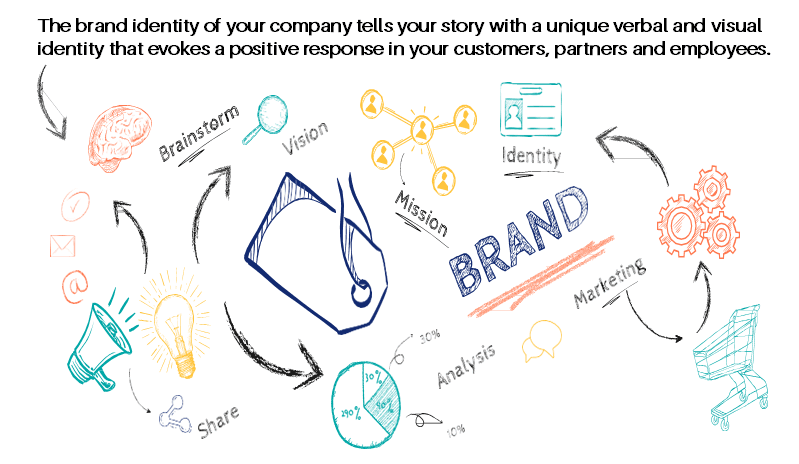
Here’s a short list of what you can expect from a branding exercise.
Unravel your identity
A branding team can help you cut through the cobwebs and focus on what your brand stands for. It can help you crystallise your values, mission and vision.
Spotlight your Target Audience
You'll gain a deeper understanding of your ideal customers, their needs, preferences, and behaviours.
Define your USPs
You might think that your business has a million positive points. A branding expert will help you identify unique selling propositions by focusing on your target audience and their wants and needs.
Be easy to spot and remember
Your marketing is a success only if you remain in your customer’s memory. They need to pick your product or solution from the long lineup of similar products and services. A consistent message as well as a visual identity is the most effective way to keep yourself front and centre.
Find your voice
Develop key brand messages and a brand voice that communicates your brand’s voice and values. Like Tata Group’s ‘Leadership with Trust’ or Dairy Milk’s ‘Kuch Meetha Ho Jaye’, brand slogans or messages should speak to your audience.
I left Pondicherry, with the promise to visit again and run a branding workshop.
***
Editor’s Note: Branding is an ancient art! The word ‘brand’ connotes ‘marking’ or ‘burning’ one’s insignia onto goods. It’s an age-old practice, perhaps from when Egyptians branded their cattle before setting off to market. Merchants used seals to brand their products in markets the world over.

"Wild Times..." is a story from Clearly Blue's Goobe Guide to Branding, where Maya, Serendipity and Lilian are an intrepid trio of marketers, who go round the country, helping clients set their branding and marketing efforts right.
Public Speaking Imposter
It was early 2018. My good friend Rashmi Balakrishna, who was helping me with business development, ushered me into the office of Enquero, a mid-size software company in Koramangala. It was Women’s Day and Rashmi had used her good offices at the company to arrange a talk with the women at Enquero.
What on earth could I talk about?, I wondered nervously as we made our way into the swank office. Here I was, having founded a content/design agency in sheer frustration because I couldn’t find a job that gave me professional satisfaction as well as flexibility. I dropped out of the formal workforce in mid-2005 to focus on my young children. Then spent a decade in the professional ‘wilderness’, freelancing for a content company in Bangalore and picking up consulting gigs with tech startups in Hyderabad. Who would find me interesting?
My anxiety peaked when I entered the conference room. There they were—the women of Enquero. Suave, talented engineers, finance professionals and HR folks. Well dressed in western attire, as Bangalore professionals tend to be. Very much in contrast to my oiled hair and salwar kameez. Yes, I’d lived and worked abroad for a decade before being a freelancer. But that only dated my salwar kameez all the more.
The Head of HR introduced Rashmi and me to the eager audience. Rashmi primed them by talking about my professional background. A techie-turned-entrepreneur, she said. I gulped nervously.
When it was my turn to speak, my voice quivered. The HR Head looked on, half in alarm. Her Women’s Day celebration was off to a shaky start! I started by speaking of my corporate experiences in the West and then jumped into my career break. As I spoke about my boys, my voice gathered confidence. After all, no one could talk about my decade with them like I could—every glorious moment of it. I also spoke of my growing frustration interviewing with Indian software companies of all hues who paid lip service to flexibility. And my decision to start Clearly Blue.
Well, here we are. I arrived at the present in my story. A small agency working with tech companies, thriving on offering flexibility to restarters, completely hybrid and doing some kick-ass work. Surprisingly, my audience loved it. In the Q&A that ensued, they peppered me with questions on balancing work and home, on managing toddler tantrums and remote clients. It turns out that they all had similar stories. Some of them even nurtured entrepreneurial ambitions. It was commendable that they spoke openly about their ambition with their HR Head present. We spent a lovely couple of hours together. The HR Head heaved an audible sigh of relief at the happy turn of events. They thanked me with a jade plant in a yellow ceramic pot.
My takeaways from this encounter?
Imposter syndrome is real. I continue to get flustered when I receive compliments about my ‘achievements’. If I saw this kind of behaviour in any of my team members or friends, I would openly berate them. Go figure!
Fear of public speaking can cripple. I know it well. I’ve been there more than once. Many a time when I have to speak, I flashback to a high school stage where I picked a dumb charades chit to enact meeting a ‘hot guy in a lift’. I blathered nonsense in front of a
What makes us human?
“It was huge and dark, like a moving boulder. The mouth as large as a cave, it’s roar like thunder!”

Telling stories by the bonfire. AI Art by Dall-E
What qualities make us human, and separate us from ‘lower’ intelligences such as animals, and machine intelligences with immense computing power. Is it our ability to think and feel and communicate, in an astonishing variety of ways? Is it our empathy for fellow living beings? Is it an inherent code of base ethics that glues societies and prevents anarchy?
A leading candidate is creativity. In the words of poet-philosopher Shathavadhani Ganesh, creativity itself cannot be measured or even discussed in isolation. We can only view it in its manifestations, one of them being language. Despite LLMs making inroads in it, language, as we use it in all its shades, is still very much a human endeavour. Within language, creativity manifests as stories.
Why stories? From the days of the Neanderthal man, when groups clustered together around bonfires to ward off the chill and listened, wide-eyed, to tales of great monsters and far-off lands, storytellers with vivid imaginations have fired the synapses of listeners’ brains, building vivid images in their minds.
The comparisons that storytellers draw between seemingly unrelated entities amaze us. We have a unique ability to draw comparisons, in the similes and metaphors that govern our spoken language, our literature and our songs. This ability takes its birth in poetry and is then visualised in art, architecture, music, literature and other uniquely human endeavours. The height of this is seen in poetry, an art form governed by metaphor.
“Love is a smoke made of a fume of sighs!”
- (Romeo) William Shakespeare
From the days of Shakespearean similes to modern-day poets writing in a dizzying array of styles, poems are a powerful testament to the humanness in us. Here’s a metaphoric line from a favourite modern poet -
ನಾ ನಿನ್ನ ಕನಸಿಗೆ ಚಂದದಾರನು
ಚಂದ ಬಾಕಿ ನೀಡಲು ಬಂದೆ ಬರುವೆನು
“I am a subscriber to your dreams
I’ll definitely visit them to pay my dues.”
- Jayant Kaikini in ‘Gaalipata’ (Kannada)
The words paint scenes in our brain, with images that no ‘real’ visual or VFX can do justice to. Have you ever been disappointed when your favourite book was made into a movie? The visualisation in the movie, even in the hands of an Oscar-winning director, can never match the what your mind conjures up.
Consider the images this couplet from Sanskrit evokes in your mind’s eye -
करारविन्देन पदारविन्दं मुखारविन्दे विनिवेशयन्तम्।
वटस्य पत्रस्य पुटे शयानं बालं मुकुन्दं मनसा स्मरामि।।
Grabbing his lotus-like foot with his lotus-like hand,
Mukunda places it in his lotus-like face [sucks his toe]
As he floats on a banyan leaf
I [reverently] think of this baby.
The same simile multiple times! Depending on your background, your reaction to a solo infant on his back on a leaf floating in the water, sucking his toe, could draw out so many ‘What if’ stories.
Cutting across cultures and languages, these figures of speech defined human thought and spurred human imagination, even ambition.
Back in the mists of time, in the dense forests of Dandaka in the Indian subcontinent, poet-bards (called Sutas) narrated tales of gods and gandharvas to avid listeners after fire sacrifices were completed. Our earliest compendiums, the Puranas, and the Mahabharata are all in such a narrative form. The stories are full of similes and metaphors, and other sophisticated turns of speech.
Sanskrit literature was enriched by poet laureates whose distinct styles led a wag of that era to posit that:
उपमा कालिदासस्य भारवेरर्थगौरवम् ।
दण्डिनः पदलालित्यं माघे सन्ति त्रयो गुणाः ॥
upamā kālidāsasya bhāraverarthagauravam |
daṇḍinaḥ padalālityaṃ māghe santi trayo guṇāḥ ||
Kalidasa’s Similes, Bharavi’s deep meanings
Dandin’s beautiful words and Magha (with/has) all the three qualities!
What makes Kalidasa the ‘King of Similes’? Sample how he starts his remarkable Raghuvamsham -
वागर्थाविव सम्पृक्तौ वागर्थ प्रतिपत्तये ।
जगतः पितरौ वन्दे पार्वतीपरमेश्वरौ ॥
vaagarthaaviva sampRuktau vaagartha pratipattaye |
jagataH pitarau vande paarvatIparameshvarau ||
“I bow to the parents of the universe, who are as inseparable as a word and its meaning…”
Can a word exist without meaning? At least not in the human brain. What an apt analogy for the divine couple!
Metaphorical thought spills over beyond language into art. The use of visual metaphors has led to entire schools of art - consider a favourite example, Salvador Dali’s ‘The Persistence of Memory’ - a striking, strange work of art for any bystander, art critics call it a Surrealist take “..on the collapse of our notions of a fixed cosmic order”. The artist himself said he drew inspiration from Camembert cheese melting in the sun. It’s exciting to interpret this in a variety of ways - perhaps even in ways the artist never intended!

Pic: By the author
Metaphors abound in architecture. This art form affords architects vast, real-world canvases to etch out their stories, drawing upon their life experiences and their extraordinary talent into brick and mortar. Consider the Lotus Temple in Delhi, designed by Iranian-American architect Fariborz Sahba. The structure adheres to Baháʼí conventions that stipulate their house of worship must be nine-sided and circular. It derives inspiration from the humble lotus, a sacred symbol in India. The marriage of these cultures in this building results in a beautiful and memorable visual metaphor, and a landmark in India that invites people of all faiths to sit up and pause.

Pic courtesy: Wikimedia Commons
Reducing “humanness” to figures of speech is perhaps an exercise in absurdity, but like the blind men feeling the elephant, it is an attempt to understand what makes us ‘not machines’.
What else makes us human, do you think?
If you’re curious:
“Minchaagi neenu baralu” - a typical movie song elevated to great lyrical heights by metaphor master Jayant Kaikini.
Peak Living -- In Conversation with Shathavadhani Dr. R.Ganesh | Philosopher | Poet | Polygot
The 5 Most Important Social Media Trends for 2023
Trends relevant from a business marketing point of view
In a world of 4.89 billion social media users, trends keep rising to the top and fading away. Some however, get retained in user psyches.
Let us take a look at the trends that hold promise for the social media landscape for 2023.
Trend 1
Small-medium sized businesses have higher opportunities to partner with top content creators
As recession looms large over world economies, larger brands may tighten creator budgets to cope. This may be an opportunity for smaller businesses to grab the time of top content creators. A few months ago, BuzzFeed News stated that content creators are facing a decline in sponsorship offers from brands. This means that smaller businesses now have wider access to creators at lower rates.
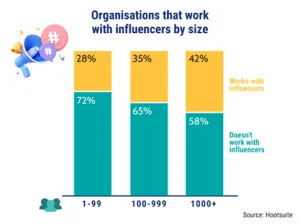
Trend 2
Cross-posting is becoming the new normal
It’s not a sin to post the same content across different platforms.
A Hootsuite survey showed that 52% of respondents cross-post content to multiple social platforms with as few changes as possible.
Social media marketing is all about being confident in everything you do. So don’t worry about the value of cross-posted content. Focus on exploring more platforms that align with your business goals. Apart from the ‘big five’ (LinkedIn, Facebook, YouTube, Twitter, and Instagram), businesses can benefit by having a good presence on Pinterest, Quora, Telegram and Snapchat as well.
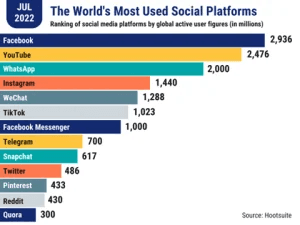
Trend 3
There is a growing demand for social customer service
Consumers have increasingly turned to social media for shopping as well. But there’s a high level of customer dissatisfaction. Poor customer service was faced by most of the respondents of a survey by SproutSocial.
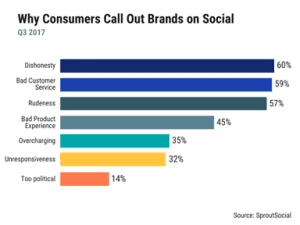
Hence, boosting the efficiency of customer services on social media should be a top priority. Adopting chatbots on social and messenger apps is an excellent way to maintain customer reputation.
Trend 4
Social media is the new search engine
According to a Google study, forty percent of 18- to 24-year-olds use social media as their primary search engine.
This makes Social Media Optimization (SMO) and Social Search Optimization (SSO) make-or-break marketing skills for brands. And of course, we all know that our social networks are also used for brand research.
Trend 5
AI post recommendations are getting better in quality and quantity
2022 was a big year for AI, and the coming year will be even bigger.
One of Meta’s top goals for 2023 is to display more relevant AI-suggested content on users’ newsfeeds.
In July 2022, Meta’s CEO Mark Zuckerberg said, “Right now, about 15% of content in a person’s Facebook feed and a little more than that of their Instagram feed is recommended by our AI from people, groups, or accounts that you don’t follow. We expect these numbers to more than double by the end of next year,”
A trend you didn’t see coming: The ultimate hashtag strategy.
Hashtags are no longer relevant
The keywords in your description matter more than the common hashtags. The algorithm is smart enough to identify the content of your post and push it to the right audience. So work on constantly improving the quality of your content for greater reach.
These were some of the dominating trends of this year’s social media. Take good advantage of them to stay ahead in the game! Remember – the social media landscape is dynamic and competitive. Make sure to keep an eye on all that’s happening. It doesn’t mean that you always need to do something new. Work smart, and get more strategic.
We hope that you win a lot of

this year!
Sources:
https://www.statista.com/statistics/278414/number-of-worldwide-social-network-users/
https://www.hootsuite.com/research/social-trends/marketing#64BA0hEcwZlA4jVhJmwMm0
https://www.hootsuite.com/research/social-trends/customer-service#rp2WXPCELFpQIe4VbgIHw
https://www.hootsuite.com/research/social-trends/commerce#2IA6F2eWa6Z9iGxBF64FCt
https://blog.hootsuite.com/social-media-updates/facebook/ai-recommended-content/
Top 5 Graphic Design Trends of 2023
We live in a world where everything is constantly changing. In the branding and designing world, these changes seem to take place at a relatively faster pace than everywhere else. It is a given that designers constantly worry about their designs being well-received by their audience. The only way to beat that is by staying informed of all that is happening in the industry. We’ve been keeping an eye out. Leading brands are applying some interesting graphic design trends to stay ahead of the competition.
We have curated a few graphic design trends that are definitely going to shape 2023. Designers, without any fear, are now taking a more innovative approach to design. Do try these trends and create your own popular designs!
1. Oh, so Gradient
If you had asked a designer about the popularity of gradient, a few years back, they would have given you a cold shrug. But no more! Gradient colours and abstracts have been popular for a few years now but they’re taking a whole new shape in 2023. Designers are experimenting with radiant gradients to churn out their amazing designs and why not? After all, gradients are visually pleasing and an easy, effective way to add magic to any design.

By kuro via Dribbble
2. AI-generated Design (Of course!)
If it comes as a surprise to you, then, my friend, you have been living under a rock. AI tools have been shaping the world over the last decade and are now making their way to the design world. Text-to-image AI generators are making waves in the design world. By entering a prompt text, AI can give out interesting pictures, better than what you could’ve thought of. Fascinating, right? OK, worrying too! “Will designers be nudged out?’. We will let that worry us a little later.
For now, let us work with the popular belief that humans with their brilliant minds in combination with AI can take the world to a new level.
Below is an AI-generated image to which the text entered was simply ‘a dog scientist’ and boom the word was done.

3. Innovative Typography
All that jazz you imagined in typography to make your design look more impressive is now possible in action. You no longer have to stick with the same old boring standardised fonts. In fact, designers all around the world are experimenting with varied depths, widths, and dimensions. Not just that, they’re also building fonts from scratch with a handwritten effect to add a different flair to the design. After all, the human touch has always been a win. So go ahead, make yours ‘one of a kind.’

4. Cartoon Stickers, whaat!?
Yes, that’s right, we said stickers. We all at some point have used physical stickers. Now, it is time to use them in your designs. From a replica of a physical sticker to an abstract cartoon-style sticker with motion, volume and fanciness, they are all in trend.
A design with some fun elements and stickers is way more attractive than a flat design, right? So, sticker away!

5. Modernised Retro
If you think the retro era is finished, you are mistaken. It is not quite done yet. We are seeing a lot of retro designs with a touch of modernisation lately. Pick minimalist line art and add a cartoonish touch to it with bold colours. Pair your design with bubble font and oval borders to give it a retro look.

Now all these trends make you want to try them out right? These trends are here just to push your imagination to new heights. Remember, you’re the boss of your design. Happy designing!
References:
https://www.dotyeti.com/blog/the-10-most-famous-graphic-design-trends-in-2023/
https://www.envato.com/blog/graphic-design-trends/
https://docs.google.com/document/d/1VoEYZRBQqZwcLKitsVBFShFXKRGwxlaF5hu39nGhgvg/edit
To pitch or not to pitch…
…is never the question! Rather, the dictum seems to be, “If you are an entrepreneur, you must pitch”! Startup founders who don’t go out and seek funds are a rarity nowadays, much to the delight of content folks like us: after all, they fuel our bread and butter as we toil on investor decks, explainer videos, value prop statements and website content for them.
Investor decks or pitch decks are often the first step towards ‘gelling’ as a team, yet, one of the most contentious things among startup founders. I think it’s because many times, a deck is the first time that co-founders may sit around a table and start putting pen to paper as to what their understanding of the value proposition of their product or service is. I’ve been in meetings where co-founders have argued about their value proposition till the cows came home – rather, till our office manager booted us out. They came back the next day and argued some more, but we did manage to get a winning deck out!
These decks are used to pitch first to investors, and then in some modified form, to mentors, early adopter customers, prospective employees and other stakeholders up and down the chain. They’re a crucial piece of collateral to get the product journey off the ground.
The three Cs that matter
What is it about these decks? For one, a pitch deck is a crystallization of the value proposition, as I said, and the plans for the first few years – where your total addressable market (TAM) and serviceable/available market (SAM) and serviceable obtainable (SOM) are, where you hope to make money, how you plan to do it and so on. Although it requires a lot of work – market research, competitive analysis, pricing strategy creation, revenue number crunching – to get to these numbers, the end result is almost always crisp – beware of pitch decks that go on and on into tens of slides. Finally, it makes sense that the deck must score high on clarity of messaging – when you have a few minutes with your target audience, you better ensure your story is on point and easy to understand.
The ideal size? Around 10, according to the legendary Guy Kawasaki, whose pitch deck structure I love and use as a foundation while starting new pitch decks. I also love this recreation of the original Airbnb pitch that the Pitch Deck Coach has helpfully put on Slideshare.
How does one build a pitch deck? Let me narrate our process here at CB. We have a discovery call (or two) with our client and pull in all the necessary information from them. The information roughly falls into three categories:
The offering (product or service) – this could include the product story (the why?), the value proposition (the uniqueness versus everyone else in the market), and the features and benefits.
The financials – this could be the TAM and SAM, any market and competitor data regarding pricing, pricing packages, business and revenue models, and related details. It could also include an operations plan for the coming year or two. In essence, the road to using the funds well and making profits
The team – the founders and their stories (why do they feel passionate about building this product?), their credentials – academic, business success, past startups. This information is part of what I call the ‘trust building’ – showcasing to investors that their money is in safe hands with a sound team that knows what they’re doing. This is also an opportunity to do a little bit of name-dropping and relationship-building with your investors!
We then take this information and build our storyline – we have a couple of in-house variants on the different templates.
The work on the deck begins once the client signs off on this core storyline. We bring in copywriters and/or senior folks to finesse the headlines and make the on-slide copy crisper. We often give a storytelling touch to the narrative. The visual designers step in to build the beautiful infographics and slide layouts that make the deck memorable. [Side note: We always recommend keeping the visuals clean and uncluttered. Less is more, is our mantra. But some clients like more of everything!]
What’s on screen?
Some clients ask us to build a script for them that they memorize before delivery. Whether the script is a set of bullets or a detailed narration is an individual choice. Frankly, I would sweat bullets if I had to memorize a detailed narration, but I’ve seen some folks ace it! I’ve also worked with some master presenters who just take their cues from what is on screen to talk extempore. Such presenters don’t need much on-screen to weave their magic – a few images and keywords will do. Others prefer more detail on-screen – if there are multiple narrators using the same deck, this is often the case. Your mileage may vary.
Another note on what goes on the screen – please stay away from fancy animations, exit and entrance effects and things that crawl on the screen. These almost always go awry at key moments and they are terribly distracting anyway. Also avoid fancy and custom fonts. If you’re using someone else’s computer to present (as is often the case with pitch events), take a PDF version along with you – a PPT may not render well if that computer does not have the fonts you’ve used.
Scaling while pitching?
One of the key asks from startup teams is to build ‘scalable’ decks. I recommend this approach from experience: I’ve supported a startup founder in the minutes leading up to a major pitch when they told him he had 3 minutes and needed to pitch with just one slide! So, work with your content/design team on three formats for your deck:
A single slide ‘infographic’ approach for a 3-minute ‘speeding dating’ pitch
A three slider – product, revenue/business model, team – all in infographics for a 10-minute pitch
A more elaborate 10-12 slide deck for all other cases. This one should encompass the previous two sets, if possible.
So there you have it! A primer on building pitch decks for all seasons and all reasons. If your end result is quite simple and startling, it’s a great job done, in my opinion. Go out there and get that funding with the deck! We wish you more wind under your wings as you go out and conquer the marketplace.
Carpe Diem! If you’d like CB to build your pitch deck, let’s talk.
Sustaining reading, writing and books – easier read than done?
One of the common threads amongst the various avatars I don is that of interviewer. As I speak to various candidates to gauge their ‘fit’ for the position to be filled, I usually ask them ‘What books do you read?’
The last interviewee I spoke to very hesitatingly blurted out that she loved the Harry Potter series. I was delighted…here was a reader, a fellow imagineer! She is definitely one among a vanishing tribe, as we move en masse to more ‘visual’ forms of entertainment/imbibing knowledge. There’s something about a fellow reader that sparks an interest – for me, it usually means they love stories, recognise good writing and have a yen for language. These are super skills – essential for many content creation roles, and allied roles in marketing or communications. Many voracious readers are also above-average communicators, an essential trait of managers and leaders. The converse is definitely true – all leaders I’ve met and interacted with read voraciously.
That brings me to the topic of this blog – just what is happening to readership in general? My kids’ generation is certainly not reading as much as we did, although they consume huge amounts of content via various digital formats. Heck, many of us don’t find the time to finish a book most of the time – leading to ‘tsundoku’ piles of unread books. Books are cheaper and more available, and the big libraries are still around although they’re rapidly transforming into hybrid centers of content. The small ‘circulating libraries’ that my generation frequented and borrowed books at 2 rs per day have vanished – as have alarm clocks, ‘video libraries’, analog wrist watches and a host of other late 20th century gadgetry – but that’s a topic for another blog.
To go beyond subjective nostalgia, I decided to do a little secondary research into this. I discovered that book readership is indeed falling across countries – global book sales have slumped post-pandemic after a strong surge during the pandemic. Total book reading has fallen significantly in countries such as the US where the National Endowment for the Arts is tracking such data.
Much of this data seems to be about physical books though – 83% of Gen Z (the generation born between 1998 and 2015) go online to get their fix of webnovels, e-books, and webcomics of diverse hues. This is in contrast to 51% of the older generation using their phones to read. It’s evident that the era of reading purely paper books is firmly in the rear mirror – has been for a decade or two now.
Yet, various forms of books – fiction, faction and everything in between are being written furiously. Book fairs, festivals and events are doing rip roaring business. Books are often the cherry on the marketing pie for many thought leaders and celebrities. An industry of ghostwriters can put together books from talks, blogs or even keywords – this is the way it has been done for millenia anyway! However, the key difference today is that we’re drowning in an ocean of books – they are literally falling from the overloaded shelves.
What is sustaining this boom? I don’t have many answers, but a subjective hypothesis that many silent readers lurk – our tribe may be thinner on the ground, but they’re still around, and they’re lapping up the books. Albeit, many tsundokus may be getting built, but that’s ok, in my opinion, because they sustain writers and the book industry.
What about writing? Writing is certainly an essential skill for success in college and higher education – and as Stephen King famously said, “If you want to be a writer, you must do two things above all others: Read a lot and write a lot.” What does this even mean in the age of AI though, when ChatGPT and other avatars can complete stories, correct your mistakes, and even write original fiction? Is the era of ‘pure writing’ over, similar to that of pure reading?
While I’ve railed against the onslaught of AI in other blogs, I’ve come to recognize that AI is embedding itself into the pantheon of tools we use as content creators. So writing will continue, aided by AI story generators, ideators and correctors. Perhaps, movies and immersive content, and even books shall be created from AI-generated stories.
Readers are after all, a certain type of content consumers. The coming generations of content consumers will not mind, or even care where the stories will originate. They may consume the stories in immersive AR/VR environments, or even via chips embedded in their brains. They may experience stories in ways we never imagined. Imagine walking along the dark corridor besides Mrs. Danvers as she shows you Rebecca’s bedroom. Or flying on the Pushpaka Vimana with Ravana as he kidnaps Seetha. What if you experienced the Mars landing with Dr. Watney? This is a rollercoaster most of us never imagined getting on!
That, though, is the crux of this whole thing. Stories written by humans and read by other humans create a bond of imagination. What Stephen King or Daphne DuMaurier or Maharishi Valmiki imagined grips me today, grips me now. We – the reader and the writer – form an inviolable bridge where his words provoke my imagination. What does this mean when the story originates from a machine, and the machine ‘paints’ the scene for me – in glorious technicolor? Where does that leave MY imagination? Do I even want to form such a bond with a machine?
I end where I started – with more questions. There is an ancient wish/curse attributed to the Chinese that says ‘May you live in interesting times’. We certainly do, don’t we?!
The Great White Lie in Marketing
Or, why there ain’t no free lunch for most of the world
Dear Modern Day Marketer,
In your experience, what – among the many scams, outrageous claims, snake oils, and ponzi schemes that float around the flotsam and jetsam of the internet – is the biggest one out there? In my opinion, it’s the term ‘growth hacking’. There, I said it.
While ‘growth’ is something all product professionals, marketers, and CxOs want for their businesses, the word ‘hack’ suggests a shortcut – a clever, clean, straight cut to bypass the snarls of ‘traditional’ marketing and get there quickly – whether with users, revenues, SKUs sold or other growth metrics. Typically, ‘growth hacking’ refers to acquiring users in a very short time for little or no spend for SaaS platforms.
So why is it a ‘great white lie’? Let me make my case by parsing some famous growth hacking stories. Take Dropbox. Their ‘simple growth hack’ was to give free storage for referrals – effectively building a referral network from their user base. Parse – storage that someone paid for. Initial users that were acquired by some means. Even word of mouth takes diligence and effort! Granted, traditional advertising was not done, but then, Dropbox is not a traditional company.
The venerable Hotmail came up with a similar referral scheme that went out as auto inserts in signatures of users. “PS I love you. Get your free Email at Hotmail”, it said. AirBnb’s startup team traveled to host apartments to take stunning pictures of the homes they initially featured. Paypal ingeniously gave money away for referrals – cheaper than billboards or print ads!

The common thread here is that someone ponied up an initial kitty to kickstart the virality. The products were disruptive, the growth ideas were original and ingenious, some of them genius even. Many others helped execute on the ideas – great writers, imaginative video creators, ingenious systems integrators and crafty marketers. Intentional campaigns were planned, calibrated, and deployed in a data-driven manner. They caught the imagination of the users. Ergo, virality. Speedy user acquisition – millions in months, if not weeks.
But. Not. Free.
Let that sink in. So anyone thinking they can just build a product and get users easy-peasy for free – no time, no effort, no money – needs to wake up and smell the roses. Said roses will decay and stink as investors and VCs demand their pound of flesh when users are not acquired, and fast.
If you just build it, they will not come. They never have, and never will.
So, what works? Can you go to market without a budget?
Let’s see what the experts say. I pulled up a Hubspot article about ‘Marketing without a budget’. Here’s what the listicle offers, with my editorial comments in square brackets –
Develop a content marketing strategy [Undervalued. Costs money. Needs expertise. Yes, even with ChatGPT and Dall-E and other AI content generators.]
Seek out co-marketing opportunities. [Connections. Time. Effort.]
Invest in your social media presence. [The ‘I’ word!]
Increase community engagement. [Content. Moderators. Time. Effort.]
Offer free trials or free resources. [Who is building these, I wonder?]
Arrange giveaways. [Who’s paying for these?]
Encourage user-generated content. [Hmm, yes. If your MVP is compelling.]
Host a webinar. [Platform? Topic? Speaker? Minimal investment to build the brand, but will it sell subscriptions?]
Invest in SEO.[Hey! The ‘I’ word again!]
List your company on business directories. [Yes, good one.]
A 10-minute Google search will yield more, similar results with similar venerable names. If you look beyond the surface, you’ll realise many of these articles are clickbait content for the ‘names’ themselves. But that apart, much of what they’re suggesting is actually getting down to the brass tacks of modern-day content marketing.
Content – written, video. Short-form video is super hot these days. The algorithms love them.
Social media
Website (owned properties)
UGC
SEO
Consistent communication
User engagement
Customer success programs
Testimonials.
This is hard work. This is a (hopefully, well paid) team that puts out thoughtful content and consistent marketing. Teams need to do this day in and day out. For weeks. Months. Years even, before they taste success.
Don’t get me wrong. Marketing without budgets can happen with small, committed teams executing to a specific plan for MVP validation or initial user acquisition. It helps you go viral or fail fast. Think out of the box, understand your user base, and plan. Execute. Track.
Even after that, many platforms do go viral fast. Some of them do disrupt the marketplace, upend current business models, deliver sticky experiences, and grow speedily. Many fizzle out and fail. What distinguishes the winners from the rest is the consistency of getting the word out. Listening to the users. Tweaking the features and the messaging. Delivering superior user experiences. Capturing testimonials and publishing. A virtuous cycle that you rinse and repeat.
Exhausting. Enervating. Fulfilling? Absolutely, yes. Some sly sort of ‘hack’? NO!
Can we just call it ‘growth marketing’? And, the next time someone (your client, boss, or CEO) asks you to ‘growth hack’, please, tell them there’s no such thing, and ask for a budget, resources, and time.
Let’s grow!
Can numbers tell stories?
I hated numbers when I was young. That is until I figured out that they tell interesting stories. It was during my years in the insurance sector that I realised that I had a secret weapon. I could see patterns in the data. Data analytics and predictive sciences fascinated me. But there was a problem. While I could keep my audience engaged with the data at hand, I needed to be present to take them through it and get them fascinated with the little nuggets of information I had unearthed.
Of course, you could use colour codes and notes in sophisticated ppts to keep the audience engaged but it often lacks the impact of an in-person presentation. That’s because you can weave in the context or story while presenting data in person. Data without context is just a set of numbers and does not leave an impact. In other words, you need to be able to relate to the numbers presented to be able to influence decisions.
That’s why in-person presentations of data were so effective for me. But the in-person method is only effective if you are able to meet the decision-makers and state your case aka story. If you had to rely on third parties to convey your thoughts to the decision-maker, it’s very likely that your story would be distorted or diluted by the time it reached its destination. I wonder how many more arguments I would have won with insurers and clients if I had been able to show them the patterns I was seeing.
Stories to the rescue!
Perhaps that is why I found Richie Lionell V and Ramya Mylavarapu’s book, “From Data to Stories” so interesting. This data comic story is a pleasure to read. The duo keeps the reader engaged with each game’s detailed cricket scorecard and analytics while running a very interesting family story (or is it a love story?) in the background. Wait a minute. Is the cricket data and analysis the main course of the book, or is it Ringo and Priya’s love story? The jury is out on that one, as far as I am concerned.
What hooked me was the ease with which they weaved in interesting snippets of data stories into the main plot. It made the cricketing data interesting to even a non-cricket lover like me (Yes, I know, that’s literally blasphemy in this country). I realised that the style used was very similar to how our team at Clearly Blue weaves in stories to make deep technical courses like Kubernetes, AI and ML more interesting to learners. We normally develop a storyline with characters and take them on a journey of discovery. They start with a problem that they have to solve and find a solution by the end of the course.
Richie and Ramya talk about similar approaches in the book. I liked their reference to Kurt Vonnegut’s “the shapes of stories”. Adopting one of the story structures detailed in the book, would be an easy way for a beginner to get started.
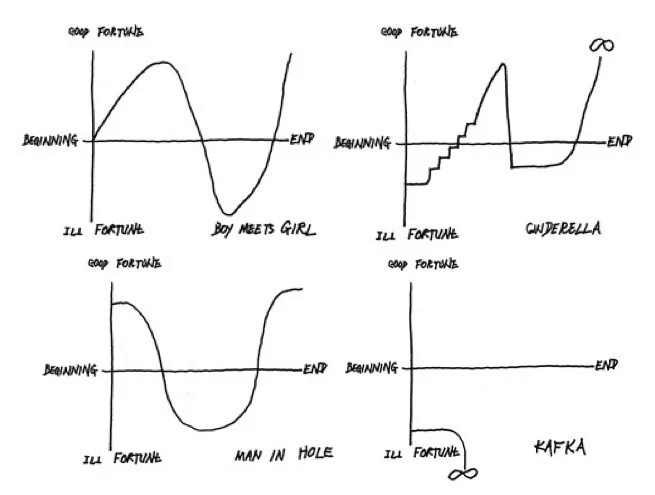
It’s a comic book!
Clearly Blue has been experimenting with the comic strip style of writing as an effective medium of instruction. In fact, we ran such an experiment recently with one of our products, SmartStart, and were astounded by the high engagement rates ( 60%).
Perhaps that’s why Richie and Ramya’s comic book style of telling data stories resonates so well with me. Their style of writing was easy to grasp and not overpowering. I’ve noticed that when the subject is already heavy, like data analytics or deep tech, you want to make it more appealing with a sprinkling of humour and simplicity.
At Clearly Blue we’ve mastered the art of using stories to keep our audience engaged. Be it deep tech or soft skills , we’ve realised that comic strips can help you reach your audience and keep them listening or reading. I can’t wait to try this style on data now. My hands are just itching to make a comic book out of some claims analysis or loss ratio trends. What about a comic book on stock market trends?
I just love it when a book opens up the mind to a million possibilities.
Want to know what Suresh was brooding about?
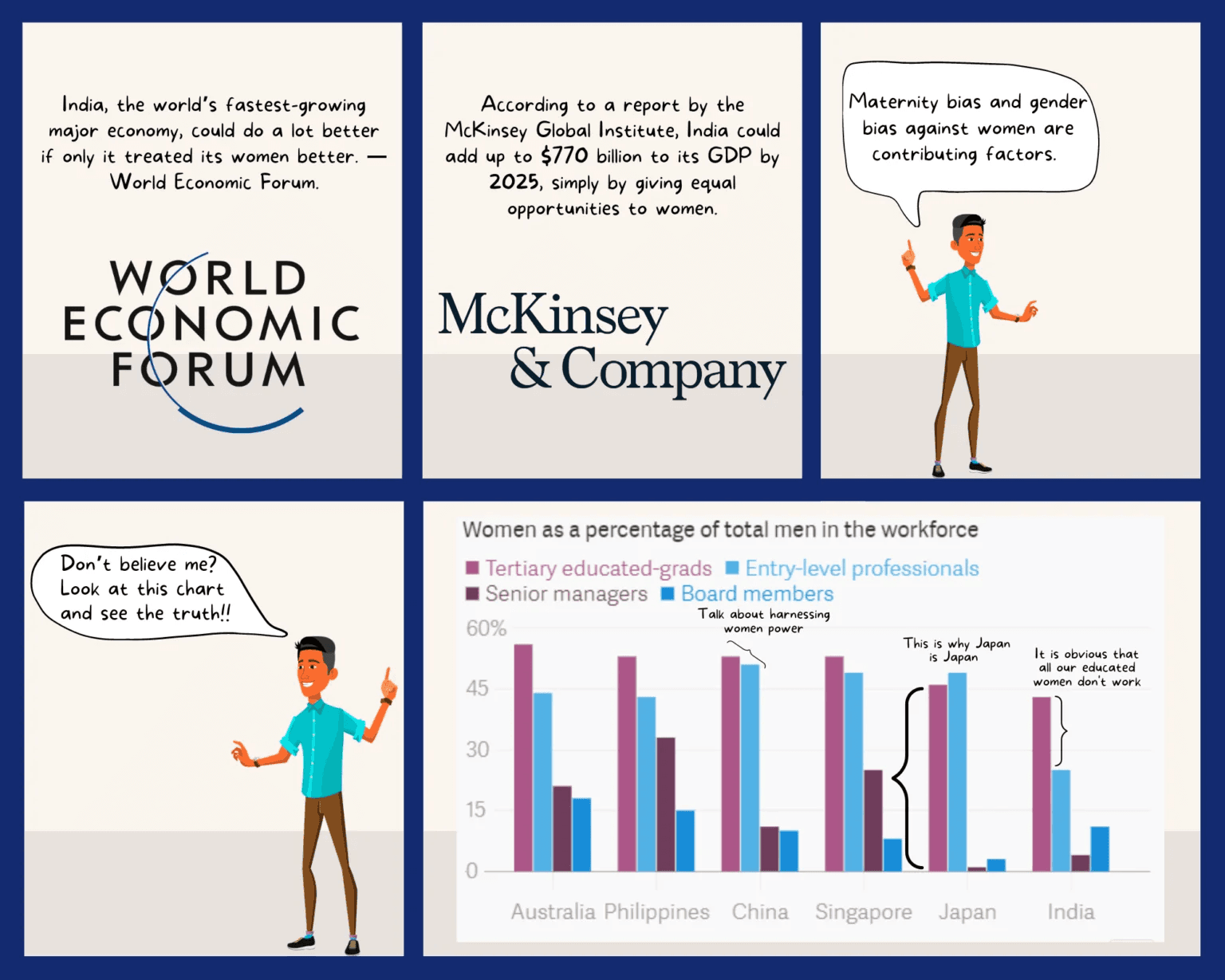
Branding Workshops: When the storyteller gets enthralled with your story
As branding consultants, we often conduct branding workshops for our clients. These are either during the course of a single day spent with the client’s team at their offices or during offline meetings spread across a couple of days. Have you noticed that none of us can spend four to five hours in an online meeting but we can spend the same time interacting offline? Hmm, food for thought and for a blog, the writer in me thinks. Well, what I wanted to share was that I really enjoy these excursions, whether they are offline or online.
These interactions are often like meeting new acquaintances for the first time. In fact, it’s like being invited by a new acquaintance for a walkthrough of their home. No, I am not a voyeur. I have just been blessed with insatiable curiosity.
What makes the other person tick? That’s what drives my curiosity.
We often get to meet the founding team as part of the branding exercise. These are people who found the courage to follow their dreams and start their own company! There are often interesting stories behind each of these serious enterprises. As storytellers, we are fascinated by these stories.
As branding experts, we also have the license to prod and dig deep into the psyche of the company.
We get to know clients while they answer profound questions like:
How did you arrive at this place? What led you to follow your passion for this business?
What needs of your customers do you fulfill?
How do you fit into your customer’s lives?
It’s also interesting to see what the team perceives and absorbs from these interactions. The designers in the team start to visualise the colours and the emotions. The writers start grabbing on to small little nuggets that the client says. These will later turn into catchphrases and keywords. That’s why it’s crucial to encourage the client’s team to tell their stories, even when they feel that their stories are run of the mill and boring. But, that’s what we are there for. As the client opens up and shares the what, how and why of the company, the team starts building a picture or story. We polish product stories and coax out the human elements in service offerings. We are always aware that each one of these stories are an interesting part of the tapestry of life.
As each story unravels, we introduce our clients to themselves through the mirror of brand archetypes. We reacquaint them with their customers, in an effort to see if their brand archetype “speaks” to their customer. More often than not, it’s one of those rare occasions when the storyteller in me takes a backseat and I become a fascinated spectator.
As the story unravels, the team starts rebuilding the story as a brand book. Very often, developing the brand book gives us a sense of accomplishment, making us a part of an interesting journey.
I guess that’s why we enjoy these excursions into your stories, dear client!
Want to know what happened to Kalyani Cheese?

Praseeda was determined to turn around the conversation about the name of the cheese brand.
Praseeda: Of course, Sir, but think of brands like paper boat. They might have flavours like Aamras, but their brand has a more universally appealing name, right?
To say that the meeting was interesting would be an understatement! We left after Mr. Namboodiri agreed to consider our suggestions for a different name.
Each small win works. For the client and for us!
Influencer Marketing for Turmeric
Does turmeric need any marketing? Especially in India?
Well, at a recent event that I attended, turmeric was a hot topic. Everyone I met had a turmeric story to tell. Madame Turmeric was the hero, wait…the heroine! From the stories that were floating around the table, Madame Turmeric had saved most of the guests from myriad childhood ailments.
Rub turmeric on your shoulder to chase away that nagging ache.
Add turmeric to milk and chase your throat infection away!
The stories were many and varied. Not to be left behind, I added my own turmeric story to the mix. I regaled new friends and old with the story of how my father fleeced me off my scholarship money (a handsome sum of Rs 2500) to plant a small hillock full of turmeric. He promised me untold riches when he harvested the turmeric. But, my luck was such that the price of turmeric fell so much that it didn’t even cover the cost of harvesting it!
Well, to cut a long story short, I never expected that turmeric would be the main topic of discussion at a formal party in Bangalore. But that’s exactly what happened. On reflection, I realised that it was all thanks to a bit of influencer marketing (of the in-person kind) by one of my long-time friends.
Every time he makes the trip from Australia, he has a new diet or a new therapy that he’s tried out and wants to share with the rest of us. A few years ago it was intermittent fasting and this time it was all about this new magic drug he’d discovered – turmeric. I realised that his interest and advocacy of turmeric made everyone in his sphere of influence want to engage in a bit of their own marketing. This created a ripple effect with a wholly unintentional buzz about our very own yellow spice. This is influencer marketing at its most rudimentary.
With the barrage of content that hits us on a daily basis, it’s not surprising that we tend to trust micro-influencers who we connect with, rather than celebrities. This trend is reflected in the growth of the influencer marketing industry which is projected to expand to USD 16.4 Billion in 2022. Not surprising when you consider that most teenagers trust influencers more than traditional celebrities and 86% of women make their purchase decisions due to influencer posts.
If you are thinking of influencer marketing for your brand, just remember that authenticity and relevance is more important than reach. Here are some key pointers to keep in mind when going shopping for your influencer.
A match made in heaven
Find an influencer who can become an extension of your brand and aligns with what your brand stands for. Don’t be too fussed about the number of followers. If your influencer can reach the target market of your brand, you’ve hit the jackpot.
Know your path
It’s important to have clear goals before launching an influencer marketing campaign. Metrics like website traffic, engagement rates and sales are good ways to measure your goals. This will help you measure the success of your campaign and determine whether it was worth the investment. It’s also important to communicate your goals with the influencer so that you are aligned in terms of messaging as well as goals.
Be as clear as water
If your influencers do not know what you want, how will they be able to help you achieve your goals? Be transparent with your influencers about what you expect from them. Make sure that you have a clear agreement in place before starting a campaign. Provide influencers with the information and resources they need to create high-quality content that will help you achieve your goals.
Keep your ear to the ground
Being nimble and sensitive to the winds of change around you is an essential trait for a marketer. Continuously evaluate and update your influencer strategy to stay relevant and effective in the ever-changing digital landscape.
Weed out the fakes
Last but not least, beware of fake influencers. Influencers can purchase followers to make their following larger than it actually is. Make sure that the influencer you choose has a following that grows organically. You can check this manually or with a tool.
Sperry’s success story
The secret to a successful influencer campaign is its authenticity. If the influencer and the brand are already aligned, it comes through in the campaign. A good example for this is the 2016 Sperry campaign. The boat shoe brand identified 100 fans of the brand in Instagram who were already sharing content and invited them to develop content for its official Instagram account. That’s 100 authentic micro-influencers! What more could you ask for?
She’s here, there and everywhere
The friendly Devi in the polka-dot blouse is a symptom of a larger malaise
A typical verse in the Devi Stuti (credited to Rishi Markandeya) goes –
या देवी सर्वभूतेषु बुद्धि-रूपेण संस्थिता।
नमस्तस्यै नमस्तस्यै नमस्तस्यै नमो नमः॥
“That devi who exists in all beings in the form of intelligence, I bow to her”.
Similar verses extol her for existing in all beings in the form of क्षुधा (hunger), शक्ति (power), तृष्णा (desire) and so on.
I was reminded of this verse when a colleague posted a pic from his bank’s wall in our team WhatsApp group –

We call her the ‘girl in the polka dot shirt’. She crops up here, there and everywhere. We’ve noticed her in diabetes ads…

..social media posts by software giants…
.. in a women returnship program graphic

..and other creative campaigns galore!
Her photos are among the top search results on shutterstock.com when you search for ‘Indian girl’ or ‘Indian woman’

…and therein lies the reason for her popularity.
Despite the huge upswing in digital campaigns in India, most creative managers still rely on western stock image portals such as Shutterstock or Adobe Stock for creatives. Imagery of non-white/non-Caucasian shoots is quite limited. So limited in fact that this friendly girl in the polka-dotted blouse is seen in literally hundreds of campaigns across our digital and even non-digital landscape.
So is this guy with the salt-and-pepper beard:

I’ve seen him on the sides of buses, the clingfilm of hospital facades and innumerable ad creatives.
Purely from a personal perspective, I feel that it’s a crying shame that despite being 1.4 billion strong, we still rely on Western portals for our imagery. Portals such as Images Bazaar are starting to make inroads to combat this hegemony. Still, the larger question is about the content online: much of the written, image or video content on the internet today has originated and is still originating from the west – we’re flooded with Caucasian images, Western points of view, and European or American takes on global events.
This is the cultural soft power of these countries that we must take on as content creators and creative storytellers. The ramifications of such power can be felt in diverse ways: from generative AI that is trained wholly or mostly on Western images, leading it to generate inaccurate/stereotypical images for Indians, to auto-correct tools that result in this:

We must strive to generate more content, of better quality, originating from our lands, that speak our languages, and contain imagery of our people. Content rebalancing must be part of the decolonization effort we’ve started as a country.
Otherwise, let’s continue to glory in watching the polka-dotted Devi in all her avatars, and worse!
This blog was not (totally) built by a bot
“AI has become an increasingly important tool in the realm of content creation. With its ability to quickly analyze and understand large amounts of data, AI can help content creators generate new ideas, identify trends, and create more engaging and personalized content.
One of the key ways that AI is being used in content creation is through the use of natural language processing (NLP) technology. This allows AI systems to understand and interpret human language, making it possible for them to analyze large amounts of text data and identify patterns and trends. This can be useful for a variety of purposes, such as generating ideas for new articles or identifying popular topics to write about.
Another important use of AI in content creation is through the use of machine learning algorithms. These algorithms can be trained to analyze large amounts of data and identify patterns and trends that may not be immediately obvious to humans. This can be particularly useful for identifying trends in consumer behavior or identifying popular topics to write about.
One of the biggest benefits of using AI in content creation is its ability to help content creators create more personalized and engaging content. By analyzing large amounts of data, AI can help identify the interests and preferences of individual users, and use this information to create content that is more likely to resonate with them. This can help content creators create content that is more likely to be shared and engage with their audience.
In conclusion, AI is becoming an increasingly important tool in the world of content creation. With its ability to quickly analyze and understand large amounts of data, AI is helping content creators generate new ideas, identify trends, and create more personalized and engaging content. As AI technology continues to advance, it is likely that we will see even more ways in which AI is used to help content creators produce high-quality content.”
Hello human! The 320 words of “high quality” blog content you see above were spewed out by ChatGPT, an OpenAI initiative, when I sent it the prompt “Write a blog about AI in content creation”. Once you’ve picked your jaw off the floor (or not, depending on how much you’re keeping touch with the goings on in the world of AI), let’s talk.
The future is here, and it is now. We are in the age of bots and AI, in that dreaded age when machines will indeed take over human jobs. Turns out, it’s not just jobs like soldiering and assassination. AI is set to take away the jobs of bloggers, social media managers and the like as well. Perhaps the jobs of editors too!

Or is it? What does it even mean for AI to write a blog? What knowledge/insights/entertainment would you derive from such a piece of content? You will undeniably gain information in a well-structured, grammatically correct format. But will AI have the capability to make a sly reference to popular culture that may leave you chuckling? Will it be able to read the tea leaves and make connections between seemingly random ideas and events and offer startling forecasts (which may be wildly off)?
I posit that these are very human things. The machines may be learning how we write, but they are not (yet) capable of making the leaps of faith that the human brain does. And keep in mind, the human hive mind is very active – my dire predictions may trigger a thought process in your mind that leads you to write something else or take some action that may spawn a totally different future for AI. We’re 8 billion strong and it’s going to take some incredible machine power to cow us down!
A eulogy for budding mediocrity. Foolish bravado apart, I’m convinced that AI-generated blogs will find their place in our content toolkit. And when that happens, it will separate the fine craftsmen and craftswomen from the also-ran opportunistic ‘content writers’. Why struggle to teach someone the nuances of language, grammar and structure when ChatGPT can ably generate typical marketing blogs and listicles? The sea of mediocre writing that the information era had unleashed may become a lake soon.
The chaff will get separated from the wheat pretty fast. Good writers will rise to the surface, and offer points of view that will continue to engage readers. There may be machine vs human contests – think of the Kasparov and Deep Blue matches in the mid 1990s – which he won 4-2. The world of chess is thriving (and humanly alive) two decades later.
As someone on Twitter said, the days of “Verified Human ” are not far off – we may soon be employing technology such as Blockchain to stamp a piece of writing as human as it makes its way through the labyrinths of the internet.
Passing the Turing Test – happening soon at an AI near you. This doesn’t mean AI will stick to listicles. The machines’ ability to learn and get better is enormous. Projects such as Jabberwacky are looking squarely to build AI that passes the Turing Test (a classic test for intelligence in a computer – requiring it to give replies that makes it indistinguishable from a human).
One thing that almost certainly will happen is generic-purpose content AI companies will have to retool very fast and specialise – or lose out in the competition with OpenAI.
Is it panic time yet? Should content people abandon their careers? You probably already use AI and don’t know it. That nifty tech that Google uses to complete your sentences in Google Docs and Gmail is AI after all. Or the Hemingway App. They’ve been around for a while now, and they’re learning how to write as you feed them inputs. They’re learning how you write!
Historically, we’ve never been averse to using tools to write. Think of the long march of human civilization when the first neanderthal scratched with a handy sharp rock to create hieroglyphics on the cave wall. Onwards to the pen, the typewriter and the word processor. Heck, even the dictionary and thesaurus are tools that help us build content. Yet, something feels different now – while all these tools made parts of our job easier, none of them had the temerity to think for us. They didn’t learn from us, and outpace us in spewing out content – bland or otherwise.
I think I speak for the average content person when I say “Bring it on!” We may sink without a trace in the years (months?) to come. But we may – and that’s the tantalising hope – we may just rise above AI-driven “noise” in the content world and hone our craft to be as sought after as Swiss watchmakers, Benarasi saree weavers or artisanal winemakers and chocolatiers.
Keep reading, comrades, and keep writing. The war is at our backyards but we shall not give up.
“You must stay drunk on writing so reality cannot destroy you.”
–Ray Bradbury, Zen in the Art of Writing
An Inclusive Workplace
If you’ve been around in the workplace as long as I have, which is a little over a quarter of a century, I am sure you have a healthy collection of workplace stories and experiences! When I started working with Clearly Blue Digital, CB as it is fondly called, about 11 months ago, I brought my collection along and its shaped and influenced interactions with my colleagues at CB. So, when asked to write about “An Inclusive Workplace”, I thought, “How about a CB-flavoured special, infused with my experiences?
Three aspects have resonated, time and again, that are to me the basics of an inclusive workplace. Employees should:
Have a voice – When I started working over two decades ago, meetings would have senior experienced folk dominating the proceedings and fresh graduates like me and others, hardly ever heard our own voices. Decisions were taken from above and communication was by and large uni-directional. We only listened and followed. Today, making employees feel that they have a say in decisions works in the best interest of both employee and employer. Giving a space where employees can actively participate in arriving at solutions, critiquing work and asking questions gives them a strong sense of involvement and purpose. Knowing they have a voice helps employees become more confident. Having informal talks and creating small focus groups around specific topics are ways to ensure everyone gets a chance to voice their opinions. Being aware of everyone’s presence and mindful of giving all a space to share their thoughts works wonders for a workplace.
Be accepted and valued for who they are – I would often get intimidated by colleagues that had PhDs and other higher degrees from world-class universities. I noticed that other colleagues treated them with a reverence that was different from how many of us, including myself, were treated. I also saw that people with less experience were viewed differently than experienced workers. These comparisons and differentiation created friction and barriers between colleagues at work. I learned over time that each individual brings their own unique self to work and we need to learn to see it, accept it and find how best to work with it. At the workplace, it is a common purpose that binds people. Yet, a team is a combination of unique individuals who need to deliver. Accepting uniqueness and appreciating the value of what each one brings to the table, and most importantly the manner in which they bring it, helps people and businesses achieve their goals. I know it helped me discover my strengths and helped me find how best I could add value in any team I worked with.
Be assured of a collaborative environment – If the first two aspects are nurtured, then, I believe, collaboration happens automatically. People naturally come together to deliver the best when they know “they matter”. Having a voice and being accepted for who you are create a strong sense of connection between people. They know how to utilize and complement their strengths to deliver the best for the business. We know today, that the power of diverse thought, multiple perspectives and inclusive contribution to solutioning drives innovation and the desire to “give my best” at the workplace. Collaborative environments create a win-win situation for people and the business. I have felt the presence and practice of all three aspects at CB. It’s not only the more experienced folk who have made it part of their daily way of working, but all people at CB I believe have contributed to in some way around these three to create an inclusive workplace. I invite our readers to share what they believe are hallmarks of an Inclusive workplace.
Here’s Manoj’s brilliant answer!
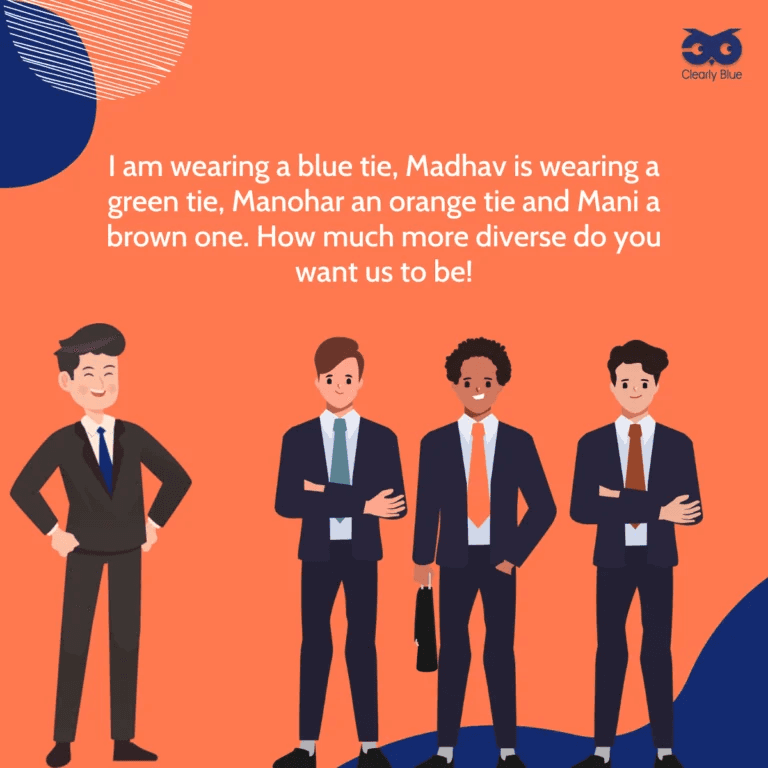
Food: The Great Unifier
Manna from the cafes, courtesy canny employers
Whether it’s the naming ceremony of a newborn, or the wake of a dear one; whether an inauguration, celebration or closure post mortem; whether it’s a gathering of protestors or a party of peers of the land, one common facet of any event of humans is food.
Food is what keeps us going, and to some events, the only thing that keeps us going. The reputation of bad food may keep us from going to a venue. There is a saying in Kannada that translates to, “At a wedding, the groom is interested in the bride, the bride in the groom, everyone else is interested in the food.” Do you remember the food at your own wedding? Probably not, but others will, if it was particularly good (or bad!)
Food as peacemaker, panacea and poison:
Food plays a unique role in our psyche as a species. The forgoing of food – whether voluntary or forced – is associated with all sorts of saintly connotations. It is an ancient practice that has become a health fad today. Binging on food has the opposite connotation. Languages are rife with food-related idioms. One popular one is ‘breaking bread with the enemy’ that signifies the onset of peace and a sense of closure.
Given these rich and hoary meanings associated with food, it is no wonder that employers across the globe use food as a ‘weapon of mass construction’ – a device to attract talent, retain employees and build great times.
Consider Googlers, who, like many Silicon Valley tech employees, get free food. It’s one of the great perks of working at the tech giant. Prior to the pandemic, the free food at Google HQ was the stuff of legend: 30 eateries, including multiple themed food trucks, exotic fusion cuisine, irresistible snacks – Google management sure knows their way to its employees’ hearts!
Post pandemic their famous buffets were scrapped and boxed meals and individually packed snacks appeared on the scene.
The buffets, we are told, are making a comeback. As are Googlers.

Culinary sparks to innovation:
Legend has it that Google co-founder Sergey Brin mandated that the company’s office be so designed that no employee is ever more than 200 feet away from food. Google’s then-Head of People Operations Laszlo Bock revealed in his bestselling book Work Rules that the idea of so many food stations and micro kitchens was to encourage casual, informal interactions and spark innovation. A delicious way to spark innovation, we must say, making the ‘Google 15’ a weighty reality for many Googlers!
Similar culinary tales dot the Silicon Valley landscape: Free gourmet restaurants at Facebook, subsidized menus at Apple, snacks on every floor at Twitter HQ, and at Airbnb beer and wine on tap!

Free food, these companies seem to (rightly) hypothesize is an almost irresistible attraction for young, unattached engineers who’ll probably hang out at work longer when they don’t have to worry about prepping or making the next meal at home.
Closer home in India’s Silicon Valley Bangalore, Intuit India has some hip food courts styled after local hangout spots, offering everything from fresh fruit to filter coffee for hungry employees. Midsize companies often get food catered – sumptuous rice- and roti-laden multi-course affairs – so that employees can focus on their jobs with a sated stomach.
Battling the hybrid work paradox:
As business leaders and office managers battle the ‘hybrid work paradox’ – employees hunger for more in-person interaction, but hesitate to brave commute traffic and return to daily work-from-office – food may turn out to the great unifier that brings the hordes back to the office cubes. The pandemic had put paid to many cafeterias and eateries surrounding Sarjapur Road, but all signs now point to a slow return to a new normal: albeit with staggered cafeteria timings, boxed lunch options and limits on in-cafe dining. Food, indeed, is leading the way back to normalcy.
At Clearly Blue, we’ve firmly believed that the way to employees’ hearts is strictly through their stomachs. Some employees have complained that they have gained weight after joining CB. Besides the de rigueur coffee and tea, the pantry is stacked with snacks of the healthy and not-so-healthy varieties. The team is known to take many a Friday afternoon off to sample the delights of local eateries. Team offsites inevitably are centered around taking in the sights and smells of new hangouts in South Bangalore.
Perhaps the eating out and snacking in was what most of us missed during the enforced pandemic lockdowns and work-from-homes. The limp back to normalcy has started, however: our recent annual get-together at the Mango Mist offsite was memorable, as was the food on offer.
With a team of foodies, what else does one expect?!

I guess you’ve realized my idea.
Yes!
Lure them in with food.
The smell of freshly baked pizza, the aroma of a dum biriyani or even the promise of ice cream with gulab jamun. All of these sprinkled with good conversation will surely do the trick.
Five Lessons from my Career Reinvention
Five years ago, while waiting for yet another high powered client, my boss turned around and asked me, “ Where do you want to be in three years, Linda?” I startled him when I replied, “ I want to sleep under a banyan tree, Mike. That’s the sum total of my ambition.” I think that was the moment when we both realized that I had reached the end of my road. After 18 years with the organization, I formally retired from the insurance industry in March 2019. I thought I would stay at home and chill for the rest of my life. Little did I know that there was a new adventure right around the corner, just waiting for me.
I took a baking course and the family had to suffer through my enthusiasm and my not so successful experiments. I binge-watched Madam Secretary and Mentalist. I unearthed an old copy of Alex Hailey’s Roots and found it as profound as it had been when I read it in my teens. I laughed through Anuja Chauhan’s novels and became enthused over a series of romantic novels. I re-acquainted myself with Isaac Asimov’s Foundation series and still, time-stretched endlessly in front of me.
It’s when I started painting murals on one wall after the other that my children intervened. “Amma, we know you’ve retired, but maybe you can find a light and breezy career to occupy your time,” they said. I think the family had a secret conference to the tune of:
How do you solve a problem like Linda?
How do you catch a cloud and pin it down?
How do you find a word that means Linda?
A flibbertijibbet! A will-o’-the wisp! A clown!
The children were always fond of The Sound of Music!
So, I started looking out for options. One thing was for sure, I did not want a management position where I would continue doing what I was doing before. I had started writing short posts on Facebook (purely to alleviate my boredom) and one of my uncles suggested that I should pursue writing. Since he was someone I respected, I thought perhaps that was something I could do.
I started searching for content writing jobs and realised that folks run for the hills when I introduce myself as a retired Executive Director looking for an entry-level position in content writing. Luckily for me, the Clearly Blue team decided to give me a chance and I embarked on my new and exciting journey.
These two years with CB have been a rollicking ride with new learnings around every corner. I feel this career move has been one of the best decisions I’ve made. So here are some of the lessons I learned on this journey. They might help you make some exciting decisions of your own.
It’s never too late to follow your heart
When I decided to retire from my well-established career, I was besieged with a plethora of doubts. The job had become my identity and my safety net, both financially and socially. You should call it quits if your job is just a safety net for those awkward moments in a dinner party when a stranger walks up to you and asks you, “So, what do you do?”.
You might be like me with no clear plans but a definite sense that your current job no longer fits you. You might be one of the lucky ones who really know what they want to do. Whichever category you fall under, follow your heart and take the plunge.
Travel light
You might have accumulated a wealth of knowledge in your previous career, but make sure to cleanse yourself from all your previous baggage and preconceptions. What worked well before might not work in the new scenario. It’s always good to wait and watch and volunteer an opinion only when you are sure that it will make a positive impact.
Let your inner child loose
A new career is a perfect opportunity to awaken your inner child. Since you are a novice, you are free of great expectations—from yourself and others. You are free to experiment and improvise. Embrace every new experience with the curiosity and enthusiasm of a kitten. If you approach each situation with a positive attitude and the willingness to make it work, anything is possible.
Be ready to learn
Focus on what you don’t know, rather than what you know. Some of us feel that we have to incorporate what we already know into every situation we encounter. You really don’t need to. If you go with an open mind and with the mindset of a learner, every new challenge becomes an opportunity. When I opened my mind to learn new skills, I realised that my brain gained back its old vigour. Being a beginner in the team was a cleansing and empowering experience. I felt as if I suddenly sprouted wings.
Play to your strengths
If you are like me and have switched from a well-established career, the change can be disconcerting. A new environment where your earlier status means nothing is a lesson in humility. It also helps you dig deep and find your core strengths. You’ll realise that your attitude and values are more important than your skills and experience. Take it from me—that’s a liberating moment. It’s a reaffirmation of who you really are.
I know people who have distinct goals and a vision they work towards. I’ve always felt that they are the lucky ones. If you are one of those, grab your dream now and start your adventure. If you are like me and have a tendency to serendipitously fall into interesting careers, here are a few nuggets of truth. It’s your will to work and do the best you can that really matters. The rest will fall in place. If you search deep within, you will find long-forgotten skills that will suit your new role. Those moments of discovery are the most gratifying.
Editor’s note: Linda is a brilliant writer whose vivid stories are lighting up many client deliverables. A tiger can’t hide its stripes forever, however, and she’s shining as our Chief Content Officer as well.
How and why things get done and how people feel – discovering the culture of a company
It’s often hard to describe what the culture of a company is. There are a plethora of definitions if one searches the vast terrains of the internet. It’s the one thing that every fresh college graduate or newbie joining a particularly large corporation is “inducted” into, through a set of carefully crafted onboarding and assimilation procedures.
In reality, it takes a while to figure out.
“We take pride in our work culture”, is a phrase one often hears in organizations. How does one experience culture? From prior experience, many of us know that work culture is what makes our work worth our while, pushes the business needle, and binds people at work via an invisible thread.
Being asked to write about the culture of a place is a challenge, particularly for a newbie like me. I was thus glad to be part of a team. It turned out that all of us in the team were newbies! So, we put our heads together and thought about how we wanted to write this piece. We concluded that what people think and feel about their work, and how they get things done would tell us about their work culture.
So, we got talking to others who had been with Clearly Blue Digital (henceforth referred to as CB in this post). Here is what we learnt about work at CB.
‘I love my work’, translated to:
I feel a sense of purpose and accomplishment through the work I do.
I feel connected to everyone at work. CB feels like an extended family.
I am relaxed while working.
My work is recognized and I feel valued.
‘I am living my dream’, said some. When asked how, they said:
I wanted to be a writer. I came here with no career experience in writing, and I created pieces that delighted our customer.
I wanted to be the best HR professional. I manage HR for CB and I do it very well.
I took a break of 10 years and was nervous to come back to work. My days now are filled with engaging interactions and work.
After 20 years of working in the Insurance industry and wondering what to do next, I found my place at CB.
‘I am learning all the time’, quite a few people said.
The sheer diversity of work is astounding. Content, animation, video editing, e-learning, research, writing and more!
Design has infinite faces; I see it taking shape each day at work.
There is innovation all around. In methods, tools, techniques…in everything. And I can brainstorm, collaborate and carry my ideas to fruition with all round support.
Fluidity in roles means we step into people’s shoes without stepping on their toes! So we learn new things all the time.
I know I don’t have to “attach” myself to a role and that opens my mind to learning.
Creativity, collaboration, communication and critical thinking are our default ways of working. Did someone say HOTs [aka Higher Order Thinking Skills]?
‘I know people have my back’, is something everyone at CB feels.
I see how my colleagues mobilize themselves to collectively deliver solutions when the going gets tough.
Trust, respect and teamwork trump everything else.
When I make a mistake I know I won’t be called out on it in front of anyone else. Instead I get one-on-one feedback and am encouraged to ask for help when needed.
When I am in rough weather at home or at work, I know I will be supported.
‘I feel empowered, included and safe’, said everyone.
My educational qualifications or prior work experience do not dictate what I work on. If I can add value to something, I get to work on it.
I relish how I get to work with a spirit of partnership rather than as an employee.
My voice is heard, as are my opinions and questions. Without judgement, restraint or prejudice.
I have the space to find my answers and I am supported when I need help.
I am treated with fairness and respect and I am trusted.
I feel safe to say I am NOT OK.
If these aren’t representative of culture, what else is? And that’s how we discovered what the culture of this company is. If you want to know more, please visit Clearly Blue and read about why it’s a great place to work.
CB has grown from a 3-person company in 2016 to a 30-person company today. It may grow more; it may stay the same. Today, CB thrives because of its people. Its people thrive because of its culture.
Pic Courtesy: Photo by Mehdi Sepehri on Unsplash
Does your culture tree feed from the top or the bottom?
The culture tree
A whip-thin man walked purposefully amongst gigantic machines in a milk pasteurization plant. He tapped a uniformed technician on the shoulder, murmured something in another’s ear and continued his stride forward. In-between he climbed up a ladder to examine one of the innumerable pipes that traversed the plant.
This is how I remember my first boss. It was the year 1999 and I had joined as the quality control officer of a milk pasteurisation plant. Fresh out of college with the ink barely dry on my Microbiology degree certificate, the plant’s manager, Eldho Sir (as I called him) became my guide and mentor. He quickly took me under his wing and instilled the basic principles by which he managed the plant.
Give respect to earn respect. Go by the premise that everyone in the plant, including drivers and operators would have valuable input. They might not have a degree, but they have experience.
Never assign a task without having a fair idea of what is involved. To this effect he made me learn how to operate the machinery in the plant and even had me help in the washing of the milk tankers. I was soon well versed in rolling cans to the humongous freezer, operating the packaging machine and even cleaning the odd tanker. I never got the hang of repairing the machinery, tinkering was never my strong suit. My reward came in a few months when he trusted me with the role of acting plant manager (for the days he was away). Though I never practiced Microbiology after this stint, I carried the lessons learned to my next career.
Now, let’s fast forward to 2018. I was invited to the launch of Anviti insurance brokers in Mumbai. The highlight for me was Mr Narayan Murthy’s fireside chat. Mr Murthy’s talk about organisational culture being integral to an organisation’s success and it being driven top down caught my attention. Organisational culture was not something I had thought about much, but this got me thinking. Eldho Sir came to mind and I started examining his actions as well as more recent observations from the perspective of culture.
What is Organizational culture?
I’ve heard many perspectives of what culture means in an organisation. Some say it’s the product of compensation while others call it the immune system of the organisation. For me, Richard Perrin’s take on organisational culture makes the most sense.
“Organizational culture is the sum of values and rituals which serve as ‘glue’ to integrate the members of the organization.”
The culture of the organisation is most often developed organically. Nowadays the increasing focus on organisational culture and the many benefits it brings in terms of retention and productivity has made many a large corporate at least try to drive the culture story. Some leaders like Microsoft’s Satya Nadella have been able to lead cultural change. This process of change is however not as easy and straightforward as it may seem. A recent article I read said that 85% of organisations fail in cultural transformations. This is not really surprising considering the nebulous nature of the beast.
Can leadership drive cultural change?
The short answer is yes.
However, culture has many facets and dimensions. Its very nature means that it cannot be enforced. In a small to medium organisation, the founders or leadership can ensure that those unsaid nuances that we call culture are in line with their vision of what it should be. However as the organisation grows, they will need to ensure that they hire people who are more likely to have the same value systems and ethos. Not an easy task, as most founders and leaders are not involved in the actual hiring process!
I encountered this in my previous role. When I took over as Director of an Insurance consulting firm in 2008, we were just a bunch of closely knit people. We had a certain style of working and collaborating which I now realise is a “caring” kind of culture. It was something we had inherited from our founder who liked to consider the entire company a single family. I always felt that this close knit and collaborative behaviour was our USP as we actually extended this to our client interactions too. It was easy to keep this environment of caring and collaboration alive when we were a handful of people. It became a more complex task when we started to evolve and grow to hundreds of employees. What I tried to do and succeeded to a large extent was hire future leaders or those I call cultural gardeners who could nurture and grow the company culture in each vertical or department as the company grew.
When I joined Clearly Blue, I noticed that Padmaja and her core team also put a lot of emphasis on attitude and work ethics while hiring. A few weeks into working with the team, I realised that Clearly Blue offers a safe space for creative talents to spread their wings and explore their capabilities. The non-hierarchical work environment where every voice was heard was very refreshing. I felt it was the perfect soil for creativity to grow and flourish. I soon realised that the hiring team looks for qualities like sincerity, independent thought, curiosity, passion and punctuality while hiring. We also try to gauge if the candidate is a team player and honest. I strongly believe that if we continue to give emphasis to these characteristics while hiring, we can keep the current culture and work environment alive.
If you are looking to bring about a cultural change in large organizations like Mr Nadella, you will face an uphill battle. The task however is not impossible. It’s just a matter of strategy and perseverance. Once you have the strategy in place, find charismatic people to seed across the organisation. They will nurture and grow your culture tree.
Like any other tree, you need to water and watch the tree of culture grow. Weed out employees who pose a threat to your culture, promote the ones that enhance your culture. In a couple of years you will realise that your cultural tree is no longer a sapling but a huge tree that shelters your organisation. You might even decide to sleep under the tree!
What’s cooking in your company ‘kitchen’?
I recently asked my mother the recipe for ‘kalasu melogra’. A bit of this and a bit of that, I was told. Kalasu melogra, a Kannadiga specialty, is a mishmash of a lot of things resulting in a delicious dish.
I feel like the term perfectly describes what makes a company a great place to work. In this era of hypergrowth, with hugely inflated salaries and insane offers raining down on people with choice skill sets, what could possibly make an employee stay on? Is it the flexibility? Personal development opportunities? Is it just about the money perhaps? Or about how inclusive the environment is?
Let’s face it, a low attrition rate is a key, but often unnoticed marker of long-term success for a company. Heresy, some may say, when loyalties are switched easily and guiltlessly on both sides of the employment divide nowadays.
Here are some realisations about that recipe.

A dash of emo
Money is what powers the sun in a rich man’s world, as ABBA loved to say. Younger employees with fewer shackles such as mortgages are more liable to have a money-first attitude. They take risks with job hopping and don’t mind gaps in their resumes.
But, all things being equal, it’s not (always) the money. Talented, experienced people tend to stay on in companies where they feel an emotional connection with the vision and values of the company and feel like they’re appreciated. Modern-day enterprises recognize this and spend big bucks on building employer brands. Powerful stories of why/how the company was started and tribal knowledge of the company’s growth can fuel employer brands.
So can a strong social vision. At Clearly Blue, we’ve been focused on building a great place to work for women restarters – professionals seeking a second career after a break – from day 1. Towards this vision, we’ve formulated multiple work models – full-time WFH, part-time come to office, freelancer, consultant on retainer, intern, trainee and many variants in between – that have resonated with our team. Once a CB Inspirer (as we call ourselves), always one!
Many employees also look for the company’s involvement in local communities and causes dear to them as a marker of appreciation. Great Places to Work notes that the culture has moved from WIIFM (What’s in it for me?) to WIIFTC (What’s in it for the community?) in the pandemic. We can learn from shining examples – among many others, Medtronic India ran a vaccination program for employees and families.
A splash of convo
An open culture of communication is a good place to start the involvement game. This means not just talking, but listening: being heard. What makes them tick? What are their problems? Where can we help? Many companies such as Amazon run all-hands sessions where the newest intern can ask tough questions of CxOs.
Town halls are also great places to elaborate on the ‘Where are we headed?’ kind of questions. They give the company a human face. That is an open culture worth emulating. Jeff Bezos famously started his 2019 town hall asking employees to raise their hands if their year was rougher than his (he was going through a very public divorce). Very few hands stayed down!
My first employer Intel had an open door policy – anyone could walk up to anyone else in the company and seek a sit-down session. Tough to implement, but many get it done very effectively.
Some learning perhaps?
A culture of learning is probably second nature to most modern-day organizations. If you don’t keep learning and innovating, you risk being edged out of the marketplace. So most unicorns, technology wunderkids and up-and-coming companies encourage constant learning and training. Whether with Udemy passes, L&D sessions (that have now moved online), sponsorships for continuing education or more, an employee who is encouraged to keep learning is an employee who may stay on.
Employees appreciate companies that support their quest for variety and movement in their careers. Job rotation programs and leadership development rotations are common among large multinationals such as TELCO, Intel and GE seeking to develop a core cadre of employees who have the 50,000 foot vision needed to power the company in the years to come.
A pinch of ownership
Feeling ownership may be the secret ingredient that many companies need to bake into their retention pie. This takes many forms. ESOPs and stock grants are a de facto part of the compensation package in the technology world. In smaller organizations like ours, employees report that it is empowering to graduate from just getting things done to having a say in the company’s branding, roadmap and service design. We solicit inputs from everyone when we build out some of these artifacts for ourselves.
Setting standards for communication, building checklists, and blueprints for service delivery are other examples of helping employees own their role.
The Spicy ‘Tadka’ To Round It Off
Job sharing? Mid-career sabbaticals for soul searching and reflection? 11 months on and one month off? HR managers have experimented – often successfully – with flexibility options such as these to keep employees motivated and energized. Some lessons are hidden here for the IT sector staring at the ‘great resignation’.
All of this and perhaps a little bit more make for that tasty kalasu-melogra called the ‘company culture’ that leads to employees staying on through ups and downs and helping the company rise to greater heights.
What keeps your teams ticking? Have you tried some experiments in employee retention that worked well? Do share, so that I, and other
Indian Storytellers
From the Puranas to Mrs. Funnybones
India’s tryst with stories goes back into the mists of time when stories were told but not written. I grew up with stories from the Aithihyamala and Panchatantra. I remember chortling with glee along with Naranathu Bhranthan as the gigantic rock he’d pushed up the hill came tumbling all the way down. I was too young to understand the philosophical significance of these stories back then, but they seeped into my consciousness. These stories would whisper to me in my grandparent’s voice whenever I felt down and needed a moral compass or a helping hand.
In the recent past, talented authors like M.T. Vasudevan Nair and S.L. Bhyrappa got us thinking with their retelling of the epics. Their acclaimed works like Randamoozham (translated to English as Bhima) and Parva are thought provokers with an emphasis on the human elements of the Mahabharata.
From the Puranas to Mrs. Funnybones
India’s tryst with stories goes back into the mists of time when stories were told but not written. I grew up with stories from the Aithihyamala and Panchatantra. I remember chortling with glee along with Naranathu Bhranthan as the gigantic rock he’d pushed up the hill came tumbling all the way down. I was too young to understand the philosophical significance of these stories back then, but they seeped into my consciousness. These stories would whisper to me in my grandparent’s voice whenever I felt down and needed a moral compass or a helping hand.
In the recent past, talented authors like M.T. Vasudevan Nair and S.L. Bhyrappa got us thinking with their retelling of the epics. Their acclaimed works like Randamoozham (translated to English as Bhima) and Parva are thought provokers with an emphasis on the human elements of the Mahabharata.
We’ve been similarly blessed with literary geniuses across our 23 official Indian languages. It would be a herculean task to talk about our literary wealth in all the regional languages. So, I’ve decided to give Indian English writing a whirl—starting with a few popular authors.
Can one talk about storytelling without mentioning the great Rabindranath Tagore? The answer is a resounding no! Tagore’s Gitanjali earned him the coveted Nobel Prize. These are beautiful poems that read like conversations with God. Like the Biblical Hymns of David, but without the religious connotation. His works also include short stories such as Kabuliwala and Atithi, and novels like Chaturanga and Ghare Baire.
R.K Narayan’s novels and short stories initiated the average Indian into the world of English stories.
I was so enthralled with the happenings in Malgudi that I thought that it was a real village in Karnataka. While Malgudi days is by far his most popular work, I have found his versions of the epics beautiful in the telling. You can find all of them bundled into The Indian Epics Retold: The Ramayana, The Mahabharata, Gods Demons and Others.
Kushwant Singh’s, Train to Pakistan (adapted into a movie in 1998) is a poignant retelling of the story of the partition of India and Pakistan. Singh’s account of the human loss and horror involved in the partition, is an essential read for anyone wanting to explore Indian culture and history.
Ruskin Bond won our hearts with the adventures of Rusty in The Room with the Roof. He’s since then entertained us with many heartwarming stories like The Blue Umbrella and A Flight of Pigeons.
The White Tiger by Aravind Adiga is a refreshing take on the class disparities in contemporary India.
Kiran Desai’s Man Booker Prize winning novel, The Inheritance of Loss, is described as “a magnificent novel of humane breadth and wisdom”. Anita Nair is another versatile Indian author. Her Ladies Coupe delves into the trials and tribulations of the contemporary Indian woman.
If you are in need of a pick-me-up, try one of Sudha Murty’s books. These stories are inspirational and heartwarming. A personal favourite is the collection of 11 short stories titled, Three Thousand Stitches. On the other hand, for laughter and uplifting your mood, try Anuja Chauhan. The Zoya Factor and The Battle of Bittora are absolute riots with their comic take on romance, cricket, politics, and life in general.
Chetan Bhagat, Amish, Devdutt Pattanaik – the list goes on and I find myself hard-pressed on where to stop!
But, are authors of literary works the only storytellers?
Theatre is one of the most vibrant and interactive forms of storytelling. Playwrights like Girish Karnad, Vikay Tendulkar and Badal Sarkar have made us proud by taking Indian theater to the world stage.
India has laughed and cried along with the creations of master storytellers like Javed Aktar, Imtiaz Ali and Satyajit Ray on the silver screen. Let’s not forget Sarat Chandra Chattopadhyay’s Devdas and Parineeta.
Shobha De’s and Twinkle Khanna’s columns are not fictional, but they definitely have a storytelling feel to them. Twinkle Khanna’s collection of columns, “Mrs Funnybones” is certainly worth a read.

I leave you with stories of these storytellers in the hope that you’ll sample their stories as you go. Enjoy!
Storytelling is indeed well and alive in India. From the ancient tales told around campfires to the modern-day boardroom tales narrated to draw in the VCs, the argumentative Indian is also a great storyteller. At Clearly Blue, we pride ourselves on telling authentic tales for our customers, their products and services.
Let us know if we can spin an engaging yarn for you!
More Suggested Reads…
R. K. Narayan’s Swami and Friends
R.K Narayan’s The Guide
Amitav Ghosh’s The Glass Palace
Rohinton Mistry’s A Fine Balance
Anita Desai’s The Clear Light of Day
Sudha Murty’s Mahashweta
Amish’s The Immortals of Meluha
Arundhati Roy’s The Ministry of Utmost Happiness
Vikram Seth’s A Suitable Boy
Ravi Subramaniam’s The Bankster
Marketing Basics: Explainer Video
Why your business needs it? And why it is the right solution for you?
Suppose you are researching the latest mobile phones, you will quite likely find the right product video that best explains the pros and cons of the product. Not just gadgets, even when there’s a public issue or a natural calamity we look up videos that describe or depict everything we need to know about the event. Watching a 2-minute video can give us enough facts and figures that can be remembered and shared with our friends and family. Videos that share knowledge, create awareness, and which makes us think, laugh and cry are generally known as explainer videos.
Explainer videos are mostly used for business or sales purposes. Now, what is an explainer video in a business context? Explainer videos are those that describe or highlight the product, service or any business idea offered by the company, and convey it in the most efficient and compelling way.
What is your objective? Do you want to find new customers? Build your brand? Then again, you may want to find the right audience and keep them engaged on your web page. Explainer videos solve your problem. These videos catch the eye of viewers with a short attention span. The captivating animations and visual effects are created to offer a clear vision about your company, product or service. But, why do you need to choose an explainer video over other forms? It is because explainer videos:
Are shorter than most videos
Break down complex ideas in a fun way
Reduce the bounce rate of your webpages
Can engage and tell compelling stories
Help improve SEO rankings
Build trust and credibility
Are highly shareable
Now that you know why explainer videos are better, let’s understand the various types of explainer videos.
Basic 2D animation: It is one of the most popular forms of explainer videos. It has a high engaging rate. It involves simple animations of objects. It is fun to watch!
High-End 2D animation: It comes with a higher standard and resolution. It tells more engaging and compelling stories.
Whiteboard animation: This is one of the widely used forms of explainer videos. This involves animation over a whiteboard or chalkboard. Animations of objects and texts are found.
3D animation: This type of explainer video uses representational objects and not just static pictures. It brings characters and objects to life. The visuals keep the viewers engaged.
Live-action video: This type of video uses the animations of people and objects to create more engaging and appealing videos. It involves a narrator who explains the product and services offered by the company.
Motion graphics video: This is an animated video. It uses the visuals that are used in infographics and representations.
Stop motion video: It is a type of animated video in which the small increments of the objects are filmed frame by frame. In this video, the objects are photographed many times, each time with an adjustment in their position. When these shots are played in a sequence, it shows movement in the objects.
Infographics video: This type of video delivers brief and clear details about products and services. It involves simple, clear and engaging animations.
Screencast video: In this type of video, everything happening on the computer screen is recorded. This is done for marketing purposes. Voice-over may also be added if needed. These types of videos explain actions in a crystal clear manner.
Cutout animation video: This is a lot like the stop motion video where images and representations are used. It is quite like the puppet shows of olden times. Such videos are a lot of fun to watch!
Testimonial video: This features appreciation and acknowledgements from clients. In these they discuss what they liked most about the products or services offered by the company.
Kinetic typography video: It is a type of animation video which captures the movement of text on the screen. It is also known as “moving text” animation.
Now that you know that there are an array of explainer videos, choosing the right video as per your audience would be very crucial. Once you’ve selected the right style, you can move on to the next phases of production and post-production. After this stage, it is the time for a final check, and then, you are all set to meet your new customers and clients!
It is a fast-moving world! So short and engaging videos are the way to go!
Marketing Basics: Pitch Deck
Are you a budding entrepreneur looking for growth opportunities and not sure of how to build a winning pitch deck? Here’s all you need to know…
You happen to meet your potential client at a recent summit you attended. After listening to your elevator speech, the prospect is piqued by your product and wants to take this forward. (Check out our blog on What is an Elevator Pitch for a Business) So, he asks you to present your project to his leadership team. While you’ve landed a great opportunity, are you not quite sure of delivering a powerful presentation? Let’s see how to build a great pitch deck, a sales deck or a product deck.
What is a pitch deck?
A pitch deck is a brief presentation. It is often built using PowerPoint, Keynote, etc. It gives a quick overview of your business or project plan.
What is the ideal number of slides?
Ideally, a pitch deck should contain 8-12 slides.
Should the slides be text only or visuals only?
There are two kinds of decks. The first has a lot of text. Such decks are often used in emails.
The second has mostly visuals. These are the most preferred for presentations.
Now, let’s understand the 12 main components of a pitch deck.
Introduction: This slides describes who you are and why you are here. Keep this short and sweet.
Team: Describe the talent behind the project and explain their roles in brief.
Problem: Elucidate the problem you want to solve. The problem should be relatable and not a complex one that your audience finds difficult to understand. Address just one problem.
Advantages: Here, you explain why and how your solution is different and what makes it special.
Solution: Describe your solution to the problem. Keep it concise and clear. This is an important slide. If you explain your solution right, you make your case! Avoid statements like you being the only one doing this, you being the clear leader, etc. Make sure your idea stands out. Do not repeat what others have said.
Product: Now, explain how your product or service actually works. Quote some real-life scenarios or instances.
Traction: This slide should describe the revenues, metrics, etc., and depict the measurable set of customers. Hence, proving the potential. You can show month over month growth of your business.
Market: Here, you should describe the target market you’re going to operate in. If you are not very clear, at least predict your target market. You can include a graph that shows the market growth in the past and predict the possible results. Remember to include the sources of your research.
Competition: This slide should describe the other competitors in your industry. You can show diagrams and contrast between your competitors. You can explain how your solution is better than theirs and how you plan to tackle the competition.
Business model: Describe your business model, i.e., how you are planning to make a profit and probably show a schedule when you expect your revenues to start. You should be able to project for a minimum of 3 years. Some investors may ask for even 5 years’ projections.
Investment: In this slide, you should explain your planned budget and what kind of investment you expect.
Contact: Mention your contact information and the quickest way to reach you.
Now that you know the major components of a pitch deck, document your data, find the right tool that best suits you, and get started!
Before you get started, remember the three main aspects of a powerful pitch. A winning pitch deck must be:
Clear and simple
Compelling
Easy to act on
When you work on a pitch deck, remember to not do the following.
Do not use too many bullet points
Keep it short and relevant
While you are presenting, do not read word by word from your script
Don’t create a text-rich, picture-poor presentation
Don’t use small fonts, and most importantly,
Don’t go unprepared.
Take a look at some of our product decks. In case you need help in building a powerful corporate/sales deck, reach out to us at info@cbnew.test
Sources:
https://pitchdeck.improvepresentation.com/what-is-a-pitch-deck
https://www.forbes.com/sites/alejandrocremades/2018/03/02/how-to-create-a-pitch-deck/#f7509c556c06
https://smallbusiness.chron.com/deck-marketing-64930.html#:~:text=A%20sales%20deck%20is%20a,%2Dbehind%22%20for%20your%20clients.
To Send or Not to Send‽‽
A perpetual question that bogs down a marketer
In today’s age, almost every enterprise depends highly on its social media to run its marketing campaigns, and interact with its customers. And, why not? There are over 3 billion social media users worldwide, 54% of who use social media to research products. Marketing strategies are bound to be more focussed on social media, and the once-popular cost-effective marketing tool—the newsletter—is now considered plain Jane. Although newsletters still find their place in the enterprise’s marketing strategy, many marketers, more so rookies, still have this one question – ‘In this social media era, should we run an email newsletter at all or is it passé?’
The simple answer is YES. A newsletter is an effective marketing tool that organisations cannot afford to ignore. According to the recent HubSpot Research, Global Survey, 78% of marketers have observed an increase in email engagement over the last year. Read on to know the power of the earliest digital marketing tool – the newsletter.
Communication
A newsletter, as we know, is a communication tool used to update customers or subscribers or readers (I prefer to call them subscribers) on the latest business happenings, or products and services. But hey, newsletters serve much more than just saying ‘Hi’ to people in your list ever so often. A good newsletter is something that educates, motivates, and nudges your subscribers to make a purchase or read your latest blog. In short, provide content that is of some value to your subscribers with a catchy, easy-on-the-eyes layout.
Here’s a newsletter from web-based email testing and tracking solutions provider Litmus that ticks all the boxes.
Marketing and promotions
Another important use for a newsletter is that it can increase your brand recall and nudge people to take action, usually a purchase. This is not a very common occurrence in an email newsletter, but few companies have aced it. The key is to promote and not be pushy.
Take for example, the American retail and outdoor recreation services giant, Recreational Equipment, Inc, more commonly known as REI. They run newsletters dedicated to a particular buyer persona which makes the communication very personalized.
Connecting and building strong relationships
Personalized newsletters help build strong relationships. Such newsletters have a greater impact on subscribers by making them feel seen and valued. This is a key differentiator. You can achieve this by keeping the tone of your newsletter more informal – as though you are talking to your friend, rather than like a salesperson trying hard to sell his product. You can talk about your organization culture, highlight the achievements and milestones of your team members or even talk about ‘fun@work’ from time to time. Including pictures also increases personalization. Personalized newsletters definitely help build a personal rapport and establish trust. Newsletters that target different buyer persona also increase personalization.
A perfect example of a personalized newsletter is the author and illustrator Austin Kleon’s ‘A newsletter from the desk of Austin Kleon’. Austin discusses the happenings in his life, the music he is listening to, the books he has read and more in a very friendly and informal language.
Building credibility and authority
A newsletter that shares unique and valuable content makes your subscribers wait for the next issue. Be sure to include not just business updates but also interesting and useful content that piques your subscribers’ interest. Share original content from your resource bucket that is current and relevant along with carefully curated content related to your area of expertise. You could have a theme for each issue thus providing your subscribers insightful good reads on different topics. This will increase organic traffic to your website. Your subscribers will then start to recognise your brand and this way, your newsletter can become a great brand builder.
If you are looking to build credibility and authority through your content, then, you have to check the infosec website, Hacker News’ ‘Hacker Newsletter’. The newsletter has a minimal design, is clean, and is divided into marked sections which have relevant and credible content to the subscribers.
Before I wrap up, I’d like to show how we communicate with our subscribers through our newsletter, the Chief Content Officer (CCO).
I cannot help but be biased (ok, let me redeem myself – a colleague’s written about how to address biases which is helping me deal with my predisposition!) as our CCO ticks all the boxes that I’ve been talking about
So, this is about the usefulness of a newsletter. I hope you will use the time-honoured, cost-effective marketing tool to your advantage and up your game! Good luck.
To keep yourself abreast about everything content, please sign up to CCO.
References:
https://blog.hubspot.com/blog/tabid/6307/bid/23865/13-mind-bending-social-media-marketing-statistics.aspx
https://blog.hubspot.com/marketing/email-newsletter-examples-list
https://bizfluent.com/info-8267370-advantages-newsletters.html
https://www.hubspot.com/state-of-marketing/email-marketing-trends
The Battle of the Twins
Organic reach Vs Paid reach
Have you ever been part of a marketing strategy meeting where the main conversation is whether to take an organic approach or a paid approach? Next time, it might be a good idea to jump in before the conversation deteriorates into fisticuffs and explain that the best strategy might be a combination of both. Of course, like with every other nuance in a marketing strategy, it depends on the brand, the product, the intended audience and last, but not least, the goal of the campaign.
Let’s take a look at these two facets of Social Media Marketing before we make a decision on which way to go. Like I said, this might be one of those unique circumstances where putting your feet in two boats might be a good idea!
Organic Reach
You know what comes to mind when I hear the term – Organic? Wildflowers amidst a manicured garden. Nature having its way.
In an organic strategy you essentially depend on the natural growth or reach of your post without any monetary push. The key here is to create relevant content that resonates with your audience. This then results in likes and shares (comments, even) which pushes your post to grow like wildflowers. or rather that’s what we all wish for.
The reality is a bit more disappointing. Organic reach in all the SM platforms are plummeting. While one of the reasons for this dip could be the natural avarice of these platforms, it’s not the only one. Reddit user Brian Cristiano explains that in the case of FB, this dip in organic reach is because the platform heavily weighs content based on engagement. This is in line with their main goal to keep users engaged on the platform.
So, this is how FB does it…
When your page posts a piece of content on FB, the platform immediately places the content in the newsfeed of a very small pool of your followers (approx 1% of your followers). If your audience engages well with your post, then the platform opens your content up to 2-4% of your followers. If the engagement is high for even this group, then the platform will loosen its reigns and allow your content on to a larger audience. Facebook calls it their Newsfeed Algorithm.
I think you get it, right? Social media platforms are adopting their own form of SEO. As a user, this makes perfect sense because who wants to be bombarded with mediocre content? However, as a marketer this makes it harder to make an impact, unless of course your content is consistently out of the stratosphere.
Here are 3 tips to harness the power of organic reach
Quality over quantity
Ever been disappointed because that fabulous content you’d posted did not get the reach you’d expected? It could be because the SM platform’s algorithm is rolling. i.e., it does not weigh each piece of content in isolation. If you’ve been consistently putting out low engagement content, then your “fabulous content” would also be weighed accordingly. The key is consistency. It does not matter if you post only once a week, you just need to ensure that what you post is highly engaging.
Know when to post
Contrary to popular belief, it is better to post content during non-peak hours. This way your content won’t get drowned in all the noise. According to Adweek, these are the best times to post.
Facebook – (Thursdays/Fridays) between 1pm and 3pm
Twitter – (weekdays) between 12pm and 6pm
LinkedIn – (Tuesday – Thursday) between 7am/8am and 5pm/6pm
You’ll figure out what’s best for your brand once you get started and look at your own analytics.
Build trust
While the purpose of your page is to promote your service or product let’s not forget that your audience will stay with you only if your posts look useful to them. The standard rule of thumb is 80/20. 80% of your content should be useful and helpful while 20% should promote your product or service.
Paid Reach
As the term goes, this is when you pay a platform to show your content to its users. Paid posts can be the obvious ones like the ads you can easily make out on Facebook and Instagram. They could also be disguised or indirect. Did you know that every 10th post on Facebook is an ad? On Instagram, sponsored content is in the guise of posts. In fact, you can hire an Instagram influencer to post a social shout-out with your brand highlighted. The major drawback of this strategy is, of course, the cost. Ads could cost you from $5 a day, while Instagram shout-outs can easily cost over $10,000 for a series of posts. However, if you’ve got content that’s helping conversion like crazy, a paid strategy could take it more effectively to your target audience. Use your paid campaigns to reinforce the values and messaging that you release through your organic campaigns.
Social media marketing is evolving and transforming as we speak. As marketers we need to keep abreast of new trends and experiment on a regular basis. However, at the end of the day, the story is the same. Organic or Paid, your content needs to speak to your audience.
Marketing Basics: Wireframes
A how-to guide to get started
Have you ever thought that building a website or a mobile app is kind of like building a house? Architects are often advised to design homes with a keen eye on usability as well as aesthetics. As a UX designer, your role isn’t too far from this. Your client’s website or app is the place they house their ideas or wares. It has to be visually appealing as well as user friendly. Else, your visitor is going to get a very bad impression and may never visit again!
So, now that you’ve completed the discovery phase and have gathered your client’s requirements, what next? A simple wireframe would be a good place to start.
What is a wireframe?
Well, in layman’s terms, a wireframe is the blueprint of a web service or app. Usability.gov’s description of wireframes actually nails it.
“A wireframe is a two-dimensional illustration of a page’s interface that specifically focuses on space allocation and prioritization of content, functionalities available, and intended behaviors.”
Your wireframe could be the traditional pen and paper version or you could use tools like Balsamiq or even a presentation to design a digital wireframe. Whichever method you use, just remember that your wireframe should serve as a detailed visual account of the product requirements. Wireframes normally do not include any colour, styling or graphics. This is so that you can focus on the functionalities, placement of key elements and screen flows.
Like in every other phase of design, remember that the user is King!
Why wireframe?
Wireframes are fast, economical, and most importantly, changeable. It makes it easier to invite feedback and make changes at this stage. Imagine spending hours or days on a prototype and then realizing during a stakeholder presentation that you’d got it wrong. Many times, clients change their minds once they see their idea in the flesh!

How to create effective wireframes
Your wireframe must be a bridge that connects all stakeholders. It should push usability to the forefront and makes stakeholders focus on the user journey. If you are wireframing for the first time, you could use Wirify bookmarklet to turn your favourite webpage into a wireframe. It always helps to be inspired by great work.

Now, here are some tips to help you get started.
Start with a set of questions
It’s always good to introspect and think of all the questions that your wireframe needs to address. Here are a few questions you could start with. I would urge you to add to this list as you go.
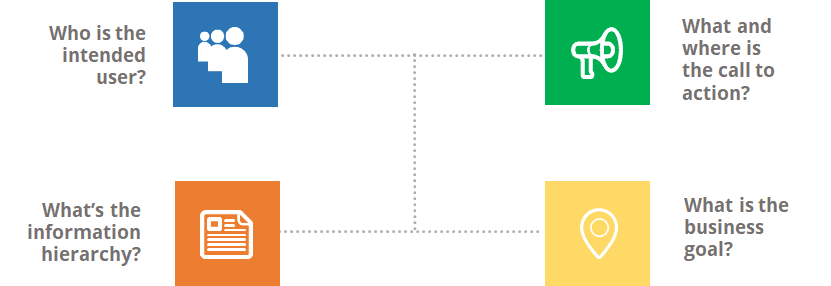
Simplicity is the key
Keep your wireframe neat and simple so that the focus is on the user journey and functionality. Use gray scales and limit the number of fonts to two. You can still show the hierarchy of the information flow by differentiating with font size and italics.
Context is important
It’s always good to set context. Give your audience an idea of the screens the user will see before and after. This is particularly important if you are wireframing a new feature into an existing environment.
Show, don’t tell
Ensure your wireframe is self-explanatory with the minimal use of bullet points under the screen. This makes the entire experience more visual.
Use real information
While using Lorem Ipsum might seem to be a harmless way to save time, you may be in for a shock when it’s time to use real data. It’s easier to discover design flaws and correct them at this early stage. So, go ahead and spend that extra time.
Like everything else, different designers approach wireframing differently. You can go from low fidelity wireframes, which are essentially communication and collaboration tools, to high fidelity wireframes, which are more detail-oriented. It’s a case of developing a style that suits you and your customer. I hope this gets you started on your wireframing journey!
References:
https://blog.prototypr.io/wireframes-in-ux-design-what-why-when-and-how-ff07bb513c89
https://medium.com/@onepixelout/8-tips-to-creating-effective-wireframes-4e0e1cbb7aff
https://www.nngroup.com/articles/wireflows/
https://www.nngroup.com/videos/prototypes-vs-wireframes-ux-projects/
https://www.invisionapp.com/inside-design/how-to-wireframe/
https://www.usability.gov/how-to-and-tools/methods/wireframing.html
What is an Infographic
All you need to know…
Infographics (a blend of information graphics) are virtually popular in almost every industry – from digital marketing to e-learning, infographics deliver important information in a visually appealing way. Would you want to read a chunk of stats in the form of long sentences?
The Oxford English Dictionary defines an infographic as “a visual representation of information or data”. For an infographic to be deemed “good”, it should have a combination of suitable colours, text/font, icons, and captivating and easily understandable illustrations.
The first infographics were spotted as engravings on the walls of the Serra Da Capivara caves in Brazil, around 25,000 years ago. Next in line is the Dunhuang star atlas from 649-684 AD ancient China, which depicts more than 1,300 stars. Now let’s fast forward to the late 1700s, when print and data visualizations were on the rise. William Playfair, considered the father of modern statistical graphs, invented the time-series line graph, pie chart, and bar chart. To date, these data visualizations are popularly used in infographics as they can depict various data and are easily understandable. Speaking of the 20th century, illustrator and graphic designer Peter Sullivan created stunning infographics for “The Sunday Times” between 1970 and 2000, which inspired many other publications to follow this movement.
Infographics can be used in several ways:
Share them on social media platforms like Twitter, LinkedIn, Instagram, Facebook, Whatsapp and Pinterest.
Use them in e-books and online courses to make the learning experience a fun one.
Display them on your website.
Incorporate them in blogs, newsletters and presentations.
They can also be used as promotional material, such as posters or banners.
Here’s an infographic we created…

What are the types of infographics?
It would be best if you designed your infographic according to its objective and the nature of the content. It is important to consider your target audience too.
Infographics are commonly used for the following reasons:
Data illustration – Using graphs, charts, and other graphic tools to present facts and statistics.
Depiction of complex topics – Using illustrations and visual cues to explain difficult concepts.
Comparisons – Visually representing the similarities and/or differences between two or more concepts, features, services, products, brands, etc…
Raising awareness – Highlighting an important cause or creating brand visibility.
Summaries of long content – Creating bite-sized infographics by taking a gist of long videos, blogs, and reports.
There are several types of infographics based on various purposes:
Statistical infographics
Informational infographics
Process infographics
Timeline infographics
Anatomical infographics
Hierarchical infographics
List infographics
Comparison infographics
Location-based infographics
Visual resume infographics
How to create an infographic – A short video
https://youtu.be/KguDPMvxG1I
Several online platforms such as Canva, Infogram, and Piktochart are easy to use. On the other hand, some of the commonly used professional software include Adobe Illustrator, Adobe Photoshop, and CorelDRAW.
What does it take for an infographic to stand out?
Let’s go through some tips to help make your infographic not only beautiful but effective too.
Use lines, borders, and shapes to sort the information
Follow a colour scheme
Use different fonts of the same family to create a font hierarchy
Highlight key takeaways using images, icons and illustrations
Use animated elements – this is the new trend.
Or, you could simply download a suitable template from the internet and personalize it.
Consider the infographic as your storytelling prop…just remember to get creative with infographics!
On the lookout for someone to create stunning infographics? One-off or a series, reach out to us at info@cbnew.test and we would be happy to help!
Sources:
https://venngage.com/blog/what-is-an-infographic/
https://www.copypress.com/kb/infographics/the-history-of-infographics-infographic/
https://www.shoutmeloud.com/how-to-create-infographic-blog-post.html
https://www.socialmediatoday.com/marketing/6-creative-ways-use-infographics-marketing
https://visme.co/blog/what-is-an-infographic/
Marketing Basics: The Elevator Pitch
Your rise to fame…
Picture this. You are at a business conference and during the tea break, you happen to see the CEO of an established start-up at the same counter. You have a great business idea in your mind, and you want to pitch it to her. But you’ve never spoken to her, and you’re doubtful whether she’d be interested. You somehow gather the courage and walk up to her. You greet her with butterflies in your stomach and tell her how inspiring she is. Next, you turn blank and say “It was nice meeting you.”
If you were prepared and confident enough to put forth your idea, perhaps she would have scheduled a meeting – is what you realise later.
Situations like these are where an “elevator pitch” comes in handy. Also known as an elevator speech or an elevator statement, an elevator pitch is “a brief, compelling speech used to spark interest in an idea, project, or product/service”. This formula can be applied for introducing yourself or for landing a job too. But, we’ll be discussing the company/startup version here.
Crafting an Elevator Pitch
As the name suggests, an elevator pitch must be delivered comfortably within 30 seconds, the average time taken to complete an elevator ride. Your pitch must be exciting such that it makes you smile naturally. Even if people don’t remember what you have said, they will surely remember your enthusiasm.
Let’s go through the requirements of preparing a great elevator pitch:
Identify your goal and target audience
Do you want to showcase your company to a potential client? Do you want to pitch a fantastic idea to your manager? Or do you want to simply explain what your profession is? Be clear with your objective and set your pitch accordingly.
Describe what you do
Explain about your organization and your role. Share some problems that you have solved and how you have helped people. Adding information or statistics on what you have done is valuable.
Portray your USP (unique selling proposition)
You need to showcase the uniqueness of your company/idea by telling how you are different from your competitors.
Here’s an example: “We cater to the specific needs of the organization by visiting them each time. Although this novel approach involves a lot of time, we have found that, on average, 95 per cent of our clients are pleased with the first beta version of their app.”
Interact with your audience
After communicating your USP, ask a question relevant to the goal of your elevator pitch, like “So, how do you manage training the freshers in your organization?”
“So, how does your organization handle the training of new people?”
Give a CTA
It is important to end your pitch by providing your lead with a call to action, such as a business card. Let them know that you want them to take this further so that they can follow up and schedule a meeting.
Set it all together
Once you’re done creating all five parts, assemble it like a story. Read it aloud and track the time taken. Make it snappy and captivating. Here’s how it could go…
“Hi, I’m Sampath Narayan, a virtual assistant who guides busy start-ups to effectively manage their workload. Last year, my clients gained profits in six figures. So is there any business activity which you dislike doing the most?………. Here’s my card. Hope to meet you soon!”
Practice makes perfect
The way you say it is as important as what you say. Don’t make it too fast, and make sure you don’t forget anything. Keep it smooth and natural, with the right body language. Practice your pitch every day in front of a mirror; you never know when and where you might bump into a potential individual. As you get a hold of it, you could vary a bit – don’t make it sound too formulaic or pre-prepared.
Hope these tips help you! We wish you all the best in turning your lead into a prospect
Sources:
https://www.thebalancesmb.com/how-to-write-an-elevator-pitch-2951690
https://www.mindtools.com/pages/article/elevator-pitch.htm#:~:text=Key%20Points-,An%20elevator%20pitch%20is%20a%20brief%2C%20persuasive%20speech%20that%20you,succinct%2C%20while%20conveying%20important%20information.
Defining Great Buyer Personas
It’s all in the detailing…
“Catching someone’s attention and being heard amid this streaming torrent of information is the greatest challenge of contemporary marketing.”
― Adele Revella,
Marketing Monica, IT Ian, Sales Simon, Mommy Megan, Accountant Ann…
Do you know who your buyer persona is?
.
.
.
Well, What is a Buyer Persona?
If you are reading this, we assume that you’ve heard about buyer personas – briefly, at the least. You may wonder what it is that makes it so important for an organisation or product’s marketing strategy. Let’s break it down in simple terms to help you understand better.
A buyer persona is a detailed representation of a semi-fictional character of who your ideal customers would be.
Let’s say you wish to market your product, developed specifically for babies. Who would you target your marketing communication towards? What will the tone of your messaging be? What sort of design will you zero in on? These are questions that easily get answered if you have a comprehensive buyer persona developed.
Why Build a Buyer Persona?
Simply put, buyer personas help you understand your customers and navigate the landscape of your most probable buyers. Going back to our earlier example, your baby product is definitely not going to be targeted towards a Marketing Monica or an Accountant Ann. Who do you think would most likely buy a baby product? Mommie Megan, you guess?!
Therefore, you will need to know who this Mommie Megan is, what her hobbies are, what a typical day of her life looks like, where she generally buys stuff she needs for her baby, what her buying preferences are, etc. Many more such insights go into defining her persona.
It is this information that will help you develop an effective marketing strategy supported by compelling content.
Building a Strong Buyer Persona
There is no hard and fast rule to creating a buyer persona. There are plenty of templates available online that you could use to build an effective persona for your marketing campaigns. Let’s go through some simple steps to create a strong buyer persona.
Put your research glasses on
Creating a buyer persona involves identifying and defining a personality to your potential buyer. It is important that you deeply understand your customers and what need they expect you to fulfill with your service or product. This is where your research glasses will come in handy. Some of the most obvious details that you will need to collect are:
Demographics: Demographics answers questions related to your customers’ location, age, and industry they work in.
Career: What do your customers do as part of their careers? What are their major responsibilities?
Lifestyle: What kind of lifestyle do your customers lead? What are the activities they indulge in? Where do they prefer going during weekends?
Media Preference: Where do your customers get their information from? What are the social media platforms they prefer and spend most of their time on?
Brands: What are some brands that your customers already use? What are the features of those brands your customers like and dislike?
Challenges/Problems: What are the problems or challenges that the customers face and need help solving?
Where do you collect all this data from? The simplest way to collect data on your target audience is by doing a thorough primary research. Face-to-face interviews, focus group study or online surveys help collect raw data that can be used to draw patterns and understand your target audience better. Survey Monkey is among the most used online survey tools that lets you design questions as per your needs to ensure you get the accurate responses to the survey.
Check your site analytics to find out valuable patterns in your target audience’s online behaviour. Your site analytics can tell a lot about your site visitors’ demographics, the keywords they used, and the time they spent on your website. All this data can be a gold mine that can be used to create buyer personas that will bring the results that you desire.
Populate a buyer persona template
Now that you have all the raw data in hand, you will start seeing patterns among the potential buyers in your target market. You will now need to segregate these buyers into different segments and create buyer personas. Every buyer persona should ideally have a unique name and a photo attached to it, to make it look and feel like an authentic person. Here’s a summary of what you should include in your buyer persona template:
Name
Job title and description
Demographics: location, age, gender, family size, income details, etc,.
Goals and challenges: How do you plan to help the buyer reach his goals, and what resolution do you have for the buyers challenges
Buyer’s personal values and opinions
Here is an example of a buyer’s persona

Image Courtesy: https://digitalmarketinginstitute.com/blog/the-beginners-guide-to-defining-buyer-personas
There are plenty of free downloadable buyer persona templates available online. You can go through and use whichever suits your needs. Your marketing message is hugely influenced by the persona you create. The key messaging, tone, timing, medium all of this is decided based on the data you put into the buyer persona template.
By following the steps outlined above, you can easily create compelling personas that can aid in developing winning marketing strategies and get your business some valuable leads.
Remember, if you ain’t giving enough attention to the minute details, your marketing strategy may well fizzle out without effect. It’s time you focus on subtleties!
The Matter of Bias
It was April 12th, 2018. Two black men walked into a Starbucks outlet in Philadelphia for a business meeting. Not long after three police officers arrived to arrest the duo. Their crime? Sitting in the coffee shop without ordering any item and asking to use the restroom. The manager, quoting store policy, refused to allow them to use the restroom since they were non-paying customers and asked them to leave. When the two men refused to leave, the manager called the police.
This incident led to a huge outcry amid calls to boycott Starbucks as well as protests at the Philadelphia Starbucks where the men were arrested. Executive Chairman of Starbucks Howard Schultz stated that the store manager was acting on her “unconscious bias,” and the company apologized to the men.
Starbucks moved quickly to handle the fallout from the incident and closed more than 8,000 of its U.S. stores on May 29, 2018. The coffee chain went on to conduct racial bias and diversity training for its 175,000 employees “to ensure everyone inside a Starbucks store feels safe and welcome”.
Bias at the workplace
Biases can hurt interactions with customers, impact the hiring process adversely, and thwart efforts at building a diverse workforce. Earlier this year in March, JobBuzz, an employer rating and review platform by TimesJobs, surveyed 1,940 employees to understand the shades of bias and diversity at Indian workplaces. The survey found that about 33 percent of Indian employees face or have faced age-based bias at their workplace. This was followed by 17 percent who faced bias because of their physical appearance and 15 percent of others had faced bias on the basis of their religion or culture. Gender-based bias was claimed by 14 percent of the survey responders. The JobBuzz survey asked employees of any if their C-suite leaders was LGBTQ or specially-abled and 76% of the respondents replied in the negative. This indicates that these professionals are still not well-represented at boardrooms.
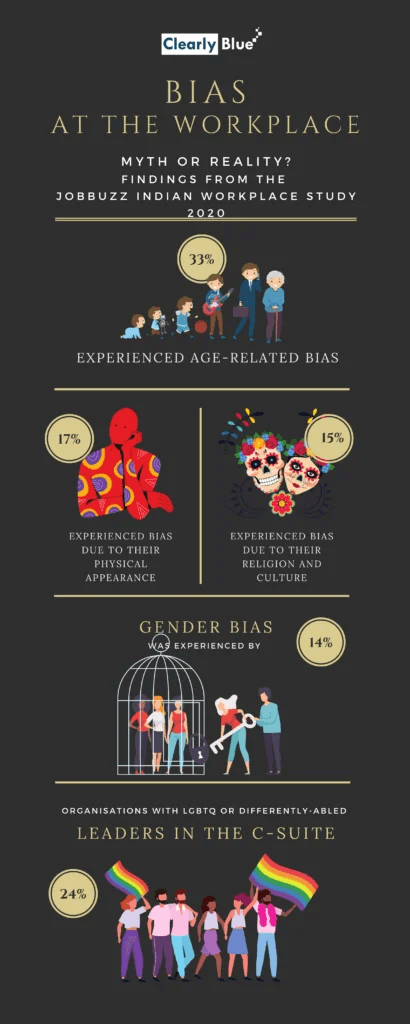
Even in these pandemic times, there is a talk of a bias in COVID-19 layoffs. According to the Pew Research Center, more women than men lost their jobs from February to May 2020—11.5 million vs. 9.0 million.
Research suggests that judging others is our natural instinct. We categorize people and things using easily observed criteria such as skin colour, gender, age and weight. We also pigeonhole people according to disability, sexuality, accent, social status, job title and educational level. We tend to put people with similar traits in the same category, thus stereotyping them. Stereotyping is harmful, causing people to have biases against those who are different from them.
How does bias affect people?
Whatever shape bias takes, it diminishes productivity and engagement. Bias can impact morale, motivation, commitment, and desire to advance in the organisation.
It has been found that working under managers with a high degree of unconscious bias causes employees to underperform and never go out of their way to excel at work. People tend to feel isolated and alienated, which can increase absenteeism in the workplace.
How are organizations attempting to keep bias at bay?
Instead of recruiting from a limited talent pool, from a small set of universities as they had been doing over several years, companies such as Unilever are attempting to remove bias during hiring by encouraging candidates to submit their LinkedIn profile instead. This allows the multinational consumer goods company to hire promising candidates from a large, diverse talent pool – unhindered by the university the candidate attended. After this, candidates are required to play a series of short games on recruitment platforms, which use behavioral science and AI technology to assess a job seeker’s true potential. Once this is cleared, the candidate is invited to complete a video interview using an AI-enhanced video platform that has the capability of assessing different traits of the candidate, including word choice, voice inflection, eye movement and facial cues, among many others.
As a result of the Black Lives Matter movement that recently took the world by storm, following the death of George Floyd in the US, companies like Twitter are reexamining how technical terms are used. Racially charged terms like “master/slave” are being replaced by neutral terms like “primary/secondary”. Similarly, some companies have stopped using the terms “blacklist” and “whitelist” and are instead using “block list” and “allow list”.
In June this year, multinational giant Hindustan Unilever Limited announced that it would rebrand its bestselling skin-lightening cream, Fair & Lovely to “Glow & Lovely”. It removed the words “light/lightening”, “fair/fairness” and “white/whitening” from its brand packaging, and featured women of all skin tones in future advertising campaigns. In a country where the fair skin obsession runs deep, this is a tiny but significant step to embracing all shades of skin colour.
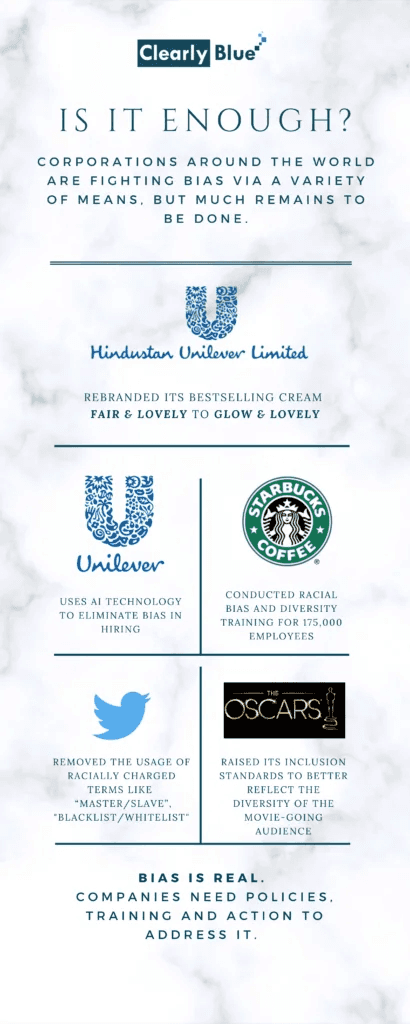
This month, the Oscars raised their inclusion standards “to encourage equitable representation on and off screen in order to better reflect the diversity of the movie-going audience.” The eligibility reforms address race, gender, sexual orientation, disability and ethnicity.
Technology to the rescue for reducing bias
It is a known fact that unconscious bias against older workers, minorities and women is common and makes hiring unfair. This leads to large pools of applicants being ignored and a lack of diversity at the workplace. Companies today are capitalizing on artificial intelligence to address the concern of any kind of bias by using AI-based algorithms to conceal the gender, name and other details of a candidate at the screening stage. This allows recruiters to assess the candidate purely on merit. Even with regard to performance management, AI-assisted performance management processes can highlight any bias in assigning ratings and compensation for individuals.
However, a point to note is that human biases do creep into AI systems. An AI system is able to make predictions and identify patterns based on data that it “learns” from. If this data itself is biased, then the AI system’s decisions and predictions will also be prejudiced. We just need to be aware of these risks and work to reduce them.
For companies to have visibility into the data around the actual work performance of employees, workforce analytics help. Such analytics enable businesses to make unbiased workforce and data-driven decisions to kindle a progressive workplace and an inclusive culture.
However, we need to keep in mind that even with access to the best technology in the world, human judgment will remain important. In the end, it is all about building more inclusive societies and creating a world where everyone is accepted without exception. As Michelle Obama says in her book Becoming:
“Let’s invite one another in. Maybe then we can begin to fear less, to make fewer wrong assumptions, to let go of the biases and stereotypes that unnecessarily divide us. Maybe we can better embrace the ways we are the same. It’s not about being perfect. It’s not about where you get yourself in the end. There’s power in allowing yourself to be known and heard, in owning your unique story, in using your authentic voice.”
Outsourcing in Pharma – The Best Prescription to Follow?
Marcia Angell, the former editor-in-chief of The New England Journal of Medicine and current senior lecturer in social medicine at the Harvard Medical School, once said:
“For all of life’s discontents, according to the pharmaceutical industry, there is a drug and you should take it. Then for the side effects of that drug, then there’s another drug, and so on. So we’re all taking more drugs, and more expensive drugs.”
It is no surprise then that, as per research, the global pharmaceutical industry will be worth USD 1.57 trillion by 2023. The factors driving the growth of the industry are ageing and growing populations, improvements in purchasing power leading to better access to quality healthcare, growing antibiotic resistance, emerging medical conditions as well as emergence of new diseases.
Pharma is alleged to be one industry that is profiting handsomely amidst the mayhem surrounding the COVID-19 pandemic. In spite of this, this industry is not without its set of challenges. Over the years, it has faced a lot of vitriol and mistrust, with vociferous allegations against it of putting profit-making interests ahead of health priorities.
Pricing pressures – Governments in key markets are adopting cost-control policies for drugs and the tightening of regulations. This is affecting the growth prospect of the global pharmaceuticals industry. The last few years have seen a growth slowdown among pharmaceutical companies. They have been forced to reduce their research and development (R&D) spending. Such a reduction, in turn, is expected to hamper growth of the global pharma market as revenue from new drugs form a large part of pharma firm’s earnings due to the exclusivity of the drug.
Accelerated speed of innovation – With major technological advances in R&D, the speed of innovation has accelerated rapidly in the pharma industry in recent years. With the pressure to find new drugs and develop “the next big thing”, pharma companies face the challenge of trying to stay ahead of their competitors and sustaining growth. Therefore, they most often prefer working with partners who help them stay ahead of the curve with proven experience in rapidly developing a new product.
Demand forecasting and assessment of price fluctuation – Pharmaceutical companies need to accurately forecast demand and analyze pricing structures to boost profit margins to stay ahead in the competitive market. Generally, drug developers—without much of a guarantee of product success—begin thinking about production capacity around three years prior to launch. Hence, predicting the required manufacturing capacity when their product finally gets developed is challenging, to say the least, and this is the reason often companies choose the outsourcing route!
The Case for Outsourcing
Pharma and biotech companies are now turning to outsourcing to assist in preformulation, development and manufacturing of drugs. Outsourcing helps companies reduce development costs, expedite drug discovery and boost production. Outsourcing development to an agency that already has the relevant expertise can enable pharma firms to reduce expenditure by postponing capital investments and get access to technologies that are unavailable in-house. Bringing a specialty drug into the market is a complex and investment-heavy process. Once companies have that brand new drug that looks promising, they look for outsourcing partners who can upscale the production process. Big pharmaceutical firms have attributed reduced time-to-market and upgraded quality as significant motivations for outsourcing their business functions to CROs, CMOs and CDMOs.
Outsourcing Partners in Pharma
Contract/Clinical Research Organisations or CROs help in the realm of R&D and focus on discovery services and molecular characterisation for pharmaceutical and biotech businesses. Drug development, marketing, clinical trials and several other facets of the procedure of obtaining a new drug prepared for market are par for the course for CROs. It was during 2007–2009 when most global pharmaceutical companies turned over their clinical research operations to strategic CRO partners such as Quintiles (now IQVIA), Covance, Parexel, and ICON.
Contract Manufacturing Organisations or CMOs: Initially, the focus of CMOs was to provide large-scale, commercial manufacturing for companies that had already developed and validated biomanufacturing processes. As a result, CMOs were generally formed as stand-alone service providers that “rented” manufacturing capacities to their customers. Examples of CMOs are Almac, Lonza and Dr. Reddy’s Laboratories.
Contract Development and Manufacturing Organisations CDMOs: Some CMOs are now providing early development support to their customers along with their manufacturing capabilities – and thus, we get the CDMO (Contract Development and Manufacturing Organisations) to provide niche services. Pharma companies, in a bid to reduce the risk of expensive over-capacities for specific drugs, started outsourcing to CDMOs. Piramal Pharma Solutions, Recipharm and Catalent are among the top movers and shakers in this space.
Indian Pharma – Prospects for Growth
Over the years, India has emerged as a prime destination for the manufacture of branded and generic medicines. Indian CMOs and CDMOs are proactively taking steps to ensure that their quality systems meet the highest standards. The mainstay of the Indian pharmaceutical business has been the generics business; but now, firms are also trying to enter the speciality drugs business.
Though the Indian pharma sector witnessed a disruption in the supply chain due to the pandemic, specifically due to the temporary suspension of raw materials from China, there is a strong focus by the Indian government to reduce import dependency. This means that the present crisis offers India a chance to use its strength in pharma as a soft power to cement its position in the world order and negotiate favourable deals.
The pharmaceutical business model has been witnessing a paradigm shift from a completely integrated company structure to one where firms use outsourcing, partnership initiatives, and other arrangements to create collaborative networks. It is clear that outsourcing in pharma is a trend that is here to stay!
Vital Disruptions in Healthcare, courtesy COVID
The heartbeat of societies finally gets its day in the sun
With over 16 million infections and close to 700,000 deaths worldwide by end-July 2020, the world is facing a health crisis of epic proportions in fighting COVID-19. This is putting a serious strain on healthcare infrastructure all over the world.
In the pre-Covid-19 era, innovations in healthcare were slow to come as the world’s VCs and tech innovators obsessed over self-driving cars, forays in space and social media showcasing ever-shorter videos. The unrelenting pandemic has necessitated a sense of urgency, making mitigating the effects of the vicious virus the need of the hour. Companies around the world are rising to the occasion with technology-based healthcare solutions that promise to pave the way for a better tomorrow.
The Brave New World of Biotech
COVID-19 has brought to light many of the challenges facing healthcare systems around the world. Even the Big Five tech giants (Amazon, Facebook, Microsoft, Google, and Apple) have spurred their healthcare ambitions into action. Each of them has healthcare units operating within their organizations, attracted by the massive $11.9 trillion global healthcare market.
Here are some standout companies that tap unserved niches and promise to revolutionise healthcare.
Breathresearch is a healthcare company with a mission to improve healthy living. It does this through affordable tracking and early detection of deteriorating respiratory health status. Breath Research has 35 proprietary biomarkers to look at various dimensions of lung health that they use to characterize asthma and Chronic Obstructive Pulmonary Disease (COPD) severity (with the help of AI and machine learning). This information can also be applied to patients with COVID-19. In June 2020 BreathResearch merged with Airehealth, a digital health company empowering healthy living through affordable treatments, symptom tracking and early detection of respiratory conditions.
SystemOne’s Aspect connectivity solution and software provides rapid diagnostic data delivery and management. The organization’s digital platform, which has already been tested by previous outbreaks of HIV, TB and Ebola, now tracks COVID-19 cases to inform preparedness, response, and tracking of outcomes. The solution is optimized to communicate healthcare data in low-resource settings. A connected network shortens the time from diagnosis to patient management, enabling reduction of transmission rates for highly infectious diseases such as COVID-19. Health ministries can now use the platform to monitor spread of the disease in their respective countries.
The standard testing method for detecting coronavirus is RT-PCR (Reverse Transcription-Polymerase Chain Reaction). However, this test can in some cases produce false negative results. Huiying Medical which is a member of Intel AI Builders forum has developed a medical imaging diagnostic solution that uses CT chest scans that complement standard lab testing and assist with early detection of coronavirus infections. The company developed algorithms based on CT imaging data from over 4000 coronavirus cases and rolled out its AI-assisted screening system to more than 20 hospitals in China that are at the forefront of battling the disease in real time.
UK-based Vantage Health manages demand for hospital services with it’s AI-powered solution. It’s cutting-edge technology considers the needs of all the stakeholders and helps in reducing the strain on hospital infrastructure by transforming outpatient care. It’s solution recently received the Innovate UK Grant from UK’s innovation agency, in recognition of its effectiveness in dealing with the large spike in demand for hospital services due to the Covid-19 crisis.
Vantage’s solution enables general practitioners and dentists to easily direct their patients towards the right care pathways, ensuring consistency of referrals, and reducing the overall number of patients that result in hospital admission. The last element led one London-based Trust to request urgent support in dealing with the increased volume of patients to their main hospital, as a result of COVID-19.

The India Story
Back home in India, the Kerala-based start-up Asimov Robotics has been grabbing headlines with its three-wheeled robot that can assist patients in isolation wards, thereby reducing the chances of the hospital staff contracting the virus. The robot is capable of carrying food and medicines. Besides this, it can disinfect used items and allows doctors and relatives to interact with patients through video calling.

A group of engineering students from IIT-Bombay, National Institute of Technology (NIT), Srinagar and Islamic University of Science & Technology in Awantipora (IUST), Jammu and Kashmir, have developed a low-cost ventilator called ‘Ruhdaar’. The team, according to a release by the Ministry of Human Resource Development, designed the low-cost ventilator using locally available materials but advanced software. While the prototype costs Rs 10,000, ‘Ruhdaar’ is now up for the next round of medical testing to get approvals.
IIT-Delhi and Japan’s National Institute of Advanced Industrial Science and Technology (AIST) conducted a collaborative research and found that the natural compounds from ashwagandha, an ancient medicinal herb used in Ayurveda, and propolis have the potential to be an effective novel coronavirus preventive drug.
Dr. Siddhartha Mukherjee, an Indian-American oncologist and author recently tweeted, “Rarely has a vaccine been developed in less than 5 years. And yet the oft-cited target for creating a vaccine against Covid-19 is 12 months, 18 at the outside. Can it be done?”
The truth of the matter is that it does take months or even years before vaccines are available to all because vaccine candidate drugs must undergo extensive trials before they are approved. Due to the urgency for a suitable vaccine for Covid-19, companies have shaved off the years required for development and several organizations are working on a vaccine.
Bharat Biotech, a leading biotechnology company in India, headquartered in Hyderabad, announced that it had developed a vaccine against the novel coronavirus, named Covaxin, together with the Indian Council of Medical Research (ICMR) and the National Institute of Virology (NIV), Pune.
In a bold move, Pune based Serum Institute, which is the world’s largest vaccine maker, has teamed up with Oxford scientists to mass-produce the potential COVID-19 vaccine developed by them. As of July 2020, the company had already begun manufacturing the vaccine with the aim of having 2-3 million doses ready by the end of August 2020.
It is clear that companies, researchers and doctors around the world are working hard to develop ways to fight coronavirus and reduce its impact. With so much effort towards alleviating the pain caused by this virus, one thing is for sure – this storm too shall definitely pass!
Introduction to Service Design Thinking
A Bodh Webinar
On 26th June, 2020, Bodh (Clearly Blue’s learning vertical), organised an insightful webinar on “Introduction to Service Design Thinking”.
The informative session packed with industry case studies was presented by Ms. Chitra Gurjar, a coach and senior consultant in Product Development and Strategy. A firm believer in continuous learning, constant experimentation and idea-sharing, Chitra has poured her two decades of experience into driving innovation creatively to find efficient solutions.
She started the session with an example of how people buy and consume music. Rewind to a few years ago, music lovers visited stores to buy music tapes/ CDs. Today, they can listen to any music at the touch of our fingertips through apps such as Spotify and Gaana. Startlingly, music as a product has been converted into a service now.
What is Service Design?
As Chitra explained, Service Design is a combination of user experience (UX), customer experience (CX) and ecosystem experience (EX).
SD = UX + CX + EX* + The People, Assets, Process & Policy, Culture of an Organization
EX* = Ecosystem experience (Employees, Contractors, Stakeholders)
Service Design is mainly influenced by:
People – The creators of the product
Assets – Physical and Digital (eg) Flipkart, Myntra
Processes & Policies used for designing the service, and
Culture – The feeling about the organisation
Service Design can be applied to almost any dimension; it helps create new business models. Cases in point are RedBus and Uber. Service design also helps monitor the way businesses are being run, .e.g., monitoring logistics services in transportation. Further, service design aids in reducing inefficiencies. It helps identify optimisations and creates ways to enable more efficient services.
One key point Chitra underscored was the importance of Service Design in producing impactful solutions: products may just be a part of the solution; most products need services to succeed. Microsoft is a great example of service-driven organisation – it has a wonderful platform ecosystem of services and service lines supporting billion-dollar products.
A Case Study from the Field
Chitra also took us through a case study of a recent public-private-NGO partnership project that she took part in. A combination of technology and feet-on-the-ground was used to deliver essentials to those in need within an area of 18 sq km in Bengaluru during the lockdown period necessitated to contain the spread of the COVID-19 virus.
As a result, about 95% of people in the target zone critically affected by the lockdown – folks below the poverty line, construction workers, security guards and others – were covered through this system.
The case study brilliantly captured the basic tenets of Service Design, which are:
Keep users at the front and center
Embrace team diversity
Be context conscious
Deliver simple, valuable, tangible results.
Basically, it follows the KISS (Keep It Simple, Stupid) philosophy .
What’s in it for You?
Service Design helps increase efficiencies and opportunities even within the business. It helps examine if processes and policies are friendly towards the delivery of a design.
The term “Service Design” has been used since 1982, a time when products and services were looked at separately. Now, there is a power shift from producer to consumer. Hence, service design becomes a very essential element in how companies and organisations can deliver value-added services to the end users.
“There’s no longer any real distinction between business strategy and the design of the user experience. The last best experience that anyone has anywhere becomes the minimum expectation for the experience they want anywhere. “ – Paul Boag
When we drop by at Starbucks or Café Coffee Day, we don’t simply get a cuppa; we carry back an experience with us. Don’t we expect a similar experience on our next visit? This is why having a design thinking mindset is important. Having the ability to envision what kind of services are required to enhance user experience is essential for every organisation to be successful.
FAQs
The Q&A Session gave us an opportunity to derive more understanding of Service Design. Here are some of the questions answered.
How does a product person approach this? How does one look at the services allied to the product and how to get started?
No product exists in isolation. It exists amidst an ecosystem. This ecosystem lies in the minds of customers. This is where the people working with the product should start their journey of understanding the product. You should actually start conversing with the target audience to identify the pain points and their expectations. For example, the advent of the iPod changed the perspective of music as a service rather than a product.
The product manager should be an empath of the user.
The true creators of products are indigenous people. For instance, during the lockdown, farmers grabbed the opportunity of delivering fresh fruits and vegetables to people’s doorsteps.
How do you decide what parties need to be involved? Is there a process?
Yes, there is. It involves considering all the stakeholders in the whole process chain, both internal and external. For example, Toyota is a caring/empathetic organisation as they consider everyone involved.
What are the typical tools used in service design?
There are many of them, depending on the stage you are at.
What are the key points which help a product manager to discover how to deliver the functionality, be it a service or product?
Start with engaging people together to figure out what you need to create, be it a service or a product. If you’re in a large organisation, ensure that everyone (business team, finance team, customer support team, engineer, marketing team, sales team) is present in the initial discussions, from Day One. All these people have an influence on the result. In this way, you can prioritise the deliverable and get quick feedback. Eric Ries, the author of “Lean Startup”, describes this in a very interesting way.
What is the scope of service design? Where does service design start and end?
Service design encompasses a very wide ecosystem. We should all cultivate a more systematic way of thinking. Look at the internet of things – IoT. The Internet has changed the world so dramatically. A digital Indian platform enables millions of ideas to thrive on it. Anything you create – a service or a product – think of it beyond itself; what is the ecosystem present around it? In a Starbucks, more than people ordering a beverage, you see that there are many people having discussions and working together. It is more like a working space for exchanging ideas and meeting new people. It also has a dropbox for visiting cards. So, service design enables you to think systemically and think of a wide ecosystem around you.
How do you make sure that the attention span of a customer does not reduce?
Be very interested in the customer. Understand the individual. Be curious and empathetic. When the person understands your interest in them, they will give you their full attention; just like how lovers give attention to each other on a date.
These are one of the tools involved in the process of service design.
Interested in kickstarting the Design Thinking journey with your service delivery or product teams? Talk to Clearly Blue for a range of design thinking services including Service Design Thinking workshops, consulting and coaching with experts and industry practitioners.


Remote Working: 4 Ways we Make it Work at Clearly Blue
Some tips for managers and employers in these harried times
Remote working (“Working from home”) is almost a norm at Clearly Blue. All employees past their probation period avail of it once a week – sometimes more, depending on what’s going on with their life, commute situation, and health. One common strain among our employees is they actually hate working from home – they enjoy the camaraderie and instant feedback at office, and feel they’re more productive here. But, external circumstances force work from home many times, and we’re happy to accommodate the best we can.
We’re all experiencing a giant external circumstance right now – Coronavirus is stalking the globe, felling celebrities and prime ministers as well as ordinary people like you and me in its wake. Yesterday, we made a snap decision that all employees would work from home for the next few days. It doesn’t really need a huge change in the way we work, given that we do it as a matter of course.
I saw several LinkedIn posts this morning about other companies shifting to this mode as well. Thought I’d share a few of our best practices – spreading the goodness never hurts! So, here goes –
Collaboration tools – Think Whatsapp, Hangouts, Slack, Cloud-based productivity aka the G-suite or Office 360. These are de rigueur if your team is going to work remotely.
What to watch out for: Do ensure you’re set up and fully productive on this front. What does this mean? For instance, CB has moved incompletely to Slack – some of our client projects demand a Slack participation, some not. We’ve made it a goal to move completely to Slack this quarter, but for now, our teams love Whatsapp – groups keep popping up for every project, landing page, conversation or campaign. I’m keeping an eye to make sure we stay productive, but am pushing my PMs to move to Slack – just so that we reap the benefits of a full-blown productivity platform rather than a glorified messaging tool. We’ll get it done soon.
Set office hours – Working from home doesn’t mean you login when you feel like it. We ask all the team members to maintain the same hours as if they were in office. This means logging in at 9ish, taking your lunch break 1ish, and so on; ensures that no one feels frustrated when they ping a colleague and are left hanging for 15-20 minutes waiting for a response.
What to watch out for: I’ve noticed that the more senior design folks can’t be pinned down to regular 9 to 5 hours. Many prefer pulling late nighters and are probably at their best then. We ask senior design folks to give us some set hours when they’ll be online, and do our meetings and interactions then. We do working sessions late night with some too – whatever works to ensure the flow of creativity doesn’t ebb!Empower with time management – It’s a fact that can’t be denied – most freshers and junior employees don’t have the time management skills needed to work remotely. What do you do when everyone is remote? Our Head of Operations spends her first hour talking to many of them (as do some senior PMs) helping them plan their day and priorities. Yes, it’s micromanagement, and yes, it’s necessary. Unfortunately, our education system doesn’t teach us these skills. So managers need to.
What to watch for: Micromanagement must be done adroitly – a word of praise here, and note of caution there. Gentle steering rather than heavy-handed monitoring. In our line of business, passion and energy count for a lot. We don’t want to dampen that!
Reliable video conferencing – Three cheers for the makers of Zoom, Hangouts calls and other video conferencing tools. They help remote teams converge effectively on calls using shared screens and allied tools. Many a roadblock is removed via a simple 20-minute call. We’ve been using this heavily even with clients (two words: Bengaluru traffic) and I highly recommend it!
What to watch for: Uneven net connectivity across the team. Do ensure your team members have good net connectivity to enable them to login without a hitch. We’ve sent some team members home with Jio wifi boxes to help them be productive.
One last personal tip – encourage your teams to ‘get ready’ as if they were going to the office before they login. I’ve found that wearing office attire puts me in the right frame of mind to work.
Everything else – cutting ambient noise from people at home, a proper work desk, internet connectivity, etc. – are a given. The onus rests on the employee to take care of these basics. But as an employer, if you take care of the 4 best practices we’ve shared, you’re more than halfway there.
Good luck to all of us as we navigate turbulent health situations and economies the next few weeks and months – may the world emerge safer, healthier and happier out of this crisis!
Hitting the High Notes with Your Blog: Here’s How To Do It
My editor and I were reviewing a blog recently and I remarked that the blog lacked depth. So the discussion led to ‘How does one add depth into a blog?’ Here are snippets from our conversation that I hope will aid not just our writers but anyone seeking to share thoughtful, ‘in-depth’ pieces of writing with the world.
‘Plumbing the depths’ is almost always a pejorative term. So perhaps, as writers, we should seek to soar and hit new zeniths rather than seek a nadir. That being said, how does one write a rich, thoughtful AND engaging piece with new insights that leaves the reader with a sense of having learned something new?
Here are 6 easy ways to try to do this –
Go to the bank – As we write in this digital era, and as most of our writing lives on the net anyway, it’s not that tough. We have the wealth of the internet – videos, quotes, memes, infographics, images and other blogs – to bank on. We also have the banality of the net at hand, so take care not to get lost in a maze of irrelevant trivia, or to overdo it. A quote a blog is good enough. Perhaps a couple of topical videos. Link to 1-2 relevant blogs that you may want your reader to look at for further reading (Side note – the ‘you link to my blog and I’ll link to yours’ cottage industry is alive and well. Try it!) Always, always, always, make sure your references are very aligned to your core topic. Show, don’t just tell.
Let your personality in – Are you a mountain climber, who just happens to write blogs to catch a breath? Or a Jane Austen fan who sees Darcy dripping out of the lake everywhere? (We have a couple of those in our office!) Perhaps you Netflix your way out of boring evenings. Hey, let that passion shine in your writing. A wry allusion to Bergschrund gaps here or a tongue-in-cheek reference to Colin Firth in the lake there never hurts and, in fact, may be the one thing that makes your blog memorable for the reader. Let your true self seep through – keeps the blog from being banal.
Research, research, research – The first thing I do when someone assigns a blog topic to me is read. It’s the happiest feeling to key in the topic into Google’s search bar and do some no-agenda learning about a brand new topic. I’m sure everyone does too. Here are some ways this secondary research can yield better results –
Look up Google Scholar. As the tagline says, you can literally ‘Stand on the shoulders of giants’ – sift through previous research, studies and writing on the topic to learn, perhaps quote and cite.
Look at news, images, videos – Instead of the ‘all’ tab on the search results, the ‘News’, ‘Images’ and ‘Videos’ tabs may yield more targeted results. Speaking of videos, Google doesn’t always index Vimeo or Metacafe videos. It’s worth searching on these portals too.
Trade publications, here we come – Every vertical and horizontal has trade publications – mags, journals, leader blogs, communities. These can be vital sources of information to build your blog. For example, if you’re researching Cybersecurity, Brian Krebs is the industry insider to follow. How do you find these sources? Google ‘Best cybersecurity news sources’ – follow the search results down the rabbit hole! Never stop your research with Wikipedia – Wikipedia’s citations list for any topic may be a good place to start.
Your client – Ask your client for sources they may want to include in the blog. They may have already collected a good set of research articles and links – most clients are erudite people who just don’t have the time to write. Help them help themselves by asking for inputs.
Structure it – Meandering blogs serve no one and only help to ensure your reader never comes back. Give your blogs a structure – awesome headline, optional explanatory subtitle, context-setting introduction, and the ‘meat’ sandwiched between that and a ‘bring it all together’ conclusion or summary. Don’t worry so much about hitting the word length desired (it will get hit if your research and structure are good). Here’s someone famous sharing his formula for getting 37,000 readers per blog post – many books don’t sell that many copies! Make it rich, make it structured.
Follow the KISS principle – This is perhaps the most important, yet most ignored tip. Short sentences. Conversational, plain English. 3-4 sentences per paragraph. Avoid the Queen’s English at all costs. Talk to your reader, ask them to talk back in the comments or with an email. Keep it simple, silly!
Sit with your editor – When in doubt, sit with your editor and have her scrub through your blog. Editors read A LOT and can be a treasure trove of tips on what to do and what to avoid. Here, I’m doffing my writing hat at our in-house editors SS and AJ who keep me on the straight and narrow language-wise, grammar-wise and depth-wise!
And there you have it! See the structure of this blog – it’s a listicle. See the single meme with Ned Stark (yes, I ‘flix my way through weekends too!) See the peppering of quote and video – just enough, not more.
Did you find this blog helpful? Is it engaging? One heartening hint for me: if you’ve come down this far, you probably did. Let me know if I hit the high notes (or not) in the comments or write to info@cbnew.test.
WFH Processes…An Ode, A Rant and The Nitty-Gritty
How Clearly Blue is soldiering on in the times of Corona: No COVID19 is going to beat down this feisty set!
The Ode
What are they, you say?
Well, m’lady, tools just aren’t enough
To make you productive
In this wfh age of corona cough
You need to be reactive!
When a PM sends an email
Asking for an after-read ack
You better do so pronto
Or else, you may face the sack!
Alright, I’m just jokin’
But you know what I’m sayin’..
Effective wfh requires many virtual hands to shake
Every email, hangouts message or ping
A prompt response to make
Login at office open time diligently
From your work desk at home, away from all the din
[Yes, we know kids are home for the summer, and so is the spouse, so are the kin!]
Fill your tracker with your tasks for the day
And get started, while the office time sun shines, make hay!
Schedule Zoom meetings when you need formal interactions
Casual “Hi”s or queries can happen on Hangouts
I know you love the Whatsapp
But I’m pushin’ you towards the Slack!
Try and get some fresh air after lunch
A short walk or (heresy!) a cat nap? Just a hunch
Hey, both are OK in my book
As long as you get the work done, by hook or (and hopefully not) by crook.
Be in touch with your PM
And our Watchful Lady COO
We have customers to account to
And deadlines loomin’ too
This corona don’t know nothin’
About us or our way of workin’
We’ll beat it, as we will master the game
Of effective WFH in its name!
The Rant
One of my PMs was frustrated today. A writer wasn’t responding on time to Hangouts pings. Was she online? Was she working? Was she ok? Such questions can drive a diligent PM batty and make her want to run back to office, Corona or no corona. As I tried to soothe her and make the writer get back in line the thought of documenting this bloomed.
This is the reality of working from home in the age of Corona. Under-communication can be a major deterrent to wfh, which we must work towards eliminating.
Vanshika Mehta tagged me on LinkedIn asking about WFH processes, which I thought was serendipitous as I put this together. My previous blog spoke about tools – video conferencing, collaborative tools; and some processes – set office hours, encourage employees to be professionally attired, and so on.
Employers and managers can set a ton of policies and guidelines, but at the end of day, the one person who can make it work is YOU – the new-age-white-collar worker-from-home.
YOU need to be –
Proactive – ask questions, respond to emails, login to video calls, just as if you were at office
Disciplined – ensure you maintain office hours
Empowered – with all the tools, technology and internet speed you need
Unperturbed – despite all the ambient noise from others at home or on the street
Inspired – overcome the comfortable environs of home to give your best
A contributor – suggest ways to optimise wfh and make it more productive for all.
Sounds like a lot to ask from an average office goer?! But that’s what we’re asking of our teams today – this epochal year is all set to transform the way we live and work. If we’re going to keep the engines of our economies chugging across the world, virtual logins will be de facto from now.
We’re in this together! Enough rules I say! We’re all adults. Let’s get to work, no matter where we login from and let’s GET IT DONE!
The Nitty-Gritty
How do information and decisions flow while the entire team is wfh? It’s quite simple really – the same way they do if the entire team were at office:
Every piece of content, design or collateral we send out is checked thrice – by the writer/designer before submission via Google Drive or other cloud platform, the editor and the PM (both on the Cloud). Many-a-times, four times as I do my dipstick checks
PMs call virtual meetings of their teams to allocate tasks and get updates
Our weekly team meeting has moved to Zoom
Team members use Hangouts for ad-hoc queries, clarifications and conversations
Team members are expected to be ALWAYS ON during office hours with email, Hangouts and Whatsapp.
Phone calls handle all other exceptions
All meetings with clients and vendors are on Zoom
Restrict all meetings to 0.5 hours if possible – whether internal or external.
Online trackers ki jai!
CHO-Who?
Does your org need a leader who worries about employee happiness?
‘Good’ stress keeps employees happy and motivated. It helps them keep their competitive spirits up, thereby encouraging a good work-life balance. Then, what is ‘bad’ stress? An authoritative source labels it as “…a state of mental or emotional strain or tension resulting from adverse or demanding circumstances.” Agree? Going by this definition, stress is unavoidable in modern-day workplaces. How then, do organisations help their people cope with it?
There are lots of ways employers try to deal with employee stress. One of them is to have a Chief Happiness Officer (CHO). Ever wondered what this role is all about? A new C-suite title or just a new nomenclature for old-hat HR stuff or, worse still, an additional ‘imaginary’ title for the HR person from whom you keep getting emails?
The CHO is an HR person who frames policies to ensure employee happiness so as to get the organisation to scale up, bring down employee stress levels, and create a happy environment at the workplace. The CHO is especially valuable if your organisation employs ‘rising millennials’ as interns/employees – those younger folks who are attracted towards intangibles such as happiness and satisfaction at the workplace – than the tangible paycheck.
What does the role of a CHO involve? It involves re-defining the HR processes starting from recruitment to the complete life cycle of an employee at the workplace to bring about a happy experience for all concerned. However, all these transformations have to be made keeping in mind the company’s mission, vision, and values.
Some of the standards CHOs work to provide their employees are:
Have a voice to express their ideas
Access to leadership
Recognise and reward performance
Motivate/mentor juniors
Create discussion forums and a buddy system
Involve employees in decision making, support their growth, and
Foster an enjoyable environment through team building activities.
As per a case study on Articulate Marketing, a remote working company, when the firm grew quickly, Liz Fielder was appointed as the CHO of the firm to bring in the right culture. Engaging and connecting employees in conversations who did have a face-to-face interaction daily was a challenge to Liz. She devised policy changes and engaged in informal discussions with employees(known as “happy talks”- a forum where employees could openly speak and seek support). With this, the organisation was able to create a workspace where:
Productivity increased
The right culture was encouraged
The right fit to the organisation culture was designed
Employees loved to work
Happy non-cribby faces were around
Ideas flowed
Hierarchy barriers in expressing views were taken down
High retention was achieved
Rewards and recognition were instituted
Articulate’s founder- Matthew Stibbe says – “With the CHO, there is a feedback loop and channel for my ideas. Fairly quickly, people can react to how policies and changes are affecting their work and have their concerns heard. In turn, this has boosted their motivation and ability to work well, as well as team morale.”
Eventually, employees learn to deal with workplace stress as they have a highly-reliable, support system policy courtesy CHOs. After all, happiness in itself should be the key to achievement.
Going Through a Pandemic in The Digital Era
Globalization and the interlinking of economies have had an impact on the 19th and 20th centuries. A higher quality of living. A better understanding and appreciation of other cultures and a spread of information and technology unlike ever before, to name a few.
But does this high level of connectivity between countries have any negatives?
Would the disease have spread throughout the world so quickly? Probably not. In the 18th and 19th centuries, poor hygiene and cramped working conditions meant that the coronavirus would have probably swept across industrial countries rapidly before travelling abroad.
Would the disease have infected more people and killed more? Certainly. Reports show that the bubonic plague killed 1 of every 1.5 patients, while the coronavirus kills 1 of every 19 patients it infects.
Globalization does have positives when it comes to COVID-19 as well. People are now able to work from home and students can learn from home. Services such as Zoom and Slack offer professional tools to stay in touch with your colleagues and run your companies.
Video call services such as Whatsapp, Zoom, FaceTime allow family members to interact with each other and spend some time together even if they are thousands of kilometres away.
Delivery services such as Zomato or Amazon have begun to enforce a number of protocols in order to slow down the spread of the virus such as contactless payments, door deliveries and mask-wearing riders.
Services like Google for Education allow educators to teach their students from home. Even before this, Khan Academy and Coursera were a few services that were offering thousands of courses for free.
Many companies have seen this demand for products and have begun offering several deals to appeal to consumers during this trying time:
Google is offering free access to Hangouts Meet.
Microsoft is offering six months of its Microsoft Teams platform for free.
Zoom lifted the 40 minute limit for its free basic plan.
Doctors have also been able to share the genetic code of the virus very quickly and have already begun the development of vaccines. Food banks and services for the elderly have been able to get volunteers by advertising on social media.
People all over the world can have better access to information about the virus and how to prevent it. We already know about the real-time count, but there are other innovations that have arisen.
Many websites are working on GPS-enabled tracking which allows its users to track coronavirus patients using their phones.
Researchers in the US have worked on a tracking algorithm that showed the movement of people throughout the country from a single party in Florida in order to demonstrate how small events can have large consequences.
Social media has turned into an escape for quarantined people. Survivors from Italy and China have shared their stories with people all over the world to convince them to stay at home.
Teachers are posting educational videos. Chefs are posting cooking videos. Gym trainers are posting daily workouts. It’s almost like our real world has been transformed onto a digital platform.
But all great things can be misused or abused.
This spread of information may also contribute to an increasing sense of paranoia and fear in citizens. Aren’t we immersed in a world of coronavirus news and facts and figures every single time that we go on to the internet?
Would citizens benefit without knowing the number of people who died every single second of the day, as headlines from newspapers or websites all feature just that?
The digital era has pushed forward a number of innovations, whether it be making ventilators in a few minutes or creating drive-through testing centres. I think it is safe to say that we are fighting this virus at the right time – connected and driven.
——————————————————————————————————————–
Source : https://www.cdc.gov/plague/faq/index.html
New Lessons From Sunny Ads From Another Era
Kick back, rewind (and learn!) with these ads from the pre-Covid days
Summer’s almost gone and we haven’t left home! We’ve had to bypass a lot of fun in the sun.
As we ease our way back to our workplaces and take the new order in our stride, don’t you think we’ve earned the right to chase the blues away with some fun?
What comes to mind is a song from the 1965 musical, The Sound of Music,
….When I’m feeling sad
I simply remember my favorite things
And then I don’t feel so bad…
So, here I am sharing some of my favourite things – works of art, mystery novels, roller coaster rides, and tragic movies – all in the form of ads.
Works of Art
I tend to fall for these ads that showcase sheer ingenuity. You just have to take a break and admire them.
This campaign created by The Martin Agency, debuted on the tops of public buses in New York and San Francisco.
The concept of looking down from the top of a building in despair and seeing this ad is sheer marketing brilliance.
It’s all about where you place your ad and what it says.
Here’s a picture that’s indeed worth a thousand words (and lives).
This “buckle up, stay alive” campaign by SAAQ (a Canadian provincial agency) needs no explanation.
The clever use of an everyday image to convey such a powerful message is brilliant.
Sometimes saying less is definitely more.
I love morphing into my favourite character and walking in their shoes. Don’t you?
Mint Vinetu, a used book store in Vilnius, Lithuania tapped into this desire of the average reader with this ad.
A person reading a book is an everyday sight. Telling a story with the right positioning of the book and the right book cover, is sheer genius!
The Mystery Novel
These are ads that earn my appreciation for the creative use of wordplay and intrigue. It’s sort of like a mystery novel – you are drawn to read the fine print because the ad sounds so bizarre.
Take a look at this ad from SAP. Don’t they want to hire people?! Well, it reads as if they don’t.
The fine print tells another tale!
Ever heard of a company that advertised the loss of a client? That’s exactly what McCann World Group did!
The fine print reads-
After four years dedicated to delivering a successful London 2012, our work here is done. It’s an exciting moment, because we now have an Olympic sized roster. We’re hoping to fill it with brands that want to perform faster, higher, stronger. And with clients that don’t wear so much Lycra.
This was just after the close of the 2012 London Olympics for which McCann handled promotions and advertising.
Loreal’s lipstick ad shouted out that “this is for men”, turning quite a few heads!
The fine print reads, “Hire more women in leadership roles. We are all worth it.” An ad that proves that you don’t need to get all ‘manly’ to become a leader. Women can do just fine as they are!
The Roller Coaster Ride
Ever been tricked by a clever play of words on a billboard? The split second from, “They can’t really be saying that publicly!” to “0h, that’s what they meant?” is the ad equivalent of a roller coaster ride. The switch from hinting at a social taboo or illicit pleasure to something quite mundane makes you feel as if you are sharing a private joke with the brand.
The Japanese car manufacturer, Diahatsu came up with this ad that rides on a brilliant “pick up” (pun intended!) line for men. Which red blooded male wouldn’t fall for that?
The comparison of an ordinary minivan with a Lamborghini is so ridiculous that it ends up being hilarious. Of course, the copy is sexist and characteristic of the age where women were objectified.
Not something Diahatsu would want to go for today.
Now if you rush into this pub without reading the “fine print” hidden within the sign board, all I can say is … too bad, my boy!
Read it again – it says, “The naked truth about our waitresses is that they only flirt with you to get a better tip”. Didn’t your Mama tell you to ALWAYS read the fine print? Well, it applies to Irish pubs too!
Subtlety was thrown out the window when they were designing this one. Well, it works, so who’s complaining!
A little too preachy for your tastes? No, this ad from Indigo is not about marriage counselling or moral advice. Read the next line, my friend. I have to admit that this is one of the classier ones in the genre.
Video ads need to reel you in within the first 5 crucial seconds. Kmart’s “Ship My Pants” ad does this so well with its simple yet cheeky wordplay. The 21+ million views tell its own story.
The Tragedy
I know you’ve seen a deluge of ads on the COVID 19 theme. Samantha Geloso mimics the mix of uplifting and tragic montages that have been pouring in from brands all over the world. This film is sure to trigger some soul searching in all of us. Do we need to rush in to take advantage of every human tragedy?
Funny, somber, ridiculous, thought-provoking. Ads come in all shapes and sizes.
Brands have been projecting their chosen persona through ads for decades now. It’s their way of connecting with us. Ads that truly embody the brand’s persona while relating to the audience are the ones that stand out and catch our collective attention.
So what?
Why look at ads and puns and one-liners in banners at all? We’re well and firmly in the digital era now and many print media including hoardings are going the way of the dodo. But these ads I crushed on showcase the glorious art of communication – that, all it needs is a play on known cliches, a tongue-in-cheek take on goings-on, a sly aside or an earnest appeal to the reader’s better sense – to make an impact or underscore your brand positioning.
This is the essence of brand communication in any era. Crisp copy that makes an impact. Especially in the digital era. Beyond the tech and the numbers, look to build great copy.
I sure had a lot of fun putting this together – and learned a lot in the process! I hope you take away some ideas and directions for your own brand communication.
Ciao!
A Shout Out for Indian Design!
Is it time again for its place in the sun?
Have you ever drooled over a gorgeous Uppada silk saree but thought, “I’ll never wear it, so why fork out 15K for it?” Or wondered if you should spend tens of thousands on an intricately carved teak table at the handicrafts emporium? We despair over the urban chaos we are surrounded by, but are sometimes blind to the immense genius of Indian design that we regularly bypass as we covet foreign goods and ape foreign sensibilities in the ways we dress, do business or spend our leisure time. Perhaps, it’s just the right time in the journey of our country to just take a step back and appreciate the beauty of Indian design.
The Case for Going Vocal for Local Design
Pre-COVID, the teetering world economy was on the edge of a recession. Now, we are bang in the middle of one. Harvard Kennedy School Professor of International Finance Carmen Reinhart opines that “COVID-19 is like the last nail in the coffin of globalization.” Prime Minister Narendra Modi’s clarion call for “Going Vocal for Local” – a new avatar of “Make in India” he launched in 2014 – is intended to support domestic enterprise and boost local talent. India Inc. is stepping up to the challenge in various ways, including in a crucial one India has long been known for: design.
Indian Design Ahoy!
Design plays a crucial role in manufacturing, engineering, marketing, and management. India has a rich and glorious heritage of beautiful and intricate design. This is evident from our temples, architecture, textiles and crafts that have inspired designers from all over the world. Much of this innovation has been based on advances in chemistry, metallurgy and other sciences, underscoring how design can be the catalyst for a whole range of industries.
Throughout her history, India has seen waves of invasions and settlements – leading to a constant integration and assimilation of migrating people with diverse cultures and backgrounds. This has made our country a unique melting pot, giving it a timeless legacy and inheritance in the form of its arts, crafts, jewellery and embroidery. Several lifestyle and fashion brands take inspiration from Indian heritage and work towards adapting Indian designs and textiles to contemporary fashion to make them more relevant for the current generation.
Colour me indigo!
We all know of indigo, the eponymous blue of the Indian subcontinent. The charms of this vivid colour have been celebrated by textile designers, couturiers and fashionistas the world over. Have you heard of Indian yellow? This is a creation by dye makers in India who fed mango leaves and turmeric to cows and extracted the pigment from their urine. This colour has been the hallmark of many works of art as well as textiles coming out of India.
Such stories typify the pursuit of excellence that made Indian dye makers, artists, textile designers and cloth merchants of yore so sought after. This is the excellence that made Indian textiles sought after, making it one of the most lucrative sectors contributing to India’s share of global trade – a whopping 25%!
Other stories abound – of muslins so fine, British colonists cut off the thumbs of muslin-makers in Dhaka rather than compete with them; of indigenous innovations in sculpture, art and architecture – many of which last to this day. The stories are both nostalgic and painful, leading one to ask, what happened?
11th Cent. AD Bronze Chola-era Nataraja statue at the Metropolitan Museum of Modern Art, New York [Courtesy: Wikipedia]
In an effort to bring those glory days back, over the past decade, the government has recognized the importance of developing the Indian design sector. India formulated and adopted a National Design Policy in the year 2007, and is one of the few countries to have done so. To implement the major provisions of the National Design Policy, it established the Indian Design Council (IDC) in March 2009. The IDC is at the forefront for the cause of design excellence in India. It works with the design community, educational institutions and industry to promote design in public service, business and society.
Today, most design activities and companies in our country are focused in four cities – Bengaluru, Mumbai, Delhi and Pune. The services offered by Indian design companies span various disciplines – interior design, architecture, fashion, graphic, industrial and automotive, animation and human computer interaction (including UX design).
Whither local design?
In spite of their capabilities in all the design disciplines, Indian designers have often been accused of aping the West without being aware of the potential within their own culture. In fact, even Indian design education has been criticized over the years for aping the curriculum of Western design centres. It’s time we regain confidence and take pride in our design capabilities, give Indian design its place in the sun – lest we lose our legacy and our skills.
The design industry could broadly be categorised into three: in-house design teams in large enterprises, design businesses, and freelancers. Many companies with inhouse design departments have excelled themselves in specific disciplines of design. For example, HiDesign (Leather Design), Tata Elxsi (Animation + New Media Design), Mahindra Composites (Automotive)…the list goes on! It is quite another matter that many small and medium businesses lack the resources or understanding of the value of design and design innovation as a source of competitive advantage.
Impetus to Design Education
The biggest companies are vying for more design talent, prompting design education in India to go from strength to strength.
Top institutes like the National Institute of Design (NID), Ahmedabad and the Industrial Design Centre, also known as IDC School of Design, were envisioned more than 50 years ago. Over the years, other design schools such as the Srishti Institute Of Art, Design And Technology (Bengaluru) and the MIT Institute Of Design (MIT ID), Pune have been providing top quality multi-disciplinary design education.
In the current climate, we may be facing a wide set of challenges, but we have an opportunity to script a turnaround in our economic growth on the back of our demographic dividend. Indian youth have rising educational aspirations and an openness to pursue alternate careers.
New media, new design: Young designers show off new typefaces in the @TypeofIndia Instagram handle
A trend to take heart from is that several young and upcoming Indian designers are going back to their roots, embracing the traditional and developing uniquely Indian aesthetics. Design schools are also becoming aware of local needs and realities in the ongoing evolution of design education.
With so much going right for it, can India become a leading influencer in global design and seize new possibilities? Only time will tell. As we look forward to a new dawn in Indian design, we leave you with an observation of past glory to draw innovation inspiration from:
“Something has been said..about the high industrial development of the Gupta times, when India was looked to, even by Imperial Rome, as the most skilled of the nations in such chemical industries as dyeing, tanning, soap-making, glass and cement…The Moslems took much of this Hindu chemical science and industry to the Near East and Europe; the secret of manufacturing “Damascus” blades, for example, was taken by the Arabs from the Persians, and by the Persians from India.” – Will Durant, The Story of Civilization
Follow us on our social channels. We are showcasing ‘Going Vocal for Indian Design’ this July. You can also send us your thoughts and ideas at info@cbnew.test on how we can support design in India. Bring them on – let’s celebrate!
REFERENCES:
https://economictimes.indiatimes.com/jobs/they-arent-it-coolies-indias-engineers-turning-into-designers/articleshow/72821004.cms?utm_source=contentofinterest&utm_medium=text&utm_campaign=cppst
https://www.bloombergquint.com/onweb/reinhart-says-pandemic-is-last-nail-in-globalization-s-coffin
https://economictimes.indiatimes.com/https://economictimes.indiatimes.com/news/economy/foreign-trade/how-india-can-solve-the-chinese-puzzle-without-hurting-itself/articleshow/76405868.cms?utm_source=contentofinterest&utm_medium=text&utm_campaign=cppst

The Power of Storytelling in Marketing and Brand Building
Stories, for ages, have been invariably used to engage audiences – effect and recollection being profound. This basic human reaction has been used by marketers to create unforgettable branding.
“In order to win a man to your cause, you must first reach his heart, the great high road to his reason – Abraham Lincoln”.
The best way to influence someone’s thoughts and actions is to emotionally engage them. And that’s exactly the power of stories! Stories trigger human emotions and activate neurons in the brain leading to long-term memory.
A physics professor once explained a lesson on friction using an example of a train accident caused due to locusts. It’s been ages; I can neither recall his name nor the formulae learnt. All I can remember is the story!
Why brands need stories
How storytelling influences buyer behavior is a fascinating story by itself! Be it the amazing way Nike connected with the world by honoring great athletes, or Steve Jobs using the Nike example and weaving dramatic stories to introduce Apple products. These stories hit bull’s eye! Nike never spoke about how its products were better than the others; all it did was honor athletes. But, the way it made consumers feel, made all the difference to its success!
Storytelling is not a new concept in marketing and brand building. Several brands have used it over the years and have been highly successful in capturing user attention and memory. Information linked to storytelling is recalled more successfully than that presented without storytelling. It’s not enough just to provide a product or service. The way you communicate to your audience matters the most! In today’s fast-paced, technology-driven world, consumers are being bombarded with content. For brands to survive, they must establish an emotional connect with consumers, and that’s where storytelling steps in! Brand storytelling cannot be treated just as an add-on anymore. This is a must-do activity for businesses. Stories can inspire, motivate, and most importantly, move buyers to action!
Closer home, Swiggy depicted stories of people hungering for a certain dish and, voila! They had it at their doorstep! The brand made its mark in the minds of the audience, Swiggy has become synonymous with food delivery in India.
But being authentic is equally important. Stretching it too far can turn out to be an erroneous strategy; PepsiCo’s Naked Juice had to agree to a settlement of $9 million after making false claims that all its products were natural.
How you could do it
If you are wondering how you could weave a story for your brand, here’s how:
Define your audience: To think of the story you’d like to tell about your brand, you need to think of who you are targeting. Knowing your audience will help you craft a story that would have maximum impact. Most health insurance companies target an older age-group with families, while soft drink companies like Pepsi and Coke have their stories wound around a younger audience.
Summarize your message: Whatever it is that you’d like to convey about your brand, you need to summarize it into a core message. What you would like consumers to perceive your brand as largely depends on the core message that you communicate. For example, life insurance company HDFC Life uses the core message of being self-reliant through inspirational stories.
Decide your story type: Based on the response that you would like from your audience; you can determine the type of story you’d like to narrate. Your stories can be about the brand, core values, community building, educational or inciting action. quality of its product. Byju’s The Learning App, narrates stories of learning being fun with Byju’s to get acceptance from parents and students.
HDFC Bank is another brand that uses storytelling to speak about its brand and on-time customer service.
Determine your goal: Your story must also be created keeping in mind what action you would like the buyer to take. Coke’s ad campaign, “Share a Coke with your loved ones”, is a story with a clear call to action.
https://www.youtube.com/watch?v=e2Rxj2z4HZA
In the online movie watching domain, Netflix says it best with “See, what’s next”.
Select your story medium: You can convey your story through any of the below ways based on your resources.
Written story through blogs, articles, or books
Spoken story through presentations
Audio story through podcasts
Digital story through videos
Share your story: Creating your story is only half the task done. You need to share and promote it to achieve your objective. Based on the medium chosen, you can share your story through print, television, social media, blogs, guest posting, email, and so on. The more places you share your story, the more likely you are to get your audience involved.
Including storytelling in your marketing strategy can do wonders for your brand. So, go on, tell your story. Make your brand more human, the audience will be all ears!
References:
https://www.harvardbusiness.org/the-science-behind-the-art-of-storytelling/
https://leanin.org/education/harnessing-the-power-of-stories
https://blog.hubspot.com/marketing/storytelling https://web.colby.edu/ar120/2014/04/25/all-the-kings-men/
https://www.restaurantindia.in/news/domino-s-launches-a-new-brand-campaign-dil-dosti-domino-s.n18975
https://www.huffingtonpost.ca/entry/naked-juice-class-action-lawsuit_n_3830437?ec_carp=8889237977200745606
Privacy Matters – For Your Business and Your Consumers
Did you know antibiotics don’t work on viruses? I bet you also know, as most people on the tech grid do, that technology giants such as Google and Facebook know a lot about you and most people around the world. They have information or data on where people are in the world, what they search for and share, what they buy and how they buy them.
Multi-million dollar businesses are built on data collected through various means. Data privacy back when organizations stored data in locked filing-cabinets was fairly less complicated. But today, in the digital environment, high-profile scandals such as that of Cambridge Analytica have sadly become a reality. Deliberate data breaches have been repeatedly exposed, resulting not only in data loss, but damaged reputations too.
A survey conducted by AnchorFree, a Silicon Valley company that provides a virtual private network for secure web browsing, reports that nearly 95% of Americans are concerned about various businesses collecting and selling personal data without permission. What does this mean? Organizations are waking up to the fact that consumers have woken up to the reality of their data being sold off without their knowledge. Consumers are conscious about their privacy when they visit websites, download mobile apps, or purchase a product or service online. They wonder if the tradeoffs are worthy enough to share their personal data online.
Having a “culture of privacy” instilled in your employees and business partners will ensure due respect given to consumer data and privacy. The most effective way to begin is to first understand what privacy means.
What is Data Privacy?
For the uninitiated, data privacy is the way a piece of information or data is collected and handled. People are more connected and share more information online than before. They also interact on social media to share their preferences and views. A world without Netflix, Facebook, or Alexa is not something many will choose to live in, having gotten so used to the technology-enabled way of life. Yet, it is hard to tell if people realize that this constant dependence on technology is slowly eating away their privacy. Given the modern world’s reliance on technology, the question really is – is data privacy even possible?
Data Privacy = Data Security?
It is a common misconception that keeping data secure, or from being compromised, is being compliant with data privacy regulations. Data privacy and data security, though used interchangeably very often, are actually quite different.
Data security protects data from being hacked by attackers. It is a practice or process that protects data from being accessed by unauthorized parties. Whereas, data privacy governs how data is collected, used, and distributed.
Consider a situation where your group or company possesses a large amount of customer, user or buyer data. You (or rather, your IT data governance cell) have enforced all the necessary efforts to encrypt them, restrict access, and put multiple overlapping monitoring systems in place. However, what if no proper consent was taken before collecting this data? Regardless of the data being secure, this could be a clear case of violation of a data privacy regulation.
Data Privacy Acts and Laws
Fortunately, the importance of having data privacy regulations has come to the fore, with companies required to clearly demonstrate how they protect their consumers’ personal data.
Here’s a peek into the recent data privacy regulations across the globe that organizations need to comply with:
General Data Protection Regulation (GDPR): Have clients in the EU? It is mandatory to be GDPR-compliant to do business in the European Union. Agreed upon in May 2018 by the European Parliament and Council, the GDPR was designed to protect EU citizens’ personal data. Some of the features of GDPR include, but not restricted to:
Explicit opt-in consent
The right to request their data
The right to delete their data
Anonymizing collected data to protect privacy
Providing data breach notifications
Safely handling the transfer of data across borders
California Consumer Privacy Act (CCPA): Most organizations have business partners in the US of A, particularly in California. Being CCPA compliant is a mandate to do business in the state. The California Consumer Privacy Act has come into effect from January 1, 2020. Businesses having operations in the state of California need to, for instance:
Disclose to consumers, categories and specific pieces of personal information the business collects
Delete any personal information, upon request from the consumer, which the business has collected from the consumer
Disclose to consumers the sources from which the personal information is collected, the business or commercial purpose for collecting or selling the personal information
Provide the right to direct a business not to sell the consumer’s personal information, known as the right to opt-out.
Personal Data Protection Bill 2019: The Personal Data Protection Bill 2018 submitted by the Srikrishna Committee provides clauses related to the processing of personal data, setting up an independent regulatory body for enforcing the data protection laws and penalizing organizations for violating the law. The bill was cleared by the Union Cabinet of India on December 4, 2019. Clause 4, among others, prohibits processing of personal data without any specific, and lawful purpose.
How To Implement Data Privacy?

There are a lot of people and businesses who thrive on using data, with marketers having the maximum opportunity to profit from it. The very nature of building marketing solutions involves identifying target groups (or paying to get information or databases), and running tests to ensure maximum return on investment. For a product/service to succeed, organizations collect user information, analyze, and employ them as part of algorithms that customize ads to target their consumers.
1. Limit the information you collect from users
Collect information that is absolutely needed, and not just for the sake of building your database. You’d end up spending more bandwidth protecting any “extra” information collected from the users, anyway.
2.Check for GDPR, CCPA, and other privacy laws
Ensure you are compliant with the laws of the land where you do business. If your clients or users belong to another country, ensure you are compliant with the laws of that specific country too. Put up disclaimers or footnotes about your GDPR or CCPA compliance. This way, the users of your website are assured that their data will not be misused.
3. Be transparent about your data privacy policy
Trust is the first step towards building a lasting relationship with your users (be it clients or consumers). Being transparent about your data privacy can help cement users’ trust in your organization. All along your users’ journey, ensure your organization is upfront about the data you collect, and why. Put up your complete privacy policy on a webpage and link it to your main website for everyone to see.
4. Train employees regarding data privacy
It isn’t enough that your users’ are made aware of your privacy policy. It is equally important that you educate your employees about the different privacy laws you as an organization to comply with.
Data privacy could well be the path to building strong relationships with consumers that are based on trust. Now the question is, what is your organization doing to demonstrate its priority towards protecting consumer data and its compliance with data privacy laws?
Reading Some Content Marketing Tea Leaves
What’s hot? What’s not? 5 trends to help with your 2020 content planning
Where does the time go? 2019 whizzed past many of us, and here we are at December already. If you aren’t planning your content marketing strategy 2020, I bet you soon will.
Consumers these days rely heavily on social media content for their decision-making. According to a recent report by Accenture, 61% of B2B transactions start online and over 50% of consumers use social media for their initial research. So, touchpoints that are traditionally seen as B2C – social media, augmented reality, chatbots and such – are, in fact, impacting B2B outcomes.
With the gap between B2C and B2B strategies closing in rapidly, would the content marketing strategies adopted in 2019 work for you in 2020 as well? Here’s a list of trends that you can adopt in your marketing strategy to make your content useful and engaging.
Trend #1: Capture Those Micro-Moments
If your marketing efforts are planned based on the buyer funnel – dedicated content for awareness, consideration and decision – then your marketing strategy definitely needs an overhaul. The time taken by customers to make decisions is rapidly reducing. Your marketing strategy needs to focus on those intent-driven micro-moments when your customer is seeking solutions to their problems. These are the crucial moments when preferences are formed and decisions are made.
How can you achieve this?
You have to identify your customer’s ‘I-want-to-buy’ moments and be there with optimal content – in multiple formats! Or in Google’s words, you have to ‘Be There, Be Useful, Be Quick.’
This strategy though is a great way to create brand awareness and improve your customer experience. It works well only when you thoroughly understand your target audience’s expectations and emotions.
A classic example of a brand which used this micro-moment strategy right is PayTM. Remember ‘…PayTM Karo’ ad campaigns in India post demonetization?
PayTM ad
Trend 2: Come Alive with Live Videos
Live streaming is set to drive more traffic and engagement in the coming year. A staggering 82% customers prefer to watch a live video as against a social media post, and 80% prefer watching a video over reading a blog.

Source: Livestream and NewYork Magazine
How can you achieve this?
Give your customers a better understanding of your business – broadcast demos, events, Q&A sessions, interviews, or even a DIY-style video to connect with your customers and boost your business. The bonus? All these videos can be repurposed later on for a treasure trove of social media shares or podcast augmentation.
Trend #3: Optimize Augmented Reality
Augmented reality (AR) is set to intertwine into our lives at a rapid rate. It is estimated that, by 2022, revenue generated by AR will touch $15B with around 44% of the population worldwide using AR. Make the most of the immersive experience that AR provides – solve your customers’ problems by meeting them in their environment.
How can you achieve this?
Understand your customers’ pain points and use AR in product demos to help customers visualize solutions.
For marketers the biggest win with AR is helping customers visualize their interaction with a product: think of campaigns where you help your customer virtually decide if a piece of furniture gels with their home decor, or assist a buyer select a shade of lipstick, for example. You can use AR in a variety of ways across multiple touch points to provide your customer with the information they are looking for in their journey with your product.
https://www.youtube.com/watch?v=UudV1VdFtuQ
IKEA AR advertisement
Trend #4: Devise an Omnichannel Content Strategy

Action-oriented omnichannel marketing strategies will continue to gain momentum in 2020. Regardless of the platform that a customer uses, an effective omnichannel marketing strategy aims to provide a seamless customer experience. Omnichannel marketing strategy is completely different from a multi-channel marketing strategy. While multi-channel strategy treats individual channels in their own right, omnichannel content marketing is all about creating, managing and delivering cohesive content across multiple channels.
How can you achieve this?
Gain an in-depth understanding of your customers; develop and deliver content experiences across all marketing channels. Strive to fulfil your customer’s requirements in the channel of their preference.
Take the example of sportswear major, Adidas. Customers wanting to buy Adidas’ products are spoilt for choices. They can buy either visit Adidas’ brick and mortar stores, their online store, and their products are available for sale on other sportswear stores and marketplaces as well. Apart from this, Adidas has a mobile app and is also present on online sales channels like Instagram, Facebook and Google ads.
Trend 5: Become Your Customers’ Commute Partner Through Podcasts
An intellectual way to reach your customers would be ideally through podcasts. In the last decade, the number of podcast listeners has tripled and is growing continually. Podcasts provide an impactful medium to earn trust and customer loyalty.
How can you achieve this?
Understand the demand for audio content in your business space. Create content intentionally that augments and aligns with your marketing efforts. Subscribe to popular marketing podcasts like Call To Action, Marketing Over Coffee, Perpetual Traffic and Social Pros Podcast to know the nuances of how you can uplevel your marketing strategies.
Clearly Blue has entered the podcasting space with ContentED – the podcast about all things content – whether in marketing or sales, education or professional development, leadership or team building. Give it a listen to know the importance of content in defining a business’ success and failure.
Use these insights to make your content do the talking. Wishing you the best!
The Secret Behind Creating Habit-forming Products
Habit-forming Products – an Introduction
What prompts us to automatically check our phones every few minutes? Why do we long for that tiny notification beep that has us reaching out to our screens in excitement? How did the act of skimming through our notifications list become the first thing we do in the morning? Think you’re getting hooked on to something? Well, that’s the general intention.
Habit-forming products are products that influence/manipulate a person into using them from time to time until it becomes a part of their daily routine. Several companies have employed this behavioural product psychology to engrave their brands or products into the users’ minds through persistent reminders and alerts.
Still a bit unclear on what these products actually are? Let’s look at a few examples,
The “like” button on Facebook and the heart icon on Instagram, motivates users to regularly check their phones to view the visibility and popularity of their posts.
The “seasonal sales” that pop up in commercial websites even when there is no specific season, capture the users’ attention and they end up spending hours on it perusing “for-sale” items.
Gaming websites that lets the user buy virtual trinkets using the virtual points received through extended hours of play.
Fitness apps that motivates users with virtual rewards and medals for hitting the daily goal.
Sounds familiar? This is just the tip of the iceberg.
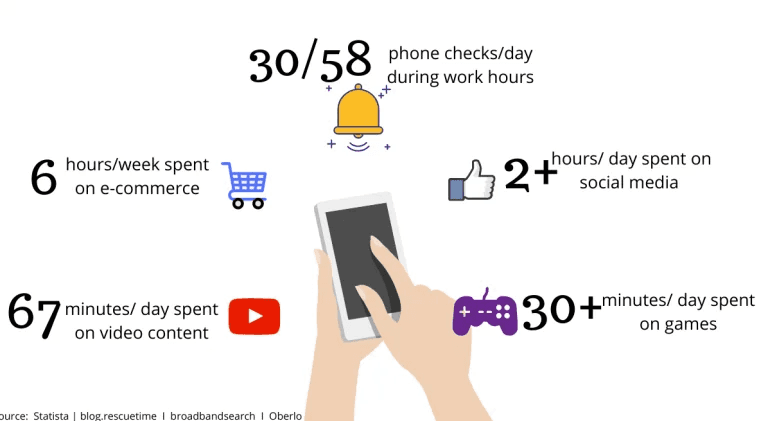
How does a business benefit from creating habit-forming products?
Converting a product into a habit eventually gains user loyalty.
Through routine usage, the company will no longer need to resort to expensive advertising.
How do companies create habit-forming products?
Nir Eyal, author of the best-seller “Hooked- How to build habit-forming products” introduces us to the “Hook model” which sheds light on the four key processes involved in building a habit-forming product.
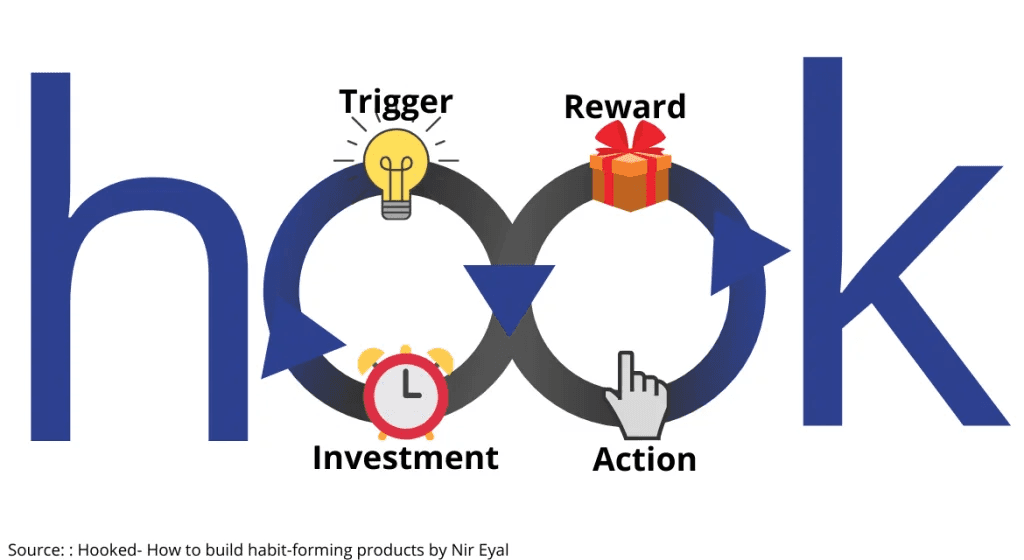
Phase 1: Trigger
It always starts out with triggers such as emails, app notifications or links alerting the user to check out the interesting information. Triggers can be external which happens in the form of paid advertisements and social media alerts; or internal, which can result from loneliness or boredom. Triggers are manufactured in such as way that it eventually leads to a call-to-action.
For example, Jane logs into Pinterest and comes across an image of a wedding dress in her newsfeed. Being recently engaged, she had been on the lookout for trending designs in wedding dresses. This image sets off the trigger by catching her eye and piquing interest.
Phase 2: Action
Action is the subsequent activity that follows a trigger, and is solely dependent on the users’ levels of motivation and the easy accessibility of the action.
Now Jane, motivated by the image, is prompted to click on the link, which leads her to the page where the image was originally posted.
Phase 3: Reward
Reward is what actually reels in a user from just being intrigued into wanting more. Companies create rewards or hooks that lure users into spending more time and money on their websites. Users feel a surreal sense of anticipation at the prospect of being rewarded with more ideas and offers.
Jane, having entered the page, is now hooked by the several wedding dress images that show up along with various other wedding-related ideas. Before she knows it, she is clicking image after image thereby prolonging her use of the website.
Phase 4: Investment
Once hooked, users invest their time by routinely returning to the website; money by making a purchase through the website; information by providing personal preferences that will help the website serve them better; and referrals by recommending the product to others.
Now Jane, having rewarded with several ideas and options, pins these images to her wall and subscribes to several other handles for future references. Eventually this website becomes her go-to place, should she hit a roadblock in planning her wedding.
Companies that create such products are constantly manufacturing similar products, nudging the user to keep returning to their platform until it becomes a new norm.
How do Habit-forming products become a bane to a company?
As much as companies benefit from creating such products for hooking others, there is a definite probability of getting hooked ourselves. It is important to draw the line between getting hooked and being addicted to habit-forming products. The hidden dark side of habit-forming products reveals itself only when it serves as a distraction in our daily lives. It is time to unplug from such products if,
Constant interruptions distract us from focusing on the job.
It keeps us from reaching our goals.
It takes away our desire to socially interact with one another.
What can be done to not let habit-forming products become a distraction?
Not all companies follow the ethical route when manufacturing these products. It is entirely in the users’ hands to decide if they want the product to enhance or restrain their cognition. Learn to control the charms of habit-forming products by,
Identifying and limiting the external triggers that instantly distract us.
Planning our calendars well ahead with constructive activities that will reroute our focus back to work.
De-cluttering our screens by removing items that will leach away our time and attention.
Conclusion
Habit-forming products, while serving as a stepping stone to success and popularity on a business perspective, can also serve as a hindrance to achieving one’s personal goals. Technology, with its alluring gizmos and gadgets, need to be put in its place, should it deviate from improving to ensnaring one’s intellect.
Are you Using OTT to Tell Your Brand Story?
Are you Using this Channel to Tell Your Brand Story?
How to use OTT Platforms for B2B Marketing
If you’ve been doing social media + drip + thought leadership + event for your marketing, we’ve got a channel that may give you the ROI of all of these and more for your brand.
Yes, Over-The-Top (OTT) is the new channel marketers should put on the roadmap. Think Amazon Prime. Think Netflix. Think YouTube and Vimeo. Think any of the channels in the graphic below. Seriously. We’ll tell you how.

Graphic: A World Awash in OTT Channels. Are You On One Yet?
Simply put, OTT is streaming video on any screen rather than live video/TV. OTT content platforms have been witnessing tremendous growth not only in North America and the UK, but also in emerging markets like China, India and Brazil. Based on research data available, the video revenues from OTT platforms in 2017 were at $53 billion. This number is expected to grow to $129 billion by 2023. These platforms have diminished geographical boundaries and made the consumer experience seamless in many ways.
OTT platforms offer different kinds of services using some innovative business models, such as Subscription-based Video-on-Demand or SVOD through which consumers subscribe to content for a specific time period; Transactional Video-on-Demand or TVOD where consumers buy content on a pay-per-view basis; or Advertising Video-on-Demand or AVOD that is free for the consumer. AVOD is usually forced upon the consumer – not the ideal model for brand content.
How to tell your brand’s journey with OTT
Here are some suggestions to start your content creation journey for OTT platforms.
Build a documentary-style video or two about your company or brand journey. While you weave in the vision/mission/values, be honest about the ups and downs. Document the learning and how the company improved as a result. Talk about your partners. Talk about your consumers. Tell their stories. Heck, build an entire platform for the stories. Microsoft does this in style.
The story is in the spice. Sample this riveting piece of storytelling from HP. There is a wolf, and there are sheep. And, oh yes, there’s Christian Slater. All telling the tale of how secure HP printers are.
If your product is a complex technology solution, build a series of educational content pieces that help viewers learn and appreciate your product. We built these how-tos for Intuit India’s QBO product, helping them drive better DAUs (Daily Average Users) for the fintech SaaS platform.
Move people. Don’t worry about the marketing aspect, focus more on the storytelling. In a world that thrives on fake and flash, authenticity connects like never before. Beer-marker Stella Artois tells the story of hand-painted billboard makers in their Vimeo documentary Up There. The connect? Both the company and the billboard makers are obsessed with traditional craftsmanship. What a way to talk about your values!
Don’t forget to be silly. Gillette’s Are we killing the kiss? is a tongue-in-the-cheek reference to shaving. 5 minutes of sombre hilarity ensue. Engaging. Funny. Great OTT content!
The numbers don’t lie: video platform Vimeo pivoted in 2017 from being a YouTube competitor to serving OTT content creators. The platform now hosts over 1000 OTT subscription services, with 1 million+ paying subscribers. These numbers show how OTT is fast gaining currency as a valid channel for communicating with customers and users.
Why OTT? Who You Want, Where You Want Them
As is usually the case, data on non-US OTT viewers is still scanty. But a sampling of US data shows us that the right target segments for B2B marketing live on OTT. The comScore OTT Intelligence report puts a significant number (~46%) of heavy streamers under the age of 18-34, about 39% in 35-44 yrs group, and about 31% in the 45-54 yrs group. These numbers are certainly significant for the B2B segment as its key decision makers predominantly belong to these age groups.
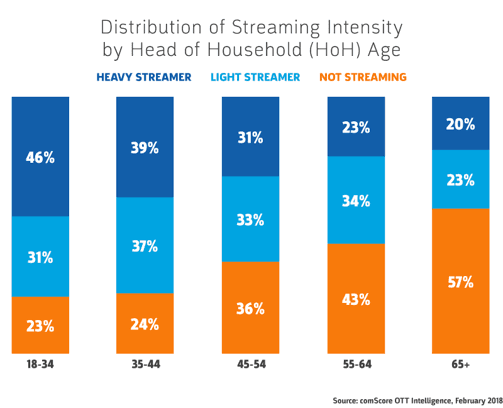
Source: comScore 2018
The comScore OTT Intelligence study reports that in the US households in Feb 2018, 59MM out of 94MM (around 63%) with wifi connected devices, streamed on-demand video content for close to 50 hrs on an average. The study puts 90% of the streamed data being consumed by Heavy OTT Streamers (with 3 hours and 22 minutes per day of OTT viewing per day) while it is 20 minutes a day for light streamers (about 20 minutes of OTT viewing daily). What does this mean? You have about 20 minutes daily to tell your story on OTT and grab the attention of your viewers. Certainly more time than an email, social post or even a longish blog (currently, long-form content is usually a 15-minute read).
OTT Content That Works
Statista reports that fact-based content (aka documentaries) on OTT channels are very popular. YouTube viewership data puts how-to videos, product reviews and educational content at the top of the pile. Globally, documentary viewership has seen a steady increase across the globe.
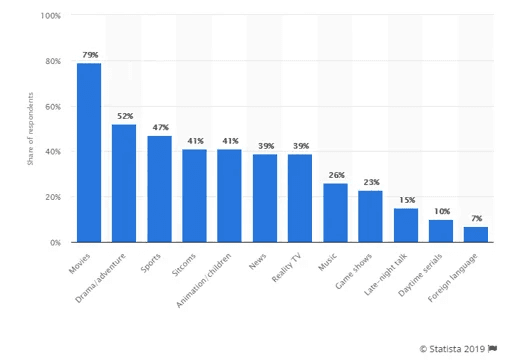
Source: Statista
Connecting The Dots
With these insights, it is not far-fetched to say that brands that create fact-based, educational, original and authentic OTT content can leave behind a lasting impression on the consumer’s mind. The AI-enabled personalization these OTT platforms provide, help businesses reach their target audience and convey their brand story, the journey and the value they offer in a powerful way.
In the next 3-5 years, OTT platforms will be the go-to place for all content. Hack this space today and be the trendsetter for tomorrow!
References:
https://www.businesstoday.in/current/economy-politics/indian-ott-market-to-reach-dollar-5-billion-in-size-by-2023-says-bcg-report/story/293323.html
https://www.comscore.com/Insights/Presentations-and-Whitepapers/2018/State-of-OTT
https://filteredmedia.com.au/blog/what-is-brand-storytelling/
https://contentmarketinginstitute.com/story/
https://www.comscore.com/Insights/Blog/Reaching-the-Elusive-OTT-Consumer
https://blogs.gartner.com/ted-chamberlin/2018/02/27/whats-happening-in-ott-here-is-what-i-am-seeing/
https://www.businesstoday.in/current/economy-politics/indian-ott-market-to-reach-dollar-5-billion-in-size-by-2023-says-bcg-report/story/293323.html
B2B Omnichannel Marketing Strategies
B2B brands are using action-oriented omnichannel marketing strategies for greater success in 2019. With greater access to differentiated marketing channels, brands are building long-term relationships with B2B customers.
Omnichannel marketing is one of the better ways through which B2B brands can build delightful customer relationships. It’s allowing brands to provide seamless customer experience, regardless of what platform their clients are using.
By utilizing the power of design, copy, and core-branding, companies are looking towards omnichannel strategies to unify their acquisition approach. While data from Forrester research suggests that less than 50% of B2B brands are following omnichannel best practices, this year, there is an increasing trend towards omnichannel strategy planning, execution and/or implementation.
Research from Accenture group shows the power of being “present where the buyer is” to create a more integrated marketing experience. Brands need to reach out to clients and buyers and have a strong presence to persuade their decision in the right direction. Omnichannel, therefore, is perfectly integrated into the domain as more companies shift online for their requirements.
Omnichannel is a premier methodology, within the B2B marketing space, that relies on integrating the overall journey. While 66% of B2B marketers agree that multi-touch marketing is essential, omnichannel methodologies bring the entire experience together. 2019 is the year for deep omnichannel integration, with the rise of multiple acquisition channels across search, social and content.
Data-driven marketing strategies
For a successful omnichannel marketing strategy, brands need to focus deeper into the integration of data. Data-driven marketing strategies outperform traditional approaches that work in silos. Using the power of AI and deep learning, brands can reach customers earlier in the acquisition process.
The process of leading the digital charge is a long one, but a profitable one for B2B brands. Data from McKinsey & Co suggests that digital-first B2B brands deliver 5 times greater revenue than their traditional peers. Omnichannel marketing strategies rely on a solid integration of data into the core outreach and acquisition process.
Focusing on deep mobile integration
One of the more effective marketing strategies to ensure omnichannel success involves the comprehensive integration of mobile experiences. B2B brands that understand the customer acquisition journey well, integrate mobile into their core marketing strategies.
Marketing decision-makers need to map the entire customer journey and find the right touchpoints through which an integrated experience can be developed. Mobile plays a major role in that process, with some of the biggest brands in the space increasing investments into mobile omnichannel strategies.
Maximizing the impact of technology
Having a well-embedded CRM system within the organization is one of the better ways to ensure that their omnichannel efforts are being captured. CRM systems can be designed to reach out to customers, engage with them, and capture the right amount of information at the right time. CRM systems need to be integrated holistically to maximize their impact on the omnichannel marketing strategy.
B2B brands are increasingly using the power of AI and machine learning to create a more omnichannel experience for their customers. By using technologies such as AI data miners, chatbots, and virtual assistants, brands are offering more accessibility to customers regardless of where they log in from.
When designing omnichannel experiences for your customers, it’s important to work with the experts. Using the intelligent marketing suite of solutions offered by Clearly Blue, organizations can maximize their output while reaching new customers through their marketing. To speak to our experts, give us a call at +91-8197264647.
Footnotes (References)
https://www.salesforce.com/content/dam/web/en_us/www/documents/reports/b2b-embraces-its-omnichannel-commerce-future.pdf
https://www.accenture.com/us-en/_acnmedia/pdf-59/accenture-the-big-read-full-report.pdf
https://econsultancy.com/reports/digital-intelligence-briefing-2018-digital-trends/
https://www.emarketer.com/content/the-data-to-drive-your-b2b-omnichannel-experiences-may-be-closer-than-you-think-sponsored-content
https://www.mckinsey.com/business-functions/marketing-and-sales/our-insights/how-b2b-digital-leaders-drive-five-times-more-revenue-growth-than-their-peers
https://blog.hubspot.com/service/omni-channel-experience
https://www.forbes.com/sites/louiscolumbus/2019/02/17/10-ways-ai-machine-learning-are-revolutionizing-omnichannel/#185c45a11181
https://cbnew.test/intelligent-marketing/
Artificial Intelligence in Marketing – Making Sense of the Hype
It’s undeniable but true: Artificial Intelligence (AI) is all set to disrupt B2B marketing. Are marketers across the globe smart enough to use this trend to their advantage?
According to the latest research numbers published by DemandBase, 80% of all marketers predict that artificial intelligence will revolutionize marketing by 2020. However, only 10% seem to be reaping the benefits of AI in B2B marketing today.
The Secret is in Getting Value Out of The Data

As a marketer, you are most likely spending a lot of time reviewing and analysing data in order to derive insights of customers and prospects. This is where Artificial Intelligence comes in handy. AI models are capable of taking on the complicated analyses and data crunching to model the ‘what- if’ scenarios in your marketing – this provides information that is actionable almost immediately.
A targeting and personalisation firm, DemandBase used AI to remove companies from its prospects list that would possibly end up with the company losing money in the future. AI proved most beneficial for this organization, highlighting accounts that were worthy of pursuit. This is what DemandBase’s VP of ABM Strategy, Jessica Fewless remarked at a B2B Marketing Conference – “We’re a stats-based company and if they churn from us in less than a year we lose money on them. So, we took the elements that made those customers churn and removed them from our model.”
Key takeaway for marketers: Find the companies that are investing in areas relevant to you and your business, and the ones that have the most potential in adding to your organization’s value. With all the insights that AI provides, you will also be able to identify the clients or accounts that are most likely to generate profit for you.
It’s All About Unique Recommendations

The world’s more successful companies such as Amazon and Netflix thrive on their ability to provide highly personalised content recommendations. This is the most promising use of AI-driven marketing. AI-based systems have the ability to continually read into preferences and tailor-make recommendations.
Let’s take the case of ServiceMax, a field service technology vendor acquired by GE. Their biggest challenge was finding the right content to cater to their customers’ different needs. ServiceMax, in partnership with DemandBase, implemented Reinforcement Learning that helped decrease bounce rates by 70%. It also increased the time-on-site and pages-per-session by more than 100%.
Key Takeaway for Marketers: Capture audience’s attention by providing recommendations based on their personal preferences and likes. Boost engagement rates of your digital campaigns by using the power of AI algorithms.
It’s the Age of 24/7 “Customised” Support

We are in an age where we expect and demand customer service 24/7 every day of the year. This rise in customer expectations means that sales and customer service teams need to equip themselves and meet this challenge. AI to the rescue again – with help from conversational AI platforms (CAPs) or chatbots.
Artesian Solutions, a UK-based sales insights company reaped big rewards with CAPs. Artesian’s AI solution “Arti” analysed millions of online data sources to derive insights. These insights helped build better relationships and sales behaviour. In the very first month of its launch, Arti was viewed 2000 times, was asked more than 3500 questions, and was involved in as many as 1000 sessions with 750 unique visitors. Says Stuart Newton, Director of Marketing, Artesian Solutions, “It has been well received by our customers, prospects and partners, who continue to improve Arti’s cognitive ability and effectiveness as a lead-generation tool, just by asking questions about Artesian.”
Key Takeaway for Marketers: Invest in AI-enabled chatbots that can record customer conversations. This will help build the analysis that will eventually contribute to better lead generation.
Content, Still The Undisputable King

Trends may come and go, but one thing that remains constant is the pivotal role content holds in marketing. Be it B2C or B2B, quality content will never go out of fashion in today’s consumerist world. Organisations are churning out more content than ever. The result? Some end up being not-so-good quality content. AI has a solution for this too.
VMware, in the process of scaling its operations a few years go, had to ensure that its content grew by a considerable amount. A total of 120 technical writers and 5 editors were responsible for more than 400 pieces of content being released per year. Their small team of editors weren’t able to cope up with the huge volume of content, being able to focus only on 1% of the total output. AI-enabled content solution Acrolinx came to their rescue. With Acrolinx, VMware was able to automate basic editing operations, giving its editors time and space to do higher-value activities. About 73% of VMware employees said the AI solution helped improve the quality of the content they produced. “It really helped focus resources and attention on improving the content quality where it will have the most impact,” says Laura Bellamy, VMware’s director of information experiences.
Key Takeaway for Marketers: Include AI-enabled solutions in your content creation to automate basic and mundane tasks. This will help free up your time and energy to concentrate on other important aspects of your marketing efforts such as developing a compelling marketing strategy.
It’s Time to Embrace AI in Your B2B Marketing Strategy
Change always finds resistance, especially when it involves adapting to unfamiliar technology. But, what AI brings to the table is the power to deliver breakthroughs to your marketing strategy; minimize the effort needed by automating tasks that are routine and otherwise time-consuming for humans to accomplish. It is time to embrace AI in your B2B marketing to open doors to endless possibilities of lead generation and delivering invaluable customer experience.
We’ve worked with several B2B enterprises to help propel their marketing strategy by providing useful analytical insights. For B2B marketing services backed by analytics, do get in touch with us.
Here’s an in-depth guide on understanding the technology that, we thought you may find interesting.
Resources:
https://www.demandbase.com/press-release/marketing-executives-predict-artificial-intelligence-will-revolutionize-marketing-2020/
https://unbounce.com/conversion-rate-optimization/machine-vs-marketer-ai-machine-learning/
Get Ready To Be Amazed-on
jeff@amazon.com. Yes, that’s the email address of Jeff Bezos, CEO of Amazon. If you’re disgruntled about some Amazon service or product (and who on the planet hasn’t been touched by Amazon in this day?), just send him a note. Company lore has it that he forwards such emails to the relevant employees with a simple note – “?”. Such an email from the big boss is sure to set some seats on fire!
Amazon, Flipkart, Walmart, eBay, Myntra, Alibaba – these are just some of the names that pop up in our minds when we say the word “shopping”. Among all these companies, Amazon has, by far, beaten the others in the e-commerce race, with its nearest competitor not being able to keep pace.
What makes the story of Amazon so amazing is the dizzying graph of the company: a company that began in a garage at founder Jeff Bezos’ home, with funding from his parents and a limited vision of selling books online, is now a global giant valued at a whopping trillion dollars.
The Everything Store deals with anything and everything under the Sun. It sells products, delivers orders, produces TV shows and movies, publishes books, sells over 165 web infrastructure services, manages data, streams video, music, gives online tuition, and does much more. Nobody dreamt of this rise – even five years after launching the company, Bezos, presently the richest man in the world, himself had doubts about its success.
One-Click Its Way to a Trillion Dollars
Amazon Founder Jeff Bezos operates with a very simple mantra – Being a Day 1 company. Simply put, be there on the first day, that is, be ahead of your competitors. The philosophy embraces focusing on results, not on process. Day 2 companies, Bezos says, are satisfied by ensuring the process is followed, and lose sight of the results.
Amazon’s business model sums up three customer value propositions: low prices, fast delivery (usually on the same day), and a vast selection. These propositions have helped the company to sustain strong revenue inflow from its different wings.
Direct sales: The core part of Amazon’s business is its online stores, now accounting for 7.7% of all retail in the US, the world’s largest retail market. Revenue at the end of 2018 was above USD 200 billion and is expected to hit USD 350 billion at the end of 2019.
Commission-based sales: Acting as a go-between between other retailers and buyers, usually for less common and higher priced products, helps the company net a commission by retaining a part of the sales price. The third party sales increased by 23%, from USD 9.7 billion in Q2-2018 Q2 to USD 11.96 billion in Q2-2019.
Subscription-based services: The global OTT media darling Amazon Prime Video ensures a steady income through consumer subscriptions of Prime. According to a study, 60% of adults in the US watch streamed video for almost 6 hours a day. At the end of 2018, subscription to OTT video services was about 52% of the US population. By increasing the amount of paid ads and OTT advertising technology with visually stunning full screen ads, Amazon is now the third largest ad platform in the US. One hundred million people watch Amazon Prime globally, with 26 million in the US alone.
Amazon Web Services: An important revenue source for Amazon is its cloud service, AWS. At the end of 2018, net sales revenue was over USD 232 billion. It provides more than 165 fully featured on-demand cloud computing services to companies and individuals. AWS is an Infrastructure-as-a-Service (IaaS) and Platform-as-a-Service (PaaS) organisation, offering users a universe of products and services to building and expanding cloud-based digital products. News of AWS downtime bringing some leading services down ranging from Instagram to Netflix to Slack shows how wide and deep AWS penetration is.
Acquisitions: A slew of acquisitions since 1998 has allowed Amazon to step into new terrain: sample acquisitions such as IMDb – the movie repository, Junglee – the data mining company, Joyo which became Amazon China, Audible – the audiobooks company, Lexcycle – the e-book which was renamed Kindle, video streaming company, LoveFilm now called Amazon Prime Instant Video, smart speaker Echo which was earlier called Yap, GoodReads – the social cataloging website, and Tapzo which became Amazon Pay, to name a few.
The rapid pace at which Amazon is acquiring other companies has led to the creation of the verb amazoned, which has come to mean your business being taken up by another company!
Customer centricity: The Core Principle Behind This Amazing Rise
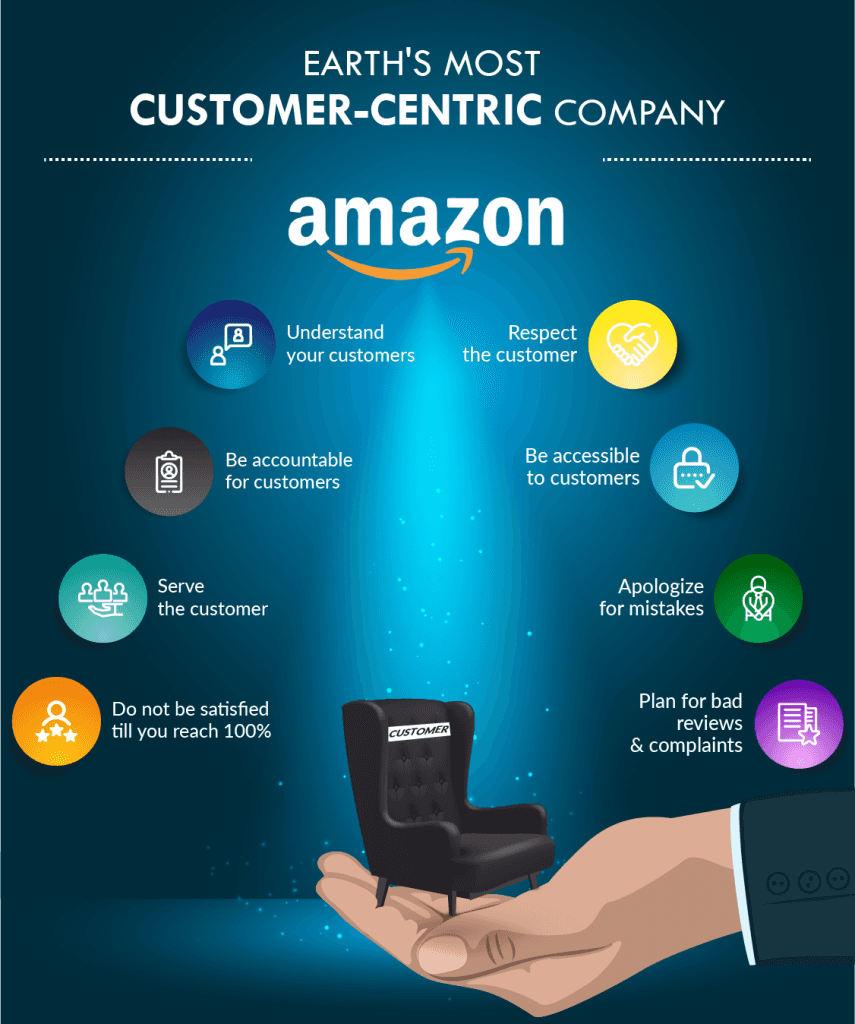
Over and beyond these amazing numbers and the range of sectors, the ‘secret sauce’ to Amazon’s growth is its obsession with customers. Bezos’ core philosophy to make Amazon the “Earth’s most customer-centric company” has become the company’s USP. Bezos’ obsession with customer satisfaction is legendary, requiring every employee up and down the chain to have a similar obsession too. Legend has it that even the logo of the company denotes the smile of a happy customer!
As content folks, we watch the rise and the rise of Jeff Bezos and his Everything Store with bemusement and awe. We learn daily lessons in customer centricity. We apply it to everything we do with our own customers. We’re amazed at Amazon!

Watch this space for our next blog on how Amazon has used content to support its march to world retail domination.
Sources:
https://hostingtribunal.com/blog/aws-facts/
https://www.quora.com/Is-jeff-amazon-is-the-real-e-mail-address-of-Jeff-bezos
https://openviewpartners.com/blog/5-ways-to-be-customer-centric-amazon-jeff-bezos/#.XT3FgpMzbOQ
https://www.innovationtactics.com/amazon-business-model-part-2/
https://www.revelx.co/blog/amazon-customer-centric/
https://www.forbes.com/sites/louiscolumbus/2018/03/04/10-charts-that-will-change-your-perspective-of-amazon-primes-growth/#31b7fd793fee
The secret part of UX you never heard of..
Product creation has become a much-studied and optimised science nowadays. From ideation to prototyping to design and development cycles, aided by oodles of iterative testing, Product Managers and Engineering teams work in Agile sprints and deliver feature releases in regular cycles.
UX is an important part of this process. With features across competitive products being near-identical, understanding what the user needs, and designing all the touch points and interfaces so that the overall experience is engaging and sticky, has never been as important as it is today.
Part of creating a meaningful experience lies in the content. It’s not enough to design beautiful screens and intuitive navigation. It’s also important to get the content right. One of the earliest proponents of great content said:
..and we couldn’t agree more!
Unless they’ve created content previously, many product designers start off with an incomplete understanding of content and are satisfied with covering the superficial aspects in projects. These are worth reviewing:
Style: Formal? Informal? Something in between? It depends on product usage, user demographics, user intent with the product and users’ needs that are fulfilled by the product. For example, while designing informational content for a medtech product for patients in a hospital setting, the language has to be very direct and succinct, aided by simple images and icons. There is no space for ambiguity.
Geography: Content style and language varies from country to country as well. European and UK products and sites may prefer a more formal tone to an American site that may be informal. Of course, the usage of the same language varies wildly when products cross the Atlantic Ocean!

Translation and localisation: Just 20% of the world speaks English. Sooner or later, as a designer, you will come across projects that require translation to other languages that 80% of the globe speaks. Localisation – adapting a product or service to the desired local ‘look and feel’ and culture – is a layer beyond translation.
As apparent, these facets are necessary, but nowhere near sufficient. In fact, they only scratch the surface for getting it right with content.
The opposite of good content is…product failure!
Somewhere down the line, the content needs of a product rapidly spiral out into a separate project of its own, requiring a content strategist, or even a team of strategists, depending on the project size. Many a time, this need is ignored at the start. “Content writers” are pulled in to write web page or help content towards the end. This can be a huge problem that is fixed with band aids – trying to retrofit poorly prioritised or categorised content into ill-designed sitemaps; using incomplete requirements to understand the user persona; or building help systems without comprehending the product. Hastily written content with little or no editing and proofreading can hurt the brand, forget helping as it was meant to. Any or all of these misfires can contribute to the failure of the project.
What a Content Strategist Does
A content strategist does not just write content. The strategist is involved in every phase of experience design, from requirements gathering, information architecture, branding, governance, marketing, post-sales customer support and more – virtually every step of the product lifecycle from cradle to grave requires the thoughtful creation of relevant content. She prioritizes content, categorises it into buckets based on user needs, audits old or current content, plans for writing new content, designs content structure and finally curates, summarizes, writes, edits and publishes it.
Indisputably, the content strategist role needs representation at the design table from Day 1. She can also be an important bridge between the UX, engineering and business teams – ergo, in many cases, the Product Manager may start off as the Chief Content Strategist before building a team as necessary.
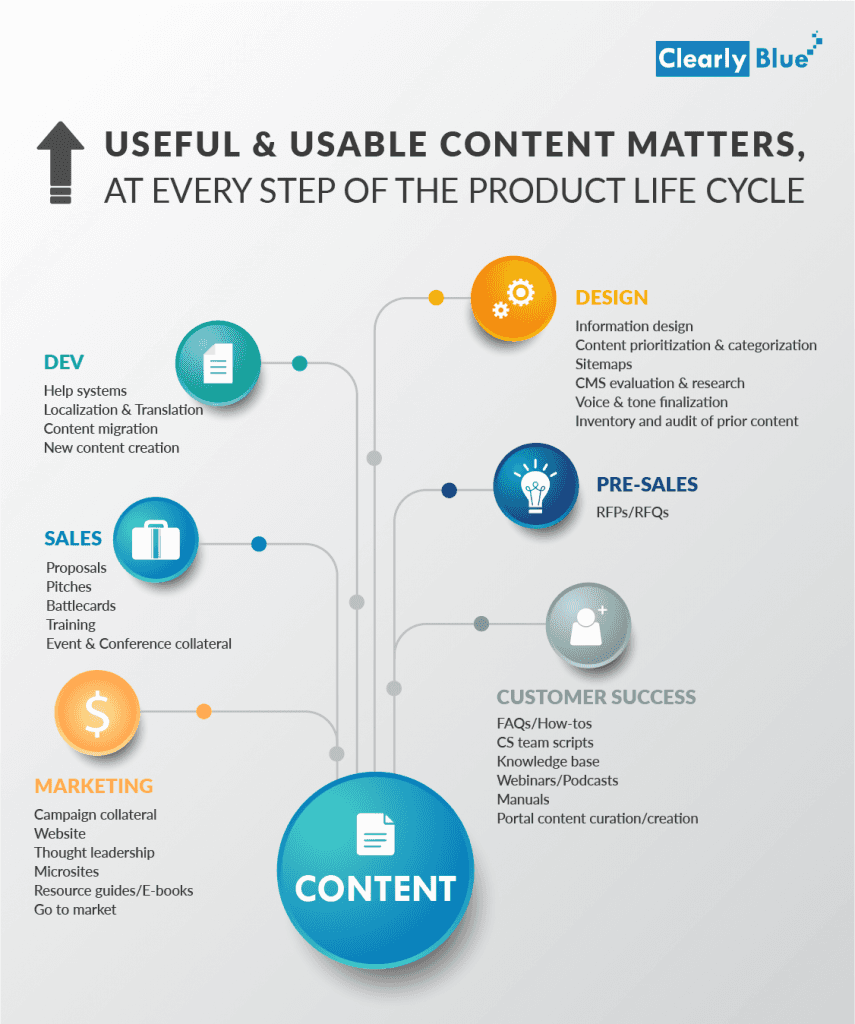
As the depiction above illustrates, different kinds of content are critical for different functions and different phases of the product life cycle. Indeed, with content nowadays being overloaded with meanings to include imagery and video, the scope of engaging content that enables product success has enlarged even more.
We’ll describe the content listed in each category above in subsequent blogs. For now, we leave you with another quote to ponder on:

If you’re embarking on product design, do it right and invite a content strategist over from Day 1. We can recommend a good content strategist or two.
Thinking of using content to sell your product? Don’t!
More often than not, business owners have serious doubts as to whether a content marketing strategy will work for their company. Are the time, effort and investment needed for content marketing worthwhile?
Joe Pulizzi is the Founder of Content Marketing Institute, THE go-to place for all things content. An accomplished author on content marketing, his book Content Inc. details a model for businesses to become successful using the content-first approach. His advice can be followed by both start-ups and large organizations in any industry. The Content Inc. model is radically different from the traditional marketing model, where the product/service is first determined, after which, the method to promote it is decided.
So, what does the Content Inc. model entail? It says, do NOT treat content like an advertising campaign for a company’s product or service. Instead, as a first step, create and publish content that attracts and builds a loyal audience. Doing this helps you get a foot in the door and paves the way to sell anything you want to that loyal audience.
Here are 6 steps that the Content Inc. model recommends to create an effective content marketing strategy.
Identify the sweet spot:
What content area does your business revolve around? This could be the intersection of your knowledge/skill area and your personal passion/customer pain point.
Let’s suppose you are the CEO of a data analytics company. Identify your potential client’s pain points, such as lack of insight into their target customer personae.
Tilt the content:
Once you’ve identified your sweet spot, find a differentiation factor or a niche area where your audiences are looking for help. Tools such as Google Trends help you find areas where there is less competition and yet enough audience interest. Aim to be the leading expert in this niche area.
Once you’ve identified your sweet spot, find a differentiation factor or a niche area where your audiences are looking for help.
As the CEO, ask yourself, what is the niche area that you wish to target? Can you help marketers who have all the data at their disposal make sense of the data and get actionable information? Or with data security being a major issue, can you give insights on how machine learning can be used to safeguard against cyber threats?
Build a base:
Don’t spread yourself thin by being on too many channels – it doesn’t really maximize your reach. Instead, choose a single platform – it could be a podcast, a blog, or YouTube. Establish yourself on that channel by consistently publishing valuable and relevant content on it. For example, you could start with a blog with tips to help marketers find their target audience and maximize the effectiveness of their campaigns with the help of the data available with them. Build a base of loyal audience who can’t wait to devour your content.
Harvest the audience:
Now that you have built a loyal subscriber base, grow the audience. Building the audience is key to long term growth and success. Email newsletters are critical for this stage – a great way to harvest the audience and a choice better than social media platforms such as Facebook, over which you have no control. Send out a fortnightly newsletter with compelling content that your clients look forward to! It could, for example, contain curated news from the world of marketing or case studies where other marketers have successfully deployed analytics-based solutions.
Diversification:
Once you’ve built your audience on a single channel, next, diversify.. Now use new delivery channels such as podcasts, blogs, webinars to expand the reach of your content. You could also look beyond the digital medium for opportunities. This is a medium-to-long-term strategy. Assess current channel(s) periodically and prep to add new channels simultaneously.
Monetization:
Lastly, figure out how you can monetize and build a revenue model that will give you great returns. What works for your business? Premium content with a subscription model, or sponsorship, or launching new products? This is a longer term play and may take more than a year or two to crystallize.
You will find umpteen examples of companies that have built audiences with a content-first, audience-first approach in the book.The Content Management Institute itself is a great example of a successful Content Inc. model. It all started with a single channel – a blog written by Joe Pulizzi himself on which he posted consistently for over 3 years. After establishing itself on that one channel, CMI diversified into other channels such as workshops, podcasts, and a print magazine, among others. Over the years, it became one of the fastest growing business media companies. It was acquired for $17.6 million by UBM, a global media company, in 2016.
All these success stories not withstanding, the fact of the matter is that content marketing requires long-term commitment. For any company to be successful at content marketing, they have to be at it for a minimum of 9 months and an average of 18 months. There is no doubt that preparing a long term content marketing plan and acting on that plan eventually pays rich dividends!
The fact of the matter is that content marketing requires long-term commitment
Maximize your time – Listen to these 10 podcasts
Goodbye playlists, welcome podcasts! As an avid podcast listener, I can say for sure that this listening phenomenon is here to stay. With the advent of smartphones and increased internet connectivity, podcasting has seen exponential growth.
People worldwide are making the most of their time listening to podcasts while doing other activities. Podcasts are more conversation-friendly and easy to use. They have the ability to entertain us, keep us well informed, at the same time give opinions on the various happenings in the social and political spectrums.
With so much of audio content available, choosing the best ones to subscribe in the areas that you are interested in can be overwhelming.Worry not. I shall help you narrow down your list.
Listen to these 10 podcasts to know what smart people talk about science and technology, to education and business and everything in between.

The Pitch
Fortune has named Gamlet Media’s The Pitch, hosted by Josh Muccio as ‘the best business podcast on startup life’. On this show, the entrepreneurs pitch to a live panel of investors. Each episode takes us behind the closed doors of a shark tank pitch, presents crucial details of what happens after everyone shakes hands and walks out.
Best episode: Three Startups Enter. Only One Will Leave. (Episode #40)
Listener says: “A must have on my podcast list. An entrepreneur can learn from other startups and their journey. Thought provoking, real and inspiring.”
Foundr
Host Nathan Chang knew nothing about building a business. He was working in a 9–5 job that he detested and wanted to become an entrepreneur. He embarked on this journey of knowing what it took to build a successful business. His thirst for knowing more and getting there led to Foundr magazine and his innumerable interviews with successful entrepreneurs. Subscribe to this podcast to learn what it takes to build a successful enterprise.
Best episode: How to Become Financially Free with Tony Robbins (Episode #60)
Listener says: “Very helpful, encouraging, with a positive approach. Is like having someone next to you, like a coach, a mentor. Gives incentive either to start or to continue.”
How I Built This
Are you a budding entrepreneur? Be inspired by knowing the stories behind how some of the well-known businesses came into existence. Get a perspective of the struggles, the ideas or the trigger that led to these successful brands. Listen to this highly recommended podcast How I Built This, by NPR. Host Guy Raz with his great narrative, talks about the idealists, the innovators, the entrepreneurs and the movements that ultimately led to the formation of the business.
Best episode: Chipotle: Steve Ells
Listener says: “How I Built This is an addictive inspiration. These are riveting stories of people from startlingly diverse backgrounds whose energy, ideas, persistence and often humour has vaulted them to extreme success in businesses that matter deeply to them. It’s a revelation that the world of business can be entertaining, emotional, and inspirational.”
TEDTalks Technology
TEDTalks Technology podcast is undoubtedly one of the best technology podcasts. This podcast covers TED conferences, TEDx and partner events worldwide where leading inventors and researchers share their visions, talk about their breakthroughs, give demos even. Every episode, roughly less 15 minutes long is interesting and inspiring.
Best episode: How tech companies deceive you into giving up your data and privacy
Listener says: “Each TED talk leads me to areas of experience that are not usually available to me.”
Accidental Tech Podcast
If you are a zealous techie who is on a lookout for an interesting podcast show ranging from programming languages trivia to the latest tech industry news, Accidental Tech Podcast (ATP) is the podcast for you. The hosts Marco Arment, Casey Liss, John Siracusa are all developers who know their stuff like the back of their hands. ATP was created accidentally while trying to do a car show. Hence the name. It is basically about Tech, Apple and related areas.
Best Episode: These Arms Are Coming Off (Episode #242)
Listener says: “I subscribe to around 8 or 9 podcasts and this is by far my favourite. When I see a 2 hour + episode I get so excited because I know it will last for two days of commuting to and from work. The hosts have such good chemistry and genuinely seem like good guys. Keep up the good work.”
The Hidden Brain
NPR’s Hidden brain, hosted by Shankar Vedantam explores the unconscious patterns that drive human behaviour directing our relationships and affecting the choices we make. Shankar, with his power of storytelling backed by science coupled with insightful commentaries and audio clips, smoothly guides the narrative of each episode.
Best episode: Embrace the Chaos (Episode #53)
Listener says: “To understand yourself, you need to understand how your brain works, and how your actions and thoughts are influenced by your world. I always learn something important when I listen to an episode.”
99 Percent Invisible
99% Invisible is a design and architecture focussed podcast hosted by Roman Mars. One episode is released every week and each episode aims to expose the aspects of design and architecture that are usually overlooked and unnoticed. The show’s name is inspired by Buckminster Fuller’s famous quote: “Ninety-nine percent of who you are is invisible and untouchable.” With an excellent narrative, every episode typically concentrates on a specific design example or a single topic and includes interviews people who have been influenced by the design, experts or architects.
Best episode: NBC Chimes (Episode #238)
Listener says: “A thought-provoking, well-produced show. Roman Mars and his team of reporters and producers have done an excellent job of talking about architecture and design the way it deserves it be spoken of. They examine not only design but also the people who designed things, examining the ways in which the life experiences of each designer informs the way they see and construct the world around them.”
Ctrl Alt Delete
Ctrl Alt Delete, hosted by Emma Gannon is a podcast that focuses mainly on feminism and technology. Emma, with her high profile guests, discusses the aspects of existing online and the world of work. Ctrl Alt Delete explores everything, from your social media presence to dealing with workplace problems and everything in between. Ctrl Alt Delete is one podcast which all the emerging women in the workplace need to subscribe to.
Best episode: Dealing With Stress & Practicing Self-Care (Episode #52)
Listener says: “Emma, host of the Ctrl Alt Delete podcast, highlight all aspects of different careers, creativity and more in this can’t miss podcast! The host and expert guests offer insightful advice and information that is helpful to anyone that listens!”
Serial
How can I not mention the podcast series that gave podcasting a new lease of life? American Life’s Serial, described as the greatest podcast ever made, is an investigative journalism podcast. Serial revolutionized the world of podcasting. This podcast is hosted by Sarah Koenig who narrates nonfiction over multiple episodes. Serial topped iTunes even before its debut and remained number one for several weeks thereafter. Episodes of seasons one and two have been downloaded over 340 million times as of September 2018.
Best episode: Misdemeanor, Meet Mr Lawsuit
Listener says: “Fantastic show! I am thoroughly interested and can’t wait to hear the next episode! My only fear is there will be no resolution at the end of this mystery. Either way, this is a very interesting podcast – you have a fan!”
The Tip Off
The Tip Off, hosted by Maeve McClenaghan, an investigative journalist herself, takes you behind the breaking news! This weekly, investigative journalism podcast gives us behind the scenes information about some of the biggest stories from recent years. Each episode typically concentrates on a particular story where Maeve talks to the journalists who led the investigation as they share their experience on how they pulled the story off – the tip-offs, the dead-ends and the leads. This podcast virtually takes you through the investigation; you can sense the doors slamming, cars chasing, narrow escapes from danger and terrorist cells even!
Best episode: The stuff of horror movies (Episode #2)
Listener says: “This podcast highlights exactly why journalism stories are so important and the way they are told, maybe even more so. Thank you for the amazing work!”
I hope this helped you figure out who your next commute buddy is going to be. Listen away to glory!
Veena Ramagopalan: From an Indian Naval Officer to a Corporate Leader
Clearly Blue’s #Gaggle is proud to feature its interaction with Veena Ramagopalan, an inspirational leader who translated her experience in the Armed Forces into a successful career in coaching and mentoring leaders.
Veena Ramagopalan is an ex-Naval officer from the first batch of women officers of the Indian Navy. After her experience in the Navy, she has worked with various companies in senior strategic roles. Her experience spans Strategic & Process Consultancy, Business Excellence, Quality Assurance & Quality Management and includes in-depth subject knowledge, implementation experience of various quality models like CMMI, ISO 20000/ ITIL, and Six Sigma.
Veena is Co-founder, Director of Inroads Leadership Development. She is passionate about connecting with people and supporting them by sharing her experiences. She enjoys engaging and inspiring women leaders to help them accelerate their leadership abilities and integrate seamlessly into the organization.
Clearly Blue chatted with Veena about her experiences in the Navy, her mantra for overcoming patriarchy in the workplace and lots more! Read on to know more about this amazing woman.
CB: You have about two decades of experience in the corporate world and in Defence. What skills from your previous work experience were most helpful or practical in your current role?
VR: My experience in the Navy made me really “comfortable with uncomfortable”. The environment expected me to pick up different responsibilities and adapt to different situations. There was always a constant change. The key skills which have helped me with various transitions in my career are:
Have the right attitude and the mindset, embrace change with an open mind. Look at change as an opportunity for growth
Transitions and changes helped me to explore new things and be a lifelong learner
Be confident and believe in yourself

CB: Did you face any gender roadblocks in your career? What advice do you have for people who face such roadblocks?
VR: Women were a minority when I joined the Navy. People would constantly keep an eye on me and, sometimes, I felt that people were just waiting for me to fail. Another roadblock that I have faced in the corporate world is proving myself over and over again and sometimes being underestimated in spite of my years of experience or the credentials that I have. My advice to people who have faced similar roadblocks is:
Speak up and make people around you aware, if things are not fair to you
Be assertive and don’t let people make your choices and decisions for you
Master the art and skills of whatever is necessary to do the job you are required to
It’s not about “gaining” titles alone; it’s about “earning” respect wherever you go
CB: The corporate world is still overwhelmingly a man’s domain. What skills and behaviors should women who want to make themselves heard in a conference room full of men, or even in a boardroom, exhibit?
VR: It is very important that you speak up and make your presence felt. It’s not just about attending meetings and being visible. It’s about actively participating in the discussion, challenging the ideas and making sure your ideas are also heard. It’s important to have a strong authentic voice which is heard by the people around you.

CB: If you could have a gigantic billboard anywhere with anything on it — metaphorically speaking, getting a message out to millions or billions — what would it say and why?
VR: It’s all about accepting us women as who we are. Behind every successful man, there is a woman. But behind every successful woman, it is the battles and challenges she had to constantly fight on her own; with people at home as well as in the professional world, and life in general.
CB: In the last five years, what new belief, behavior, or habit has most improved your life?
VR: In the last five years, I have been on a completely new journey – starting my own company which was not my forte before. It’s like starting your entire career from scratch. Each day brings something new for me and pushes me out of my comfort zone. I’ve learnt that the best way to keep ahead is to be constantly learning and adapting to new opportunities which come in front of you.
CB: What advice would you give to a smart, driven college student about to enter the “real world”? What advice should they ignore?
VR: When I see young girls today, I often feel that their decisions are made by the people around them. My advice to them is:
Take ownership of your life and give confidence to people around you that you can take care of your own
Whatever choices you make in life, be at peace with those decisions

CB: What is the book you’ve given most as a gift and why?
VR: One book which I’ve been recommending and gifting to people is Mindset: The New Psychology of Success by Carol Dweck. It is a very interesting book which talks about how your thinking can drive success in your life. She introduces two kinds of mindsets in the book – the fixed mindset and the growth mindset. The fixed mindset says that your success comes with your innate abilities or the talents that you are born with. The growth mindset says that success is dependent on your ability which can be developed through hard work and effort. There is nothing static in terms of what you can achieve and what you cannot.
CB: When you feel overwhelmed or unfocused, or have lost your focus temporarily, what do you do?
VR: I go back to the moments in life where things worked out for me and ask myself what helped me do that. I draw confidence and energy from those moments and go all out again. It’s all about having a positive mindset. Failure is inevitable in everybody’s life. How you overcome that with a positive mindset is what matters. Believe in yourself and give yourself the confidence that you can overcome this obstacle as well, just like you have done in the past.
Pinterest for B2B Marketing. Really!??
Hello there! As a marketer, you are always on the lookout for newer ways to connect with your potential customers and you understand the power of social media in reaching your prospective customers.
While LinkedIn, Twitter and Facebook are used predominantly used in B2B marketing, their cousin Pinterest is sadly labelled as ‘Perfect for B2C’. But, is this true? Well, not really.
“You must be kidding! Pinterest as a B2B marketing channel? No way! ” I hear you say.
Before you dismiss Pinterest as a platform for DIY crafts, home decoration, cooking or for selling consumer goods primarily for women and not for B2B marketing, let me take you through why and how you can use Pinterest for your B2B marketing.
Demystifying Pinterest. Why Pinterest at all?
Pinterest has been branded as the go-to place for ideas on decorating your home, planning your wedding, fashion trends and not certainly a pedestal for showcasing industry thought leadership content. But, this certainly is not the case.
Pinterest is a channel where you can share and curate your ideas, and believe me it is not limited to DIY. Do you know that many Fortune 500 B2B companies like Cisco, IBM, Oracle, HP are active on Pinterest?
Pinterest has much more to offer than a digital scrapbook. In fact, it is a clean whiteboard waiting to be written. All you need is an open marketing mind!
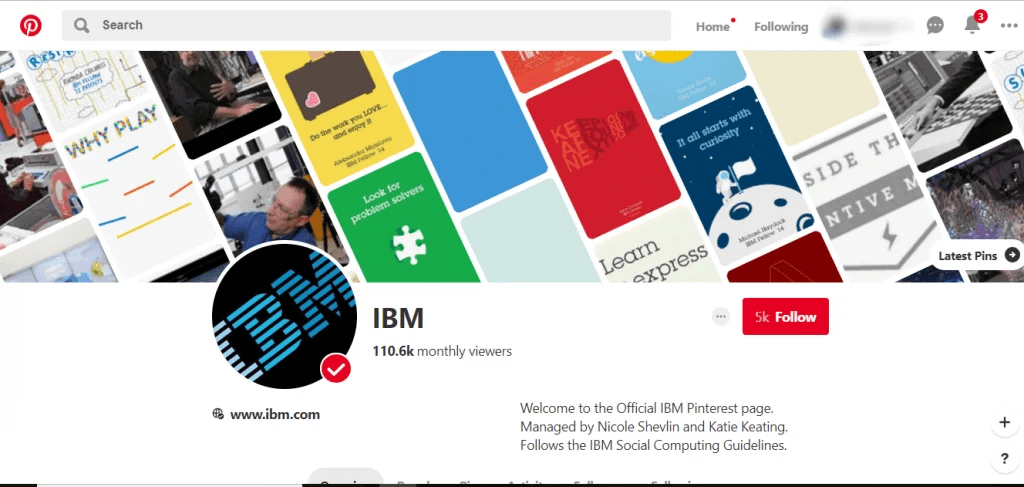
With over 250 million active users, 3 billion boards and over 175 billion pins, you can hardly afford to ignore Pinterest anymore. Let me dissect why you should consider Pinterest as one of your marketing channels.
#1 High engagement value. Pinterest is all about being visual, and the market share of a visually rich social network is high. The average time spent by a visitor per day on Pinterest is a whopping 88.3 minutes. Pinterest is a close third behind Facebook and Tumblr on user engagement level.
#2 Excellent lifespan. An average Pinterest post or Pin has a half-life of 4 months! Half-life is the time taken by a social media post to reach 50 percent of its total engagement.

Content’s Lifespan
As against a tweet that lasts for 18 minutes or a Facebook post at 5 hours, a pin surely has a long lifespan.
#3 Boost your SEO, drive traffic to your website. With intelligently named Pinterest boards that match closely with your keywords, enhance your search result rankings. You can also build backlinks to your website by adding a link in every pin you publish. One other thing is that the Pinterest is a search engine by itself.
How can you tailor your marketing strategy for Pinterest?
Now, let me throw some light on how you can use Pinterest strategically to drive traffic, generate leads and increase sales.
#1 Repurpose and Reuse existing content
Convert your existing assets like blogs or ebooks into visually compelling infographic and an eye-catching caption. Do you have an interesting blog? Add the infographic to your blog and pin it to your Pinterest page. You probably have a library of content already. Give this content a new breath of life. Create boards for various types of content like blogs, media mentions, whitepapers, ebooks, customer testimonials, etc. You can also create a collaborative board inviting followers to add their own pins. This will help promote your brand and expand your network.
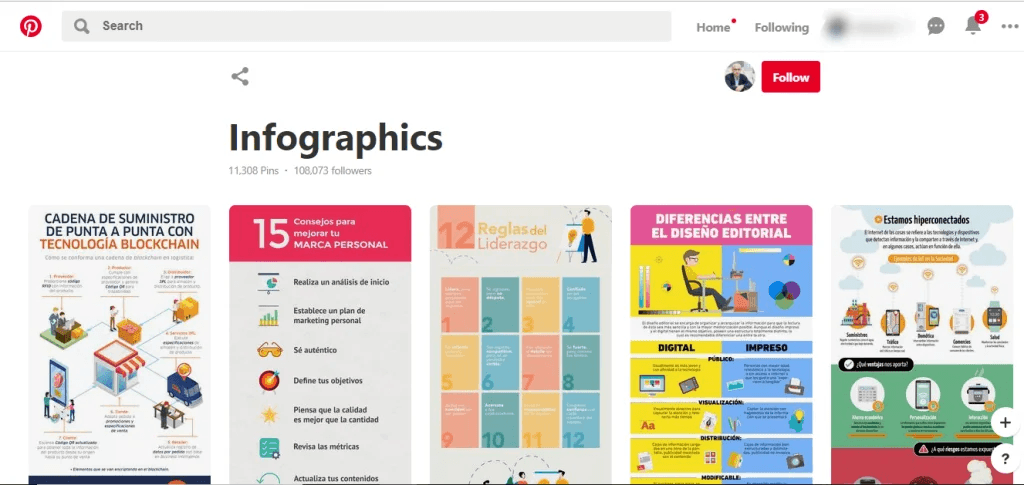
#2 Showcase your Products
The fundamental idea behind doing this exercise is for potential customers take notice of your products. Isn’t it? Create a board displaying all your products to pique their interest and generate leads. Include backlinks to your products. This gives your potential customer opportunity to know more about your products. It also helps customer gain confidence in your company.

GE’s Badass Machine on Pinterest
GE’s Badass Machines board showcases GE’s products from light bulbs to compressors to wind turbines.
#3 Humanize your company
Showcase your company, give your Pinterest followers a sneak peek into your company – what you do, your employees, etc. Help your prospective customer be familiar with your company. Know a little more. You can link the media mentions, employee interviews or the company’s YouTube account.
Microsoft’s Life at Microsoft Board on Pinterest
An excellent example of how this is Microsoft’s ‘Life at Microsoft’ board.
#4 Generate Leads
Most importantly, generate traffic to your website by intelligently using your content – whether new or existing. Upon leading your targeted potential customers to your landing pages, use techniques that increase the likelihood of conversion. You can use the call-to-action approach and lead them to engage with your business.
#5 Check your progress
After the daunting exercise, check where you stand and what works for you using Pinterest Analytics. The analytics tool provides you actionable metrics like number of pins and repins from your website, content reach, number of visitors and visit and also the most repinned and clicked post. You can use the insights from these metrics to improve your marketing strategy.
Are you still deliberating on using Pinterest as a B2B marketing channel?
Stop thinking, start Pinning!
Sources:
Pinterest by the Numbers: Stats, Demographics & Fun Facts
5 Pinterest Hacks That Can Be Used For B2B Marketing
8 B2B Marketing Mistakes to Avoid
B2B marketing is actually pretty simple, except when you make it complicated.
Hello, marketer.
A new year has begun. It’s time you sit down with your marketing team and brainstorm on your organization’s B2B marketing strategy. If you get the strategy right, you are one step away from building valuable leads, generating positive brand awareness and build a foundation of trust with your audience. On the flip side, if you get it wrong, let’s just say it’s goodbye to your precious time and marketing budget.
Want to get your B2B marketing strategy right? Read on to learn about the B2B marketing mistakes you most certainly need to avoid.
Mistake #1 – Plan?? Errr… What’s that?

Post a blog today. Let’s create an infographic for tomorrow. What about the day after?
Are you one of the marketers who goes into posting random pieces of information on your social media handles without really having a reason or necessity for it?
You may want to think again. Random pieces of content are not going to take your marketing efforts anywhere. Rather, it may just confuse your audience and tick them off.
Don’t just invest time in creating digital collaterals. Plan to have industry-specific events and collaterals related to the event. Design landing pages or micro-sites with valuable information. This will help you build your contacts database and generate leads.
B2B marketing strategy is just not about posting random bits of information on your org’s social media handles. It is extremely important to chart out your goal, vision and the purpose of any piece of digital content you put out for your audience to consume.
Where do you want to see your org’s brand in the next few months? How many visitors or leads do you wish to capture through your marketing efforts? How will your marketing contribute to that goal?
These are a few questions that you need to find answers to before charting out your B2B marketing plan.
You can get somewhere only if you know where you want to go, right?
Mistake #2 – UX is not important!

User experience?
That’s only for websites, correct?
No.
You couldn’t have been more mistaken if you think UX is reserved only for designing and developing websites.
Think about what you want to achieve through your B2B marketing strategy. You wish to win audiences trust and build relationships that will ultimately pull sales for your organisation. Audiences are not going to return to your brand unless you create lasting impressions that will make a positive difference. It is all about the experience you offer to your audience through the content you publish.
UX is as much a marketer’s responsibility, as it is of the development team. The digital content that you create throughout sales funnel is a means to communicate with your audience. Chart out customer personas and make the communication worthwhile by providing persona specific experiences.
Any layman should be able to understand what you intend to say. That is usability.
Mistake #3 – It’s all about me!

You think blowing your own trumpet on social media is going to win you followers and leads? Think again.
You are highly mistaken if you think that marketing is all about the brand. It is far from it.
It’s fine to talk about your brand and how it can help the audience in solving their problem. But make sure that’s not what you are focusing on always.
Content marketing, whether B2B or B2C, is all about the customer. It is about providing value to the people who are consuming your content. It is about resolving problems that customers may have.
Self-promotion is fine; but make sure you maintain a balance by providing the users with something of value and interest.
With all the automation that is happening to marketing efforts across organisations, content has become robotic. It has lost its human touch. Bring it upon yourself to make B2B marketing more human by engaging in meaningful conversations with your audience.
Mistake #4 – I don’t look at analytics

Here’s a situation. Imagine you are on a plane. You get to know that the pilot is blind. He cannot use his instruments, nor can he see where he is going. How would you feel flying on that plane?
Not having analytics set up or not measuring key-metrics is precisely the same thing as flying the plane without seeing where you’re going. It’s not going to end too well, now is it?
You have free tools at your disposal (Google Analytics, for example) which help you get a feel of which piece of content is working for you, and which one isn’t. These tools offer you a glimpse into what users are doing on your website, what they like and what they don’t. They help you measure your KPIs (Key Performance Indicators).
Mistake #5 – A/B testing… What’s A and B?

You’ve put up your website after a lot of research and effort. It’s now time to put your legs up and relax.
Knock knock.
Sorry to burst your bubble, but you can’t rest, yet. What is a B2B marketing strategy that doesn’t involve testing? What works with your audience and what doesn’t? Though you’ve done research on what your audience wants, you can never be sure until you put your website to test.
Moving a CTA button just a few centimeters to the left or the right, or even changing the colour of the CTA button, can improve your conversions to a large extent.
There are many free tools like Google’s Optimize, Convert.com or Optimizely to test your websites for conversions.
A few small changes here and there can make a huge difference to your marketing efforts.
Mistake #6 – Quantity is more important than quality
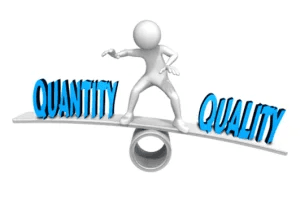
Alright. You’ve just brought out the big guns and shooting out content in all directions. You are bombarding audiences with content they aren’t ready for or have no time to see. After all the efforts you put in to create an original piece of content, you’d be heartbroken if it isn’t received well enough, isn’t it?
Well, I accept quantity is important. But certainly not over the quality of content.
Spamming users with content is not the way to start meaningful engagements. Take your time and invest in creating content that is high in quality. Your aim should be to create content that is valuable and useful to the user.
Mistake #7 – All I want is TEXT
The entire world is blogging away. And so you decide, blogging is THE way forward in your B2B marketing strategy. You put up blocks and blocks of content on your website and your social media handles and can’t wait for your users to get impressed and sign up.
WRONG!
Nobody in today’s world has the patience or the time to go through huge chunks of content that seem never-ending.
Research shows that people remember only 10% of any information they read three days later. However, if the same information is paired with a relevant image, people retained 65% of the information three days later. This shows that visuals hold a vital place in transmitting your messaging across to the user. Visuals make for better viewing and better relatability.
There are many free tools available for marketers today (Canva, for example) to make engaging and attractive visuals like images or infographics. Use these tools to make your content interesting.
Mistake #8 – I want to be perfect
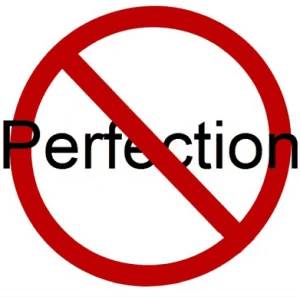
It is good to aim for perfection, but a waste of time waiting for your B2B marketing strategy to get perfect. How do you know if your strategy is the pinnacle of perfection if you do not put it to test with your audience? How will you get feedback on what to change and what to keep?
It is important that you get your plan out to your audience, and get them to react to it. Only then will you know what’s working for you and what is not.
This gives you the opportunity to tweak the rest of the content you have planned for and give your audience what they really want.
Your B2B marketing strategy has the potential to make or break your business. Be careful to avoid these mistakes to get your strategy right this year!
Here’s to a rocking year ahead.
References:
https://www.smartinsights.com/b2b-digital-marketing/b2b-strategy/top-10-mistakes-b2b-marketing/
https://b2bprblog.marxcommunications.com/b2bpr/5-common-mistakes-in-b2b-content-marketing
https://blog.hubspot.com/marketing/visual-content-marketing-strategy
Content Marketing – What’s in Store in 2019?
Your organisation’s content marketing strategy was a runaway hit in 2018. You think that you can rest easy and apply the same strategy for yet another year? It’s time you get a reality check. While some trends may continue to shape content strategies in the coming year, many a time what worked yesterday may not work tomorrow.
It’s December already. It’s that time of the year when you take stock of what strategies worked for you in 2018, and predict what strategies you need to put your money on in 2019.
Be it a B2B or a B2C audience, buyer preferences are constantly changing. For companies worldwide, it is a challenge to keep up with these changing preferences and ensure their messaging resonates with the different needs and expectations of people.
So how can you as a marketer adapt to these dynamic changes and draw your buyers’ attention? You are probably already googling content marketing trends and predictions in for 2019 to take a cue from.
Well, here’s some help for you.
The trends discussed below may help you in shaping your content marketing strategy for the coming year.
Give due attention to your audience
There is an overdoze of content everywhere. How then do you get your audience to take a second look at YOUR content? How do you grab their attention?
Personalise!
Unless you personalise your messaging across all digital channels, consider your audience lost to you. Personalising and specifically calling out to your audience will make sure that your content is noticed and consumed.
According to recent research from Salesforce, 65% of B2B audience said they’d shift brands if they didn’t receive personalised communication from a company.
Use of AI tools and Chatbots: let content take care of itself

It is impossible to talk about content trends without considering the emerging technologies like Artificial Intelligence. 2019 is going to witness content that is mostly AI driven.
There is so much content out there, that it is almost impossible for anyone to filter out and identify what they really need. It becomes overwhelming for anyone to spend hours on the internet trying to walk through the information jungle they are stuck in.
Today more than 70% of consumers have issues with content online. That includes language barriers, lack of customisation and the inability to find the right content (SDL, 2019)
As a marketer, you are better off spending your time in creating better content strategies than wasting time wading through this mess. AI tools can aid in repurposing, analysing, personalizing content to make your messaging more focussed and effective.
Yet another way to record and learn your audience behaviour is by enabling chatbots on your website. Chatbots can help personalise the audiences’ browsing experience and also to strike a conversation with them while they are visiting your website.
If technology can make your life simpler, why not use them? Let content create and manage itself.
Mobile is where your content is

How many times do you unlock your mobile in a day? Do you use more of your laptop or your mobile phone? Answers to these questions seem quite obvious, isn’t it?
According to a recent Deloitte research, the average American looks at their smartphone 52 times a day.
Here in lies a big opportunity to reach your audience – through their mobile screens.
With mobiles in mind, B2B marketers need to consider the way content is approached in terms of experience and design. It is a must to ensure that your content looks seamless across all channels and screens of all sizes.
Videos will continue to dominate
If there is one trend that is going to continue its dominance in 2019, it is videos. Video marketing.

According to Cisco’s annual Visual Network Index (VNI) forecast, video is forecasted to occupy 82% of all internet traffic by 2021.
That should give you a good idea of the power that videos will have over your audience. Video marketing is inexpensive and can easily be implemented with a few simple steps. With a carefully crafted strategy that involves video content, you will easily be able to influence and win over your audience.
Influencers can do the trick

With so many brands vying for popularity and success, audiences are left wondering who to trust. Who can they rely on to satisfy their content needs? How do you build the trust factor with your audience?
Influencers can add a lot of value to your marketing efforts. Audiences can relate to influential faces more. It becomes easy to create a bridge of trust between your brand and your audience through influencer marketing.
Mastering influencer marketing is not rocket science.
A few easy steps and you can see your engagement rates increasing.
Podcasting
Podcasting for many years has been a silent means to share knowledge and experiences. Many top-tier companies have been using podcasts to have Q&A sessions or storytelling sessions. Companies over the globe have suddenly woken up to the potential that podcasts offer.

Watch out Clearly Blue’s space, as we plan to introduce some interesting podcasts soon.
As said earlier, content marketing keeps evolving year on year. As a marketer, you need to pull your socks up, keep your ears and eyes open for predictions and trends. These insights will help you create a winning content marketing strategy for 2019.
Here’s to an eventful year ahead. Cheers!
References:
https://www.circlesstudio.com/blog/2019-b2b-marketing-trends/
https://www.content4demand.com/blog/forecasting-2019-10-content-marketing-trends-to-watch/
https://www.sdl.com
Content Marketing – Some Home Truths
Tips for onboarding the right team to build those winning campaigns
Hello there, modern-day marketer! Do you feel like you’re drowning in a babble of content? Are you confused about what sort of team you should build to ensure your product or service is heard of? You’ve landed at the right blog then.
Here’s an insight highlighting the vital importance of well-planned and implemented consistent content marketing today:

Indeed, content marketing when done right yields manifold benefits. What does this mean exactly? And how can you, the intrepid marketer, do this?
Let’s start with the basics first. What is content marketing? At its very core, it is a set of well-planned campaigns (increasingly mostly online) supported by the creation and publishing a bunch of digital content (blogs, videos, emails, social media, e-books, infographics, guides) to evoke interest in a person, product or service. Notice the phrase in italics there. The whole purpose of content marketing is to evoke interest, not to explicitly sell. Since we’re talking about the digital world, we can measure this interest in a variety of ways (likes and shares on social media, how long a person stays on a web page etc.). Of course, the measurement can be manipulated in a variety of ways, but that is a discussion for another day.
Now that we’re on the page as to what content marketing is, let’s talk about how to get it done. If you’re a marketer of a fast-growing company, you’ve realised by now that you need a set of all the collateral I listed above – you need the stories about your brand to be told online, whether on your site, or the communities where your buyers live or on social media. Who is to do this?
You essentially have three choices –
Option #1: Build a team in-house
Building a team in-house is often an excellent choice, especially for companies that have entire product lines in the market. In such orgs, marketing is a well-recognised and funded activity, with a roadmap and capabilities to tie the ROI back to content published. The effort will be well-defined from the get-go. The team can work cheek-by-jowl with your engineering and product folks, getting ramped up very well on your product and brand. Content delivery and publishing can be aligned closely with product releases and roadmap events.
Recruiting and managing the team is the overhead that must be accounted for. It’s not trivial – a decent content marketing team must have the following roles – a content writer, social media analyst, graphic designer, video developer and an analytics person to track the efficacy of content published and report it to you. Notice that I said roles, not people. You may find a single person who can perform two or more of these roles.
The biggest challenge for you as the marketing head will be nurturing the team. Who is to guide this team? Will it be you? Or a content marketing manager who knows his or her chops? Who is to mentor the video developer when it comes to the latest developments in 2D video animations? If the rest of your company comprises of teams of engineers and managers, getting the right mentoring and career development going for your content team can be a huge challenge. This will inevitably lead to attrition, bringing you back to the drawing board within months, if not a couple of years.
In essence, build a team in-house if you:
Want long-term alignment with your brand
Have the bandwidth and skills to manage and nurture the team (or, you have someone in the org who does).
Option #2: Put together a team of freelancers and manage the work yourself
Of the three options I’m presenting to you, this is probably the most economical one – happy news for frugal budgets – yet the highest in terms of risk.
With a plethora of freelancing sites and marketplaces, it is deceptively easy to find experienced freelancers for almost any skill nowadays. Content writers, graphic designers and SEO analysts abound on upwork.com and other similar sites. So, building a team of freelancers and doling out work to them is easy.
The disadvantage to a marketer running a sustained campaign, however, is the availability and scalability of the team. Freelancers are usually always remote – the best ones, in my experience, prefer to work from home and take on multiple projects simultaneously. The world is literally their oyster and it’s not uncommon for skilled and experienced freelancers to earn high amounts from the comfort of their home office. They may however not be able to stretch if your requirements increase suddenly – and, adding a new team member to a freelance team is not a trivial exercise.
Reliability is another issue. If you’ve found that experienced, skilled, ‘always-online’ freelancer who works day-in, night-out on your project and delivers, you’re all set. This has happened to me several times – in fact, I’ve worked productively for years with some freelancers without even meeting them ‘in real life’. But sadly, this tribe is rare. Excuses for non-delivery I’ve had range from a sick child and sudden guests to mystery illnesses and AWOL occurrences. The biggest shocker was on a project where a previously-reliable freelancer just disappeared for three weeks – with a major deadline on the horizon.
The amount of your time that will get sucked up can be huge too, as you may have surmised by now. So factor all these in before you jump onto the freelance bandwagon – indeed, what seems quite frugal initially may prove to be very costly in the long run.
Option #3: Outsource the work to a content marketing agency
First off, this will be the most expensive option for most marketers. Engaging an external agency implies paying for their overheads and profits that will be built-in to the cost. It also doesn’t make sense to do a one-off short-term project with an external team – by the time they ramp up on your brand requirements, time may run out on your one-time effort.
Then why do it at all? To put it simply, to get rid of the headache. Let’s say you head marketing for a new product that’s blazing a new path in the marketplace. You’re busy pumping the hands of potential new clients and investors. You’re fielding media enquiries. You’re running around fine-tuning the product launch activities and prepping your CEO on the messaging. Wouldn’t you want a professional agency by your side who can churn out all the marketing collateral consistently? An agency that has the in-house staff to take care of your website, social media, press releases, event branding and thought leadership campaigns seamlessly? After all, it’s not your job #1 to build and recruit a heterogeneous content/creative team and nurture them out of their inadequacies. Your job #1 is to focus on marketing your product and ensuring your campaigns and collateral hit the spot every time.
Surely, this is money well spent. We recommend this option fast-growing marketing teams that want to focus on their customers and stakeholders and leave the nitty-gritty of building collateral and campaigns to a team of professionals. To be sure, there is coordination and oversight required to ensure the brand expectations are being met. Insights must still be analysed, collateral drafts must still be reviewed and campaigns still tested and tweaked. But the benefits far outweigh these requirements provided it’s the right fit.
Some agencies may be open to building a dedicated team and transferring them to your org for a fee – a Build-Operate-Transfer (BOT) agreement. This may work for you if you have a 2+ year horizon.
Here’s a table summing up these options:

The Gaggle – Marya Wani
Marya Wani is the Business Unit Head, Director of Programs-School of Data Science @ Institute of Product Leadership. She previously worked as Head of Curriculum and Learning Experience Design and has been instrumental in creating high impact programs for senior executives.
Dr. Wani is an internationally published author, a keen researcher, and has been on faculty at various reputed B Schools in India and other global B-Schools. Marya Wani has published papers in reputed International Journals in the areas of Information Systems evaluation, e-Commerce, and Social Media.
Marya is a happy mother of two kids.
We sat her down for an informal chat to get to know this woman of substance.
CB: What are the books which have greatly influenced your life and why?
MW: ‘Thinking Fast and Slow’ by Daniel Kahneman. It tells you about the flow of life and how it’s very important to look at life from a third person’s perspective. Another one is ‘Atlas Shrugged’ by Ayn Rand which talks about the importance of being self-reflective. It helped me during my teenage days to find my individualism.
CB: What purchase of rupees thousand or less has most positively impacted your life?
MW: I bought ‘Thinking Fast and Slow’ just recently, priced at around 600 bucks. Nothing can be more valuable than buying a book.
CB: How has a failure or apparent failure set you up for later success. Do you have a favorite failure of yours?
MW: We had spent a lot of time and hard work designing and launching a product, but it didn’t work because the customers were not able to understand it. It was disheartening and disappointing for a long period of time.
But I realized that success is more complicated than just hard work. You can never have it all. Everybody is fighting their own war and if you’re giving it your best, you should learn to forgive and be kind to yourself.

CB: If you could have a gigantic billboard anywhere with anything on it — metaphorically speaking, getting a message out to millions or billions — what would it say and why?
MW: I read this quote which says “Instead of looking at people as male and female, look at individuals as static and dynamic. Leave your gender behind the door and think of yourself as an individual”. Women must stop thinking that they are women and start thinking as individuals.
CB: What is an unusual habit or an absurd thing that you love?
MW: Sometimes, when I’m engaged in a conversation which does not resonate well with me, I start thinking about something else and smile to myself. I love this habit because I find it very funny, and nobody has control over me when I’m in that zone.
CB: After all the success, what are some of the struggles you still face?
MW: Self-doubt. Whenever I’m given something to work on, I constantly ask myself whether I’m the right person for this job. It brings me a lot of anxiety thinking whether I’d be able to do it or not. Also, if I had more time, I’d be doing more yoga, travelling often and spending more time with my kids.
CB: Where is your ideal vacation point?
MW: Paris. I went there two years back and fell in love with it. The culture, the streets, the way people dress, the way they smell – everything is just beautiful. I could spend a month just walking through Paris and never get bored.
CB: What does your typical day look like?
MW: I get a call in the morning every day. I get up when my kids have to go to school and then I rush to office. I always have lots of meetings and work, but I try to read a lot while traveling. Then I go back home after work to spend time with my kids. Sometimes, if I get the time, I try to take a walk at night.
CB: What kind of books you read?
MW: Technical books, mostly. I have an interest in data science, so I read about it, watch videos or take up some online courses. I also love reading about management, something like a Harvard Business Review that gives out strategies on how to manage yourself and your organization.
CB: How did you overcome any gender-related roadblocks in your career? Do you think women need differential from them?
MW: The challenges that women face in the world today are very different. There is a lot of stress, especially for working mothers, to be the perfect mom. Men don’t feel the guilt that we do, so it’s easier for them. Both men and women may be equally good at something when they join an organization, but when women go into motherhood, that’s when men take up all the big positions.
CB: In last five years, what belief or habit has most improved in your life?
MW: I used to be a hyperactive person. But today, I’ve become a very mature person when it comes to understanding life. I don’t judge others, nor do I judge myself. I don’t necessarily try to change people because I’m happy the way I am, and the way people are.
CB: How differently are you taking the failures?
MW: Your failure is not you and you are a bigger person than just one incident in your life. So, I don’t judge myself for the failures that happen to me.
CB: What advice would you give to smart driven college students about to enter the real world? What advice should they ignore?
MW: Students today are much surer and more aware about themselves than we were. They know what they want. So, maintain that, and don’t jump for the first job offered to you. The first job that you take is going to determine the rest of your career and switching later becomes very difficult. Negotiate on what exactly you want and don’t settle for anything less than what you deserve.
CB: When you feel overwhelmed or unfocused or have lost your focus temporarily, what do you do?
MW: When I start losing focus, I know immediately that I must change. I’m not afraid of moving on in life. Every time I need to rediscover myself, I just do it and flip the switch. I have changed and rediscovered my career many times this way.
CB: What is your favorite cuisine?
MW: I am not a foodie, but I do enjoy non-veg Indian dishes.
CB: Would like to share any of your experience of the viewers? Or anything for aspiring women?
MW: Make sure that you grow every day, learn something you have not known yesterday. Do something which makes a change in your life, your family’s life, your workplace and people that you need. Contribute to people in the best way you can, because there is enough trouble in the world.
Technology Trends That Shape Our Living
Technology is such an integral part of today’s lifestyle. Much of the convenience that we enjoy today, in various aspects of day-to-day living, can be attributed to constant technological innovation.
For the love of technology and exciting innovations happening every second, this is an effort to depict how our life was a decade ago, the way we live today and visualize how our near future will look like, enriched by technology and its advancements.
Smart Homes
From digitally-disconnected home appliances of the last decade, our homes now are full of smart gadgets like phones, electric lighting and television. At the tip of our fingers, through a mobile app, we can turn on these devices and manage them.
According to Statista, there will be around 82.5 million home automation systems by 2021 in the US alone.

Amazon’s Echo and Google Home have made their way into homes, not only in developed markets but also in emerging consumer markets.
Zion Market Research predicts that the smart home market will reach $53.45 billion by 2022.
The homes of the future will have Smart Home OS that can help manage all the connected devices like lighting, heating, kitchen appliances, washing, home inventory and the like. Diagnostics & Maintenance of all these devices can be proactively done using technologies like predictive analytics based on Machine Learning (ML) and Artificial Intelligence (AI).
Your Smart Home Assistant could shop online on your behalf based on the demand and supply forecast using ML & AI technologies. Call it smart home commerce, if you wish. ?
Home security will get smarter. The data of your home can be used by businesses to get consumer insights. You could charge them for your data!
Commute
Hasn’t your commute been a lot easier than prior to the taxi-booking app era? Yes, traffic congestion has not allowed for much of a delight in your commute the experience. But, wait! The future probably has all these problems solved already! From sustainable fuel for automobiles to autonomous cars, everything is being set in order to enrich your commute experience.
In the next five years, there will be enough traction in the autonomous cars and fleet space, with all the major automakers across world investing in this technology.
With the different levels of autonomy defined by the SAE, the user perception in terms of safety of autonomous-driven automobiles will grow more positive.

I have been mentioning delivery drones for a while now. Companies like NASA and Google X’s Moonshot are all working on developing prototypes for Unmanned Air Traffic Control Systems and their management. So, as much as delivery drones are a near future, so are the control systems that would manage these vehicles.
Flying taxis are the next-in-line innovation in the commute space. Battery operated, helicopter-like flying vehicles are currently being tested. In the next 5-10 years, don’t be surprised if your general mode of transport is flying instead of driving.
And then there is hyperloop – the high-speed, low-pressure tube train that could cover hundreds of miles in a matter of a few minutes. Most exciting intercity travel experience! You really can stay in any city and work in a city far, far away from home, not worrying about time being wasted in commute.
Shopping
Gone are the good old days of shopping in crowded markets! You can now shop for groceries to fashion apparels to utility products – all from the comfort of your home or on the go with the click of an app. If this has not already been amazing, wait till the delivery drones show up to bring you what you want – faster and safer than you can imagine! Amazon has a 30-minute delivery-by-dron on its cards.
You may just have to cut down your urge for retail therapy as your Smart Home Assistant will take care of your shopping needs with its ultra-cutting-edge predictive analytics and smart home-commerce technology!

If you still want to walk into a retail store, the shopping experience would be totally different than today. You will know exactly the closest store that sells the product you are looking for and its location with the aisle number. Thanks to your home assistant. This is already WIP as I write and you read this.
If you want to indulge in a more experiential shopping, you can spend a day in indulgence while the 3D immersive and VR experiences help you try out what you want to buy. You can try different styles and colours with digital screens at your disposal and customize to suit your personal taste. There would be no checkout counters and long billing queues. You chosoe and place your order on a digital screen at the store or on your smartphone and it gets drone-delivered to your doorstep. Like it? You bet!
Entertainment
The television and radio from our homes that received the broadcast content from satellite transmission are shifting towards on-demand content delivered through the internet. You can now watch all of your programmes either on your mobile or tablet PC or on a smart TV whenever and wherever you want.
A study conducted by Ericsson found that approximately 70% of consumers now watch television programmes and videos on a smartphone, which is double the percentage from just five years ago. Ericsson predicts that by 2020, only 10% of people will watch TV on a traditional screen, which would mark a 50% decrease in comparison to 2010.
The new Smart TVs would soon have VR technology to provide a better immersive experience in innovative and exciting ways.

With a myriad of connected devices and vast data about consumer behaviour, the future of entertainment will see more experiential, immersive, engaging and personalized content, on demand, anytime, anywhere.
Finance
Finance has been one of the major industries impacted by evolving and emerging tech. Thanks to the digital world, you now don’t need physical or magnetic currency unless you are going to a place without internet. Pretty unimaginable, isn’t it?

Cash and cards are changing to digital & mobile wallets. Now blockchain and cryptocurrency will decentralize banks.
With the internet and a smartphone in your pocket, you don’t need a bank as much anymore.
Bank-bots will be your new bank service personnel.
Future payments and transactions could be voice-based, with all the voice and text recognition technology evolving.
Blockchain will evolve to bring in much-desired transparency and trust in financial transactions.
The finance that we know today may not be the same tomorrow.
Education
Education has also been constantly evolving with the advent of technology. Old classroom-confined methods are long gone and new tools – online and offline – are enabling students to learn from a variety of sources.
Collaboration platforms and social media have made it easier to learn and compete with fellow students across the world.

AR & VR are already replacing the chalk and the board. With AI, ML and Data Analytics at the disposal of technology, learning will move towards self-learning. skill-based, with more focus on application and research. Customized, personalized learning tools will be the future of education.
Cheers to technology!!!!
How WeWork is Mastering the Art of Instagram Marketing
Let’s face it. Instagram is the most interesting social media app of them all. No wonder 92% of influencers prefer it as their No.1 marketing platform (Nielsen’s latest Global Trust in Advertising report). But here’s the catch – it’s not as straightforward as Facebook or Twitter, where you can simply share relevant content about your industry and expect clicks back.
NOPE.
Instagram requires patience and creativity. It won’t translate right away into sales and conversions. But having an established identity for your business means more followers, which ultimately translates to more customers.
When WeWork started in 2011, it had just two buildings. Now, in just 8 years, We Work has become the 6th most valuable startup in the world.
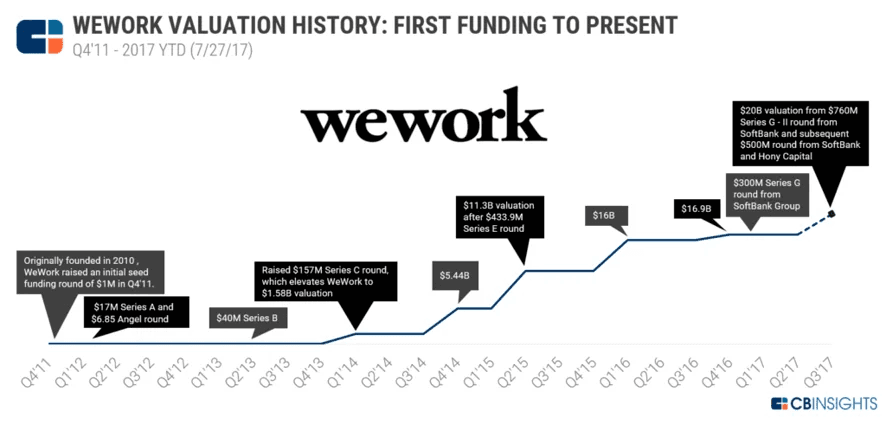
WeWork has recognised the importance of Instagram as the channel’s visual quality makes it a perfect vehicle for the company’s brand. The company uses its Instagram page to showcase its offices around the world.
I mean, seriously, just look at the WeWork Instagram page! Who wouldn’t want to work here? With over 407k followers on Instagram and active engagements flocking over to its feeds daily, We Work’s Instagram strategy is simple – it focuses on “we” instead of “me”. Let’s dive further into how it has mastered the art of Instagram marketing and what we can learn from WeWork.
#1 Work around your brand’s values
WeWork follows the mantra “Make a life, not just a living” and it makes sure its content involves exactly that. When you head over to the company’s page, you can see that the posts are about things which revolve around its goals and brand values. WeWork stays true to its brand by posting about things that it believes in and which it knows will empower its target audience as well. When you’re lost thinking about what to post, you can use your brand’s core values as a starting point to generate new content. This not only keeps your page alive but also helps maintain your identity through images and videos.

#2 Turn the camera around
WeWork constantly updates its Instagram page with photos of its employees, workspaces, company field trips, etc. One way to showcase yourself to other businesses is by showing them what life is like in your office space. We’re all humans; even your potential B2B customers are humans, and no one wants to see images of simple, plain old graphics and texts in this century. Instagram gives you an opportunity to give your brand a personality and show your unique company culture.
With Instagram no longer in everyone’s favourite chronological order, cracking the strategy code is a lot harder than it looks. You need to look out for fresh, engaging ways to personify your identity through engaging photos and videos.

#3 Tell a story
When WeWork started opening offices in India, its Instagram stories comprised pujas and other ceremonial activities celebrating the launches. Just look at the amazing short and crisp storytelling techniques used here!

At its core, social media is all about storytelling. There’s no denying that stories are an integral part of marketing and hey help you generate more engagements. Instagram launched Stories in 2018 and it quickly became a favorite among users and opened up new opportunities for marketers. Who knew a 24-hour window story could generate huge engagements! You can also make use of the latest “Swipe Up” CTA feature (if you have over 10k followers) on Instagram stories for more clicks and visits to your website.
#4 Create your content strategy
The current algorithm strategy is mainly based on engagements – this includes the number of likes, comments, saves, messages, shared posts and any other interactions a post gets. Higher numbers signal to Instagram that your content is interesting enough to be shown on people’s feeds.
Instagram’s Tumblr post reads
“The order of photos and videos in your feed will be based on the likelihood you’ll be interested in the content, your relationship with the person posting and the timeliness of the post. As we begin, we’re focusing on optimizing the order — all the posts will still be there, just in a different order.”
A study by Statisca has revealed that location tagging increases engagement per post.

WeWork continually tags the locations of where its posts were taken. This enables people searching for that location to see its posts as well.

Another strategy which WeWork uses is posting 2-3 posts a day (mostly 2). This ensures that even though one of its posts gets missed, the other might well pop up in people’s feeds. But, the most significant thing that you can do is craft quality content that will authentically resonate with your followers.
#5 Collaborate with influencers
Working with influencers goes a long way in promoting your brand, hands down. Influencer marketing has become an integral part of successful marketing campaigns. People are most likely to trust the recommendations of people they know. Read more about influencer marketing for your B2B business here.
WeWork continually works with influencers and tags them in its posts and stories, integrating each other’s audiences. A new trend at the moment is making influencers take over your Instagram stories for the day. WeWork has been quick to catch up on this trend by partnering with influencers around the world to take over its stories.

WeWork’s strategies for Instagram work because they incorporate all the latest developments of the algorithm into the posts. It also focuses more on engaging with the audience rather than talking about itself in every post.
Your page won’t grow overnight – you need to constantly research the changes that Instagram brings and how to get the best out of them. If you have more ideas on how to build your Instagram page, feel free to drop in your comments.
Here’s an interesting read for you on scheduling instagram posts to attract maximum audience – “How to Schedule Instagram Posts: The Definitive Guide“.
There’s no dearth of reading material that will help grow our social media audience. Here’s a comprehensive guide on social selling we thought would be useful – History of Social Selling.
Sources:
https://databox.com/instagram-marketing-strategies-b2b
https://www.wizcase.com/blog/stats-on-internet-social-media-and-digital-trends/
https://www.businessinsider.in/WeWork-raised-5-6-billion-in-3-months-heres-how-the-co-working-giant-became-the-most-valuable-startup-in-New-York-City/articleshow/60468380.cms
https://www.cbinsights.com/research/wework-valuation-analysis/
https://blog.crowdfireapp.com/7-things-you-can-learn-from-weworks-instagram-strategy-250b52a1fdbe
https://www.statista.com/statistics/448157/instagram-worldwide-mobile-internet-advertising-revenue/
https://www.targetmarketingmag.com/article/instagram-marketing-preferred-by-smb-brands-survey-says/
Influencer Marketing for B2B – 5 Tips to Ace It
Over the last couple of years, many companies have been integrating with influencers for their marketing campaigns. With the number of tech-savvy people rising, you would have already discovered that people are no longer susceptible to advertising, whether traditional or digital. Nielsen’s latest Global Trust in Advertising report has shown that 92% of people trust recommendations from individuals over brands and businesses.
Influencers are people who have a wide following on their social media pages as well as a very loyal audience who listens to them. Influencer marketing involves reaching out to these “influential people” to help you promote your products and services. This trend has shown no signs of stopping. As far as stats go, the future of influencer marketing looks bright.
While B2C influencer marketing is almost as simple as getting any influencer to talk about your brand, the same is not the case for B2B influencer marketing. With thousands of companies taking over the internet by storm every day, you need to stand out from your competitors. So the question here is, how can you get the best out of influencer marketing for your B2B company? Let’s get straight to it.
Use your existing customers
Businesses trust the opinion of people working in their similar fields or industries. If you can use testimonials from your existing or past customers to promote your brand, it will add credibility. Your potential customers will value the reviews of your existing customers which will help you create a bigger market for your brand.
For example, Okta, an identity management company uses this style of influencer marketing by making videos on their existing customers. They have created many compelling videos where their customers talk about the satisfaction of their service. In this video, you will see News Corp talk about how Okta helped them solve their business challenges.
Choose influencers with the right profile
Before you start blindly reaching out to influencers, you need to understand which businesses you want to target your product or service to. Finding influencers who have an impact over these businesses you want to target is the important factor. You need to do your research on what the influencer usually promotes and which type of content their followers engage with more. This is crucial for your business because you’d be wasting your money without getting anything in return.
American Express uses the hashtag #AmexAmbassador on Instagram to promote its platinum card. Amex targets high spending people like businessmen, CEOs, managers and the like. Their goal is to emphasize luxury. So, they deliberately pick people who live luxurious lifestyles.

Another thing to keep in mind is that there might be a lot of influencers who have millions of followers. But do not be swayed by this. Some influencers buy followers because more followers means they can charge the company more money. You can usually figure it out by the ratio of their engagements to the number of followers. Although you can check this manually, you can also use a number of tools to help you save your time. InstaCheck is a good tool designed to detect fake accounts by analysing engagements and overall activity.
Choose the right medium
There are a number of social media platforms to choose from, the most popular for influencer marketing being Instagram. Marketing Profs found that 92% of influencers prefer Instagram as their platform. But this doesn’t mean that you limit your marketing to Instagram. You should choose your medium depending on the message you want to promote. A general rule is to use the medium where you think your target audience usually hang out.
YouTube is usually used by influencers who want to give a detailed review of a product or service. Look at this example of Linus Tech Tips promoting Pulseway’s remote PC control service on YouTube.
Start using influencer marketing tools
With influencer marketing, as fun as it sounds, there are two challenges that you are will soon be faced with: finding the right influencers and maintaining a steady relationship with them.
Let’s first see how the manual process goes:
Browsing through all social media sites looking for the right influencers
Sending them a DM or email (or other points of contact)
Negotiating back and forth regarding prices and partnerships
Sending payment manually
Keeping track of all your expenses and reaches
This might help you out the first few times, but imagine doing this over and over again every time you want to promote something. While this manual process may still work, there are a growing number of tools which will help you to easily handle all these. We suggest looking at these tools to help you manage your workflow.
Buzzsumo
Upfluence
Pitchbox
Followerwonk
Measure you influencer marketing ROI
So you somehow managed to catch one of the best influencers in the world, and you even paid a hefty sum to them to promote your business. Now, how do you know if you made the right choice? Is your influencer really successful in helping you reach your goals?
You need to track your influencers and see how much profit each one of them is bringing in for you. One of the best ways is to use Urchin Tracking Module (UTM) parameters https://blog.rafflecopter.com/2014/04/utm-parameters-best-practices/. Assign specific UTM parameters to your influencers so you can track how much traffic they are bringing to your site.
Another option which is gaining a lot of popularity nowadays is using discount or promo codes. You could assign a special discount code to your influencers and that way, you can keep track of people who use that code.
B2B influencer marketing can be tremendously beneficial for your brand, but it is also not always about what your company wants. It’s imperative that you ensure your goals, the benefit to the influencer and their audience are all well aligned for a successful marketing campaign. You must drive home how your business can help clients overcome challenges and deliver real value for their organisation.
Sources:
https://sproutsocial.com/insights/influencer-marketing/
https://influencermarketinghub.com/7-great-b2b-influencer-marketing-examples/
https://marketingland.com/2018-the-year-of-influencer-marketing-for-b2b-brands-240357
https://www.convinceandconvert.com/influencer-marketing/11-things-you-must-know-about-b2b-influencer-marketing/
https://www.b2bmarketing.net/en-gb/resources/articles/rise-influencer-marketing
https://www.grin.co/blog/15-great-examples-of-b2b-influencer-marketing-that-prove-it-works
https://shanebarker.com/blog/b2b-influencer-marketing/
https://digitalwellbeing.org/word-of-mouth-still-most-trusted-resource-says-nielsen-implications-for-social-commerce/
https://www.marketingprofs.com/charts/2017/33095/influencers-top-social-networks-for-2018
Video Marketing – Everything You Need to Know
Your Guide to Surviving The Future of Marketing
Roll camera….
Action…
Welcome to the inescapable future of marketing – Video Marketing. It is a video revolution that you as a digital marketer have never witnessed before!
A picture is worth a thousand words. If a static image can make so much of an impact, rest assured that a video can create an everlasting impression on consumers – if done well enough, that is.
Projected numbers state that video will command more than 80% of all web traffic by 2019. Yet another statistic states that adding a video to marketing emails can boost click-through rates by nearly 200-300%. That’s a whopping percentage to ignore. More than 87% online marketers have adopted video content as part of their digital marketing strategy. Having a well-laid out video marketing strategy would be the smart thing to do if you don’t want to be left behind in the race to become the most talked-about brand.
If you are still wondering what the fuss is all about, take a look at this statistic from Hubspot.

According to the report, more than 50% of people want to see videos from a brand or a business. Hubspot research also says that consumers prefer watching low-quality videos with authentic content compared to “high-quality” ones that are not-so-authentic.
So, what does this tell you?
You don’t have to necessarily invest in a huge team of people to create a viral video. You’d be delighted to hear that there are affordable video-creation tools (some are even free!) that can help you win over consumers or clients with quality and value. All you need is a smart-phone and the rest can be taken care of quite easily.
As a B2B marketer, there are different kinds of videos that you can use to target consumers or your clients at every stage of their journey, and ultimately influence their buying decision.
Brand videos
One of the more popular type of videos, brand videos help generate brand awareness among a larger audience and establish your brand’s values. Go all out and make sure to showcase how your brand is different from other brands in your space.
For one such impactful brand video, take a look at Volvo Truck’s famous ad The Epic Split.
Van Damme’s marvelous stunt, Enya’s soothing soundtrack, and the sheer brilliance in video direction made a huge impact in creating awareness of their brand, values and their differentiators. The video got 7 million YouTube views, half a million Facebook shares and 20, 000 tweets in just two days of its release.
Wow! Impressive, isn’t it?
Explainer videos
You have been successful in creating awareness for your brand. Now what? It’s time to explain what your product or service is, and how it addresses your audience’s pain point. A short and engaging animated explainer video is a sure shot way to capture your viewers’ attention.
Zendesk’s Insight video does a neat job of piquing consumer’s interest and leading them to the next stage of the marketing funnel.
How-to videos
How-to or Instructional videos are extremely useful in answering consumers’ queries regarding your product or service’s functionality. It is an assured way of after-sales service where your consumers get their doubts or questions clarified. How-to videos help instill faith in your brand and establish loyalty in your consumers.
Case study/testimonial videos
It’s not always about you, is it? What do your consumers or clients think about your product? How did your brand make a difference in their lives? Stories of success and authentic feedback make for a very engaging video.
A clear, concise video (not to mention humorous) listing the benefits of the brand makes this video from Slack a winner all the way.
A video marketing strategy involving these types of videos is not only exclusive for B2C, but equally effective for a B2B space, if implemented wisely.
If you still think the idea of including videos is bogging you down, here is a small checklist on how you can implement video marketing quite easily in the near future.
Tell the story behind your brand with the help of video editing software like Filmora and Premiere Pro which have fairly economical subscription plans
Show a sneak-peak into your organization; give a feel of where your product is coming from
Convert pre-existing webinar content/footage into video shots
Convert event videos (seminars/interviews) into exciting ‘learning shots’/videos.
With some staggering statistics favoring video marketing’s prospect in the coming years, you shouldn’t have second thoughts about including videos in your marketing strategy.
With a well-crafted video marketing strategy, you will save your organization the budget set aside for marketing.
Virality is waiting… Have you caught the video marketing train yet?
Cut.
References
https://www.inc.com/gordon-tredgold/20-reasons-why-you-should-boost-your-video-marketing-budget-in-2017.html
https://www.forbes.com/sites/forbesagencycouncil/2017/02/03/video-marketing-the-future-of-content-marketing/#7f0790d26b53
https://research.hubspot.com/content-trends-global-preferences
https://www.skeletonproductions.com/insights/best-b2b-videos
https://cdn2.hubspot.net/hubfs/467997/Offers/3%20Breathtaking%20Examples%20of%20Video%20Content%20Marketing%20Done%20Right.pdf?t=1542211289508
https://digitalsynopsis.com/advertising/volvo-van-damme-epic-split/
Hacking Growth: How Slack Did It
How to ensure top-of-the-mind recall for your B2B tech product when you’re not Google or Amazon
Virality. We’ve all heard about it. We even think we know it. But what lies behind virality in marketing? What makes a marketing strategy so good that the brand becomes a multibillion-dollar success? And, let me throw another spin on this – how about virality in the enterprise space?
Consider Slack, the messaging and collaboration pYolatform. This company has come out of nowhere and garnered 8 million Daily Active Users(DAU) in 4 years, 3 million of them paying customers. They’ve also managed a valuation of $7 billion (yes, that’s billion with a b). Slack solves a pressing problem in the modern-day workplace: email fatigue. If you’ve searched desperately among your thousands of emails in your inbox for that one email with some keyword that you kinda-sorta remember, you know what I’m talking about.
Slack’s success has bred a whole slew of competitors, from giants like Microsoft with its Teams product and Facebook’s Workplace to Flock, Chanty, Fleep and others. There are lessons in Slack’s rise from zero to 8 million DAU for all B2B entrepreneurs, big or small.

PIC: From Zero to 8 Million: Say VA-VA-VOOM!
So, just how did they do it? Let’s start with this tweet:
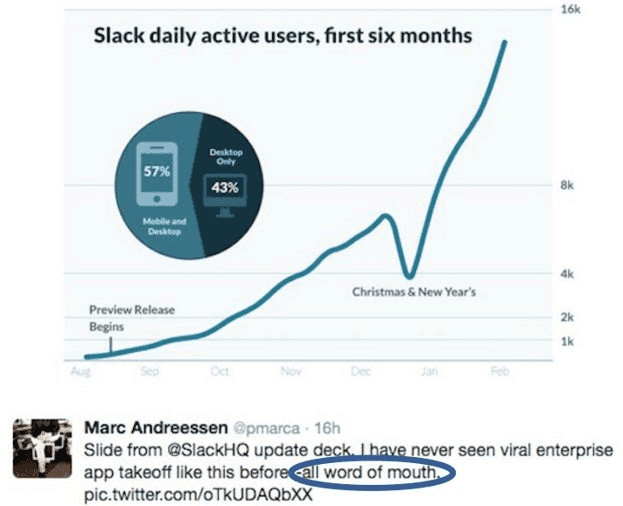
Talk about influencer marketing! With friends like Marc Andreessen (ex-Netscape) tweeting for him, you might argue that Slack founder and CEO Stewart Butterfield had it good from Day 1. But scratch beneath the surface and you’ll see that this tweet was just the last outcome of a fantastic “pull out your pocket diary and call friends and family” effort.
Butterfield has a prestigious background. The co-founder of photo-sharing app Flickr, he walked out of Yahoo when they got bought over and started up again creating an online video game. When that effort went by the wayside, Butterfield and a skeletal crew examined the debris – they had hacked up a messaging app to wade through the various versions of the game and found value in it. This eventually became Slack.
This brings us to Slack-Hack-#1 – Beg your friends and family to test your product. Butterfield fell back on his Flickr-Yahoo network and word spread about the “preview release” (note: marketers please note, NOT beta) of this hot new collaboration tool. “Begged and pleaded” was what they did, per Butterfield. They also used testimonials from these early users to burnish the brand. All this resulted in an incredible amount of organic traffic to the site, a trend that persists to this day with Slack.

PIC: Slack traffic circa 2018, with a whopping 91.35% organic traffic
Let’s now examine Slack-Hack-#2 – I scratch your (marketing) back and you scratch mine! Slack has a huge number of tools integrating into its platform. Think of the gamut from Google Drive to Wireframing apps such as WireframePro to analytics apps such as Pushmetrics. Of course, this makes the platform more usable, but sample how Slack has used this interoperability in their marketing:

Pic: Say whaa..? Slack’s incredible rankings for partner ecosystem keywords
That’s right, Rank 7 in global listings when you type in “Google Drive” goes to a Slack URL. Look at the last column for all other similar searches to see how hard Slack’s SEO team has worked to land these rankings. This is organic gold. No promo budget, no shouting from the rooftops. Plain ol’ SEO work.
Talking of shouting from the rooftops, let’s look at Slack’s work in the social media space – a space many B2B enterprise CEOs I’ve interacted with sniff at, saying it’s just not for them. To all of them, I say, “Look at Slack!”
More specifically, look at their YouTube channel – 23,687,095 views, yes, that’s 23 million+ views for a total of 103 videos. Even more specifically, look at this video, accounting for 15 million+ views on its own.
This brings us to Slack-Hack #3 – It’s the cute animals, darnit! Videos increasingly account for most of the internet traffic. If you don’t have those explainer, demo, cute animal and other videos on social media, do so pronto.
But seriously, Slack’s biggest social media channel driving organic traffic is arguably YouTube, with Twitter being a close second. Beyond the corporate @SlackHQ handle, look @SlackStatus – a Slackbot that provides a steady stream of bug resolutions, status updates and customer support responses. Slack sure has hacked customer support via Twitter.
If that is not enough, Slack has, outrageously, put out @SlackLoveTweets – RTs of people who love Slack. Bold, do you say? Risky, some would aver. But Slack has put their Twitter handle where the customer is, and invited love – 2796 followers with 10.9K tweets is nothing to sneeze at!
All this love can only generate something else that is gold for B2B enterprises – case studies! These seem to pour in from not just customers, but partners too, all only too happy to feed off the attention and mutual admiration. This brings us back to collaboration, that is the core of Slack-Hack #4 – Collaborate the love!
Pic: Nuzzel loves Slack and Slack says “Right back at ya!” – Screenshot from @SlackLoveTweets
Slack today has 1000+ SaaS partners from GitHub to Zoom and SurveyMonkey, all vying to serve the 8 million DAU and 70,000+ teams. The partner list spans virtually all of the tech industry, all of them happy to collaborate on integrations, social media and mutual marketing. A virtuous (and profitable!) circle indeed.
Talking of video, I must mention Slack’s awesome podcast campaign. Sample the Slack Variety Pack – a podcast about work, people and teams. Covers pretty much the entire world, doesn’t it? Indeed, that’s Slack-Hack #5 – Fun, breezy podcasts about work and life that don’t promote Slack. As a marketing tool, podcasts are so hot that they’re vaporising as we speak. If you’re not on the podcast bandwagon (hosting, speaking or listening to one), get on it now! If you’re a B2B enterprise marketer and don’t have it in your roadmap for 2019, you’re doing yourself a disservice. Do it right, though – make it interesting; make it about your customers; make it about topics that interest them. No hardsell – just plain ol’ storytelling.
That brings us to what Slack could have done better on this journey. Let’s hear it from the man himself:
[blockquote author=”” link=”” target=”_blank”]“If there’s one piece of advice I could go back to give myself, it is concentrate on that storytelling part, on the convincing people. If you can’t do that, it doesn’t matter how good the product is, it doesn’t matter how good the idea was for the market, or what happens in the external factors, you don’t have the people believing.” ~ Stewart Butterfield, CEO of Slack.[/blockquote]
I think his “Slack”ers are listening and their podcasts (the brand new one is called Work in Progress and is all about “…the meaning and identity we find in work”) are surely proof of that.
There are tons of other hacks Slack marketers have employed, and (I’m sure), slaved over for thousands of hours. But it sure is a pleasure to watch these campaigns unfold and learn from them!
What Slack-Hack fits your enterprise the best?
Here’s a recent article we thought could be useful in wading your way through Slack efficiently – https://knoji.com/article/slack-notifications-settings-guide/
Do let us know if you found it interesting.
Sources:
https://medium.com/the-mission/slacks-epic-marketing-strategy-and-stewart-butterfield-s-thoughts-about-storytelling-c971fcccd8a8
https://mashable.com/2015/12/07/marketing-strategy-slack/#O2plyLXr7uqs
https://sumo.com/stories/slack-marketing
https://www.linkedin.com/pulse/how-slack-flickr-founder-stewart-butterfield-twice-mastered-hoffman/
https://twitter.com/search?q=%40slacklovetweets&src=typd
https://slackhq.com/work-in-progress
https://slackhq.com/the-slack-variety-pack
Women Leaders in India – Karthi: The Designer, Mentor, Teacher, Guide!
A designer and design thinker with over 15 years of international experience in the fields of UX design and cognitive psychology, Karthi Subbaraman is an entrepreneur, wife, mother, daughter and daughter-in-law – all roles that she takes very seriously. Having worked across multiple domains including technology, education, banking & finance, insurance, and product development across the globe, Karthi has added the duties of teaching, mentoring and guiding other designers into her already busy life.
As the Chief Product Officer of design firm Xperian, Karthi leads global design teams who deliver meaningful products with an awesome user experience and provide a solid return on investment. Her specialisation? “Delivering focused innovation through consumer insight and creative foresight strategies”.
Here are excerpts from a recent chat with Karthi where we tried to unravel the multiple layers that make up this superwoman.
CLEARLY BLUE: Books play a large role in self development! What is the book (or books) you’ve given most as a gift, and why?
KARTHI: The book which I like to give people the most is, ‘The Power of Moments’ by Chip and Dan Heath. It is a book about design, but it talks about the little moments in life, how we architect them, and how they become memories to others.
CLEARLY BLUE: How do you get the time to read, besides everything that’s going on in your life?
KARTHI: I give 25 minutes of my undivided attention to reading every single day. You might think that this is very less, but I’ve realised that in the past year, I’ve read more because of this approach.
CLEARLY BLUE: As an avid reader, what do you prefer – paper, electronic or audiobooks?
KARTHI: I used to carry books with me, but now I just carry one Kindle with thousands of books in it. If a book is well designed, I give phenomenal importance to it and buy the hard copy. Otherwise, if everything is black and white and just words, I grab their e-versions. Audible books help me travel and I prefer them while travelling.
CLEARLY BLUE: Tell us about your Life Design project. What are the key takeaways and insights you would like to share with your readers?
KARTHI: Design is more than just a job for me, it’s part of my life. I used to think that, if design principles can create innovative solutions and solve complex problems, why not solve your life using design too?
I felt like there was a lot of time being wasted, even though I was busy. So, I started reducing the things that take away my energy, which made my life more efficient. Efficiency and effectiveness were the goal of this life design.
CLEARLY BLUE: How are you influencing other designers and professionals with your mentoring and teaching?
KARTHI: I don’t consider myself a mentor or a teacher. I don’t even know if I am a wonderful designer, but I do know that nobody in this universe loves design as much as I do. So, when somebody wants to be a designer, I tell them about design as a career path. But when they specifically say they want to make more money, I tell them exactly what they should be doing to get better opportunities. I profile them by their aspirations, where they come from, their skills and finally tell them where they should be going and which path to take.
[bctt tweet=”I don’t even know if I am a wonderful designer, but I do know that nobody in this universe loves design as much as I do. – Karthi Subbaraman, Chief Product Officer, Xperian in her chat with Clearly Blue. Read more of the interview here.” username=”clearlyblue1″]
CLEARLY BLUE: Let’s talk about failure, which everyone inevitably goes through. How do you pick yourself up from times of failure?
KARTHI: If I’m not able to help someone I gave a commitment to, I treat it as a failure. I’ve realised that I can’t do everything in life and I need to prioritize my life in so many ways. I’ve learnt that the best way to come back from this failure is to make people understand that you’re busy. You need to keep a clarity in terms of relationships, entrepreneurships and the things that you love to do.
CLEARLY BLUE: What are some of the struggles you still face?
KARTHI: Time management is still the most difficult struggle for me. I’m not asking for 48 hours a day but trying to do many things a day is still a challenge. You need to do more if you want to do big stuff and this is a huge struggle which everyone faces. But the idea is to accept the fact that this is how it is, and work with this time in an innovative way.
CLEARLY BLUE: You recently gave yourself a health makeover that’s inspiring to learn about! [Karthi lost 24 kgs over the course of a year and a half and has transformed herself into a long-distance runner. She is currently training to run marathons]. Do let us in on your secrets to success.
KARTHI: 95% of weight loss is based on your nutrition. If you are trying to lose weight don’t exercise. It will enhance your weight loss, but your brain doesn’t have the ability to do all at once. If you are trying to lose weight using nutrition and you add running, gym, weight lifting and lots of stuff to it, you will fail.
CLEARLY BLUE: Awesome Karthi! It really sounds like you’ve applied your design prowess to the weight loss process too.
KARTHI: As a designer I don’t know anything else! If design can be used for everything why not weight loss? Of course, there is cognitive science behind weight loss too. Let me explain it a little bit for you.
I created a framework to lose weight by understanding the system design behind our body. Based on how our body works, here are the three rules and the rationale behind them.
No sugar & no flour. Reasoning for no sugar and flour for another day.
Rationale: Set boundaries that you will never cross. Out of mind and out of sight will help you work with what you have. Reduce the number of options by removing. This is what is designing within constraints is all about. We get very creative:) Trust me!
Eat on specific times everyday as a routine. 8-9 am, 12-1 pm, 6-7 pm for breakfast, lunch and dinner.
Rationale: Our liver works a certain way and we need to go by how the system is designed. Going against will cause friction. Feed your body when it is super active.
Eat the specified portion sizes. The chart is available.
Rationale: Our mind is deceptive. Based on context it will show different colours. So use numbers to remove the cognitive overload. Portion of 6 oz protein is 6 oz at all times whether you are hungry or not. Stick to numbers and rule out ambiguity.
We all have a limited willpower battery. Use it wisely. Don’t do everything. Do only that 20% that gives 80% results.
CLEARLY BLUE: What are your tips for career success for professionals – whether a fresher, someone coming back to work after a break, or for a mid-career professional?
KARTHI: My mantra in life is, “An idea at the center”. It is not about pleasing the client or anything else, it is just about the growth of your business. If you can apply this goal in everything that you do, your focus will come, and you will know exactly what to do. You can use this both personally and professionally.
Thank you Karthi, for a most enlightening chat. We wish you all the very best in all that you are and all that you do!